
Follow us on Google News

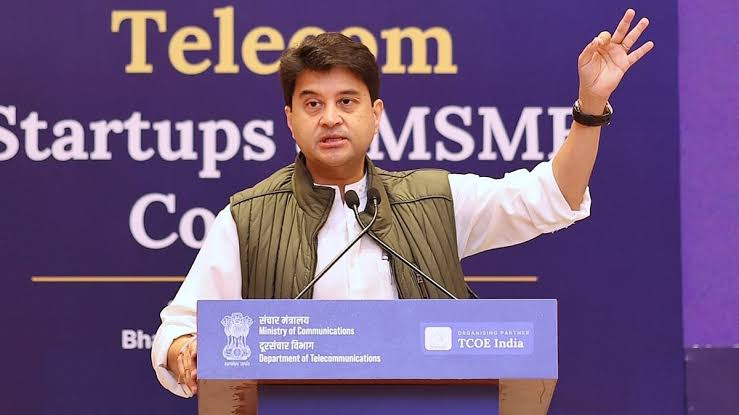
Union Communications Minister Jyotiraditya Scindia has announced plans to establish a dedicated advisory group for telecom startups and micro, small and medium enterprises (MSMEs), aiming to resolve industry challenges, accelerate product commercialisation and strengthen India’s domestic technology manufacturing ecosystem.
The announcement was made on November 24, 2026, during the Telecom Startups and MSME Conclave at Bharat Mandapam in New Delhi, organised by the Department of Telecommunications (DoT).
The proposed advisory group will hold regular discussions with the minister, allowing smaller technology companies to raise concerns about product testing, market access, government support and regulatory requirements.
The initiative comes as India seeks to expand its domestic capabilities in advanced telecommunications equipment, semiconductor design, cybersecurity and emerging 6G technologies.
Scindia said the government intends to act as a facilitator, enabling Indian technology entrepreneurs to concentrate on developing commercially viable products.
FCRF Launches Certified Chief Risk Officer (CRO) Program for India’s Risk Leaders
New Advisory Group To Address Startup Challenges Directly
The minister announced the proposed mechanism after hearing presentations from startups and MSMEs about the difficulties they face in bringing indigenous products to market.
Several participating companies said they needed greater government support for testing, validation and commercial deployment.
The advisory group will provide a platform for these companies to raise operational and policy concerns directly with the communications ministry.
Similar advisory groups already exist for telecom service providers, original equipment manufacturers, internet service providers and research institutions.
The government intends to extend this consultation model to startups and MSMEs.
According to Scindia, the new group will meet him regularly to discuss obstacles affecting smaller telecom businesses.
The DoT has not yet disclosed the panel’s membership, formal terms of reference or the date of its first meeting.
The announcement also does not establish that every issue raised by industry participants will result in a policy change or financial assistance.
The proposed mechanism is intended to improve dialogue between entrepreneurs and policymakers, particularly where existing rules or commercial conditions slow technology development.
Indian Semiconductor And 6G Firms Seek Greater Market Support
The conclave brought together companies developing telecommunications equipment, indigenous semiconductor products and advanced networking technologies.
Domestic semiconductor firms, including Atantri Semiconductors, Agilink Systems, Silizium Circuits, Signalchip and Aheesa, presented information about their chip development and manufacturing activities.
Several companies requested stronger market support to encourage Indian telecom equipment manufacturers to adopt domestically developed chipsets.
Their concerns highlight a challenge faced by technology startups: developing a working product does not necessarily guarantee access to large commercial customers.
Telecommunications equipment must meet demanding requirements for reliability, interoperability and security before network operators can deploy it.
Without opportunities for real-world testing and commercial procurement, smaller companies may struggle to scale their products.
Other participants, including WiSig Networks and Lekha Wireless, discussed their readiness to contribute to emerging 6G technologies.
The government also examined opportunities for deploying locally developed telecommunications systems through existing industry partnerships.
Scindia encouraged established companies and venture capital investors to support domestic innovations with a long-term approach.
The emphasis was on developing technologies capable of competing internationally rather than limiting their commercial prospects to the Indian market.
Government Says 96 Telecom Products Have Reached Commercialisation
The minister highlighted progress under existing DoT programmes supporting indigenous telecommunications innovation.
According to Scindia, approximately 200 investments had been supported through the Digital Communication Innovation Square (DCIS) scheme.
Of these, 96 products developed by 80 companies have reached the commercialisation stage.
Commercialisation means that a technology has progressed beyond research or prototype development and is ready for use or sale in the market.
The government also supports technology development through the Telecom Technology Development Fund (TTDF), which finances research and development, including solutions intended to improve rural connectivity.
Another programme, Technology Development and Investment Promotion (TDIP), supports indigenous technology development and participation in international telecommunications standardisation.
The DoT is also establishing 100 5G Use Case Labs to support practical testing and development.
These initiatives are intended to help smaller technology companies move from product design to commercial deployment.
However, the announcement did not provide updated figures for revenue generated by the 96 commercialised products or disclose how many have been adopted by major telecom operators.
Cybersecurity, Private 5G And Regulatory Testing Receive Attention
Cybersecurity formed one of the five technology areas discussed at the conclave.
The other areas included radio access networks and core infrastructure, applications, chipsets and technical standards.
The event also featured the winners of the Emerging Technologies Hackathon 2026, which received more than 2,870 registrations and 620 applications across nine technology domains.
IIT Bombay’s Team DRISTI received a joint third prize for KAVACH, a security engine designed for private 5G networks.
The Military College of Telecommunication Engineering’s Team RUDRA shared the award for VajraLink, an anti-jamming communication solution for drones.
Other recognised innovations included a domestically designed tyre-pressure sensor system-on-chip and a robotic optical patch-panel system for fibre connections.
The DoT also discussed regulatory provisions under the Telecommunications Act, 2023, including Captive Non-Public Networks and the Regulatory Sandbox framework.
A regulatory sandbox allows eligible companies to test innovative technologies under specified conditions before wider commercial deployment.
These discussions reflect the government’s effort to support domestic technology development while addressing technical and regulatory requirements.
The advisory group’s next steps will determine whether the concerns raised by smaller telecom companies translate into practical changes in testing access, procurement opportunities and commercial support.
For Indian telecom startups and MSMEs, the proposed advisory group could provide a more direct route to raise challenges involving product testing, commercialisation and market access. However, actual benefits will depend on the panel’s membership, meeting frequency and subsequent government decisions.