
Follow us on Google News

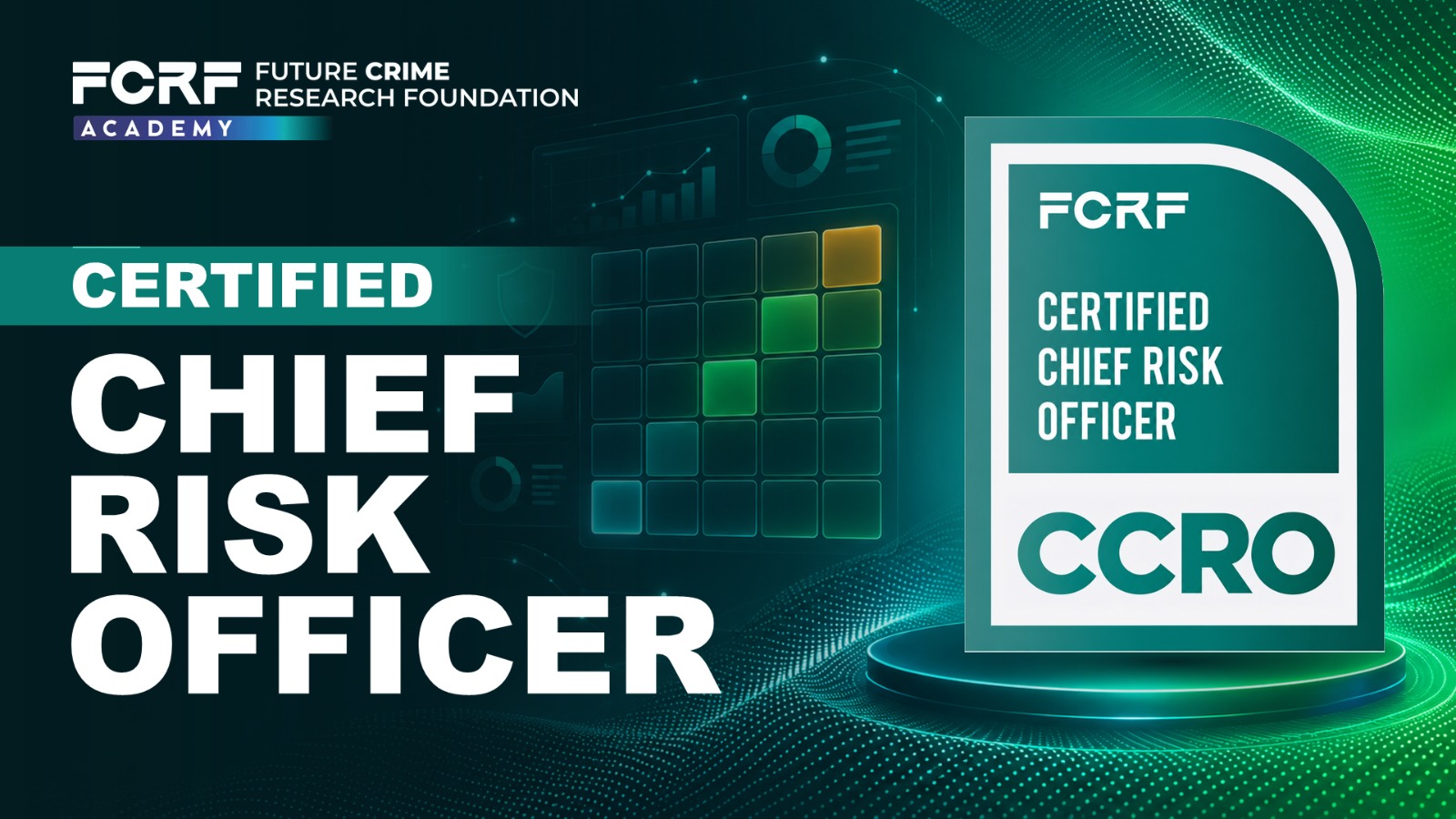
The Future Crime Research Foundation (FCRF) has launched its Certified Chief Risk Officer (CCRO) program through FCRF Academy. The certification is open for enrolment and will run over 16 contact hours. It is designed for working professionals in banks, non-banking financial companies (NBFCs), fintech firms and other regulated businesses, including those moving from specialist roles into enterprise-wide risk oversight.
Click here to register now for the Certified Chief Risk Officer (CCRO) program.
Why the Chief Risk Officer Role Matters
A digital lending business can face several risks from a single decision. An automated underwriting model can change which borrowers qualify for credit. A service provider outage can interrupt onboarding or collections. A fraud spike can expose weaknesses in identity checks and force management to decide whether to restrict a product while an investigation is underway.
Those decisions cut across business, finance, technology, compliance and legal teams. The Chief Risk Officer helps management and the board understand how the exposures interact, whether they remain within agreed limits and when the organisation needs to intervene. That requires independent judgement as well as a working knowledge of how the business operates.
India’s supervisory landscape reflects that breadth. The Reserve Bank of India issued separate fraud risk management directions for commercial banks and NBFCs in 2026, alongside a cybersecurity and technology resilience framework for NBFCs with requirements that vary by category. Internationally, the Basel Committee’s operational resilience principles focus on whether banks can keep critical operations running through disruptions, including those involving third parties.
Click here to register now for the Certified Chief Risk Officer (CCRO) program.
What the CCRO Program Covers
The program begins with the CRO’s mandate, independence and relationship with the board and its risk committee. Participants examine how business teams, risk and compliance functions, and internal audit divide responsibilities. They also learn to translate risk appetite into measurable limits, identify early warning signals and escalate material breaches.
The financial risk modules cover credit, counterparty and portfolio risk, along with market risk, liquidity, capital and asset-liability management. Other modules examine operational and conduct risk, fraud, anti-money laundering, cybersecurity, outsourcing, data protection and AI model risk. The curriculum brings Indian regulatory expectations together with global frameworks including ISO 31000, COSO ERM and Basel III.
The practical sessions cover stress testing, business continuity and board reporting. Fraud and cyber tabletop exercises give participants a setting to practise crisis escalation, evidence preservation and coordination with police, regulators and other relevant authorities. The final module examines how to assess new products before launch, set limits for pilots and decide when to pause or roll back a change. The program also includes a capstone project.
Click here to register now for the Certified Chief Risk Officer (CCRO) program.
FCRF Academy Expands Into Enterprise Risk Leadership
FCRF Academy is the training and capacity-building arm of the Future Crime Research Foundation, an IIT Kanpur’s AIIDE-CoE incubated nonprofit working in cybersecurity, digital crime, fraud risk management, cyber law and digital forensics. Its certification portfolio includes fraud risk management, governance, risk and compliance, cyber crisis management, data protection and AI leadership. Practitioners, policymakers and domain specialists contribute to the Academy’s training programs.
The CCRO program brings those areas into the same curriculum as credit, liquidity and capital risk. It is aimed both at current and aspiring CROs and at professionals in finance, treasury, audit, compliance, cybersecurity and fraud risk who are taking on broader responsibilities. A recurring question runs through the course: when several risks are rising at once, what does the board need to know, and what decision does it need to make?
Click here to register now for the Certified Chief Risk Officer (CCRO) program.