

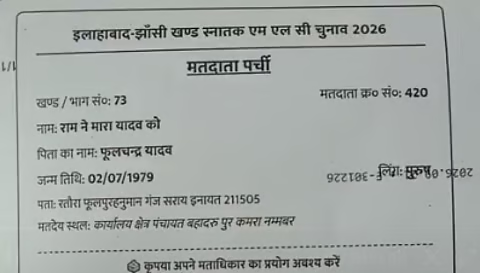

A bizarre voter-roll error in Uttar Pradesh has triggered fresh questions over the software used to prepare electoral records after the name “Ramhit Yadav” was rendered in Hindi as “Ram ne Yadav ko Maara”, meaning “Ram hit Yadav”.
The controversy widened on October 26 after Aam Aadmi Party Rajya Sabha MP Sanjay Singh questioned whether the error reflected caste bias.
Uttar Pradesh Chief Electoral Officer Navdeep Rinwa rejected that suggestion and said the problem was caused by software translating a name instead of merely converting it from English script into Hindi.
The Election Commission is now examining how such mistakes entered final electoral records and says steps are being taken to prevent a recurrence.
FCRF’s Chief AI Officer Certification Returns on November 14 to Prepare Future AI Leaders
Software Translated Name Instead of Transliteration
According to Rinwa, the electoral-roll software was designed to transliterate names entered in English into Hindi.
Transliteration means changing a word from one script to another without changing its meaning.
For example, “Ramhit Yadav” should simply appear in Hindi script as the same name.
But if the English entry was separated as “Ram Hit Yadav”, the software apparently interpreted “hit” as an English verb.
It then translated the phrase into Hindi as “Ram ne Yadav ko Maara”.
That changed a person’s name into a sentence.
Rinwa said such errors could have been corrected through the software’s editing feature, but some incorrect entries remained in the final records.
Another Slip Showed Similar ‘Sharma’ Error
The CEO’s office also produced another voter slip from the recent Legislative Council graduate constituency elections.
That slip listed a voter named Ravi Sharma, but the father’s-name field contained the phrase “Ram ne Sharma ko Maara”.
Rinwa cited this second example while rejecting allegations that the earlier Yadav error reflected caste discrimination.
In a sarcastic response on X, he said computers and software were not casteist and remarked that authorities would have faced accusations of communal bias as well had the erroneous entry involved a minority community.
The comment drew criticism from opposition leaders, who argued that the larger issue was the accuracy of electoral records rather than the caste identity appearing in the error.
The CEO’s office has said the underlying mistakes are being investigated.
Human Review Failed to Catch Some Errors
The controversy raises a broader question beyond the software itself.
Automated tools can produce incorrect outputs, but electoral records usually pass through human verification before they become final.
Rinwa acknowledged that editing tools were available to correct the translated entries.
That suggests the problem was not limited to the software.
Human review also failed to identify at least some obviously incorrect names.
Another voter-roll discrepancy cited by the CEO involved “B.Com” appearing where a father’s name should have been recorded.
Rinwa said that appeared more likely to be a case of human error or negligence.
The Election Commission is therefore dealing with both technology-related errors and weaknesses in manual verification.
Forged Voter Slips Also Circulating Online
The CEO has separately warned that some voter slips circulating on social media are fake.
Rinwa said forged slips had been shared by prominent individuals and media organisations and warned that those responsible for creating fraudulent material could face legal action.
That creates an additional complication.
Some unusual voter slips are genuine administrative errors, while others may have been digitally fabricated.
For voters, journalists and political parties, distinguishing between the two requires verification through official electoral databases or election authorities.
The commission has urged people to seek confirmation before circulating unusual voter records as genuine.
Electoral Software Already Under Wider Scrutiny
The latest dispute comes amid broader questions about technology used in voter-roll preparation.
The420.in reported earlier on October 26 that the Election Commission declined to disclose the name and version of software used to identify anomalies during the Special Intensive Revision process, citing exemptions under the Right to Information Act.
The poll body maintained that final decisions on additions or deletions remain with electoral registration officers rather than automated systems.
Separate irregularities have also been detected in districts such as Pilibhit and Azamgarh, where election authorities have ordered reviews and taken action against officials over duplicate or unsupported voter entries.
Those cases are different from the transliteration error, but together they highlight how heavily modern electoral administration depends on software combined with accurate human verification.
Technology can speed up preparation of voter rolls covering millions of people.
But even small errors can create serious problems when they affect names, addresses or eligibility records.
Accuracy Matters More Than the Source of the Error
The immediate controversy has become political because of the caste references created by the faulty translation.
The more important administrative issue is whether the electoral system can detect obviously wrong entries before voter lists are finalised.
A translation engine can misunderstand an English word.
But a phrase such as “Ram ne Yadav ko Maara” appearing in a name field should be easy for a human verifier to flag.
The Election Commission says it is examining the reasons behind such entries and putting measures in place to stop them from recurring.
That review will need to address both software behaviour and the officials responsible for approving electoral data.
What this means for you:
Voters should check their names and family details in the electoral roll rather than relying only on physical voter slips. If information is incorrect, corrections should be sought through the Election Commission’s official portal or local electoral officials.
Follow for daily updates on cybercrime, corporate fraud, DFIR, hacking, investigations, and digital forensics
