
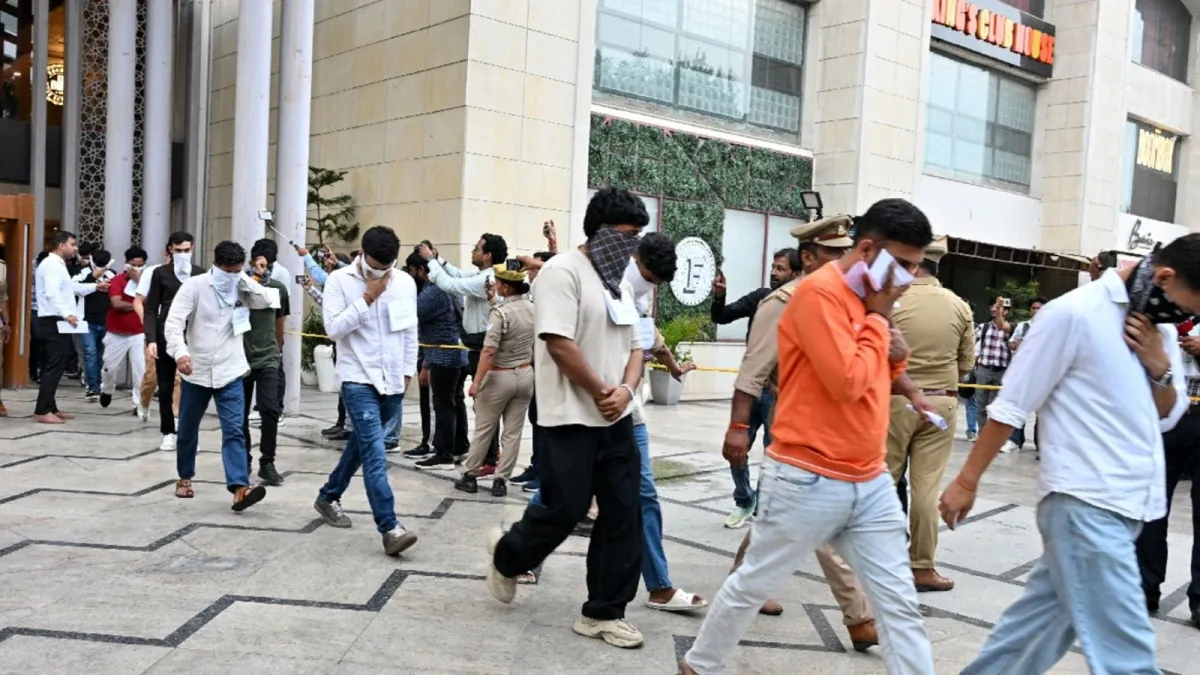

The Lucknow Police Commissionerate has executed a massive midnight raid in the capital city, shutting down a highly sophisticated international fake call center network operating right under the radar in an upscale commercial complex. Functioning under the corporate front name “Solaris Solution,” the criminal syndicate converted two premium office units on the 11th floor of the prominent Summit Building in Vibhuti Khand, Gomti Nagar, into a high-tech hub for global financial extortion.
The extensive operation, spearheaded by a joint task force consisting of the Lucknow Crime Branch, Cyber Cell, and local police divisions, resulted in the immediate detention and subsequent arrest of 119 individuals, including 92 young men and 27 young women. Raiding officers seized an unprecedented arsenal of digital weapons from the workstations: 100 high-specification laptops, 178 dedicated calling mobile phones, massive hard-drive storage arrays, and thousands of localized e-wallet tracking sheets. Senior police officials have flagged this as potentially the largest localized fake call center ring ever disrupted within Uttar Pradesh.
The Midnight Routine and the “American Accent” USP
According to the preliminary investigation reports filed by Deputy Commissioner of Police (Crime Branch) Anil Kumar Yadav, the illegal facility was strictly synchronized with Western time zones. The office remained completely dark during daytime business hours in India, only flinging open its doors at 7:00 PM and operating through the dead of night until 3:00 AM. This rigorous shift schedule was explicitly calculated to align perfectly with the daytime hours of target victims residing across the United States and other Western nations.
What separated “Solaris Solution” from crude, low-level phishing operations was its highly selective recruitment and rigorous training infrastructure. The criminal syndicate conducted aggressive talent scouts across several states, heavily drawing from West Bengal, Rajasthan, Jharkhand, and various North-Eastern regions. Young, English-fluent individuals were attracted with lucrative monthly salary packages ranging between ₹30,000 and ₹35,000. Once onboarded via a rigorous five-stage interview process, recruits were put through specialized accent-neutralization modules. They were trained intensely in native American idioms, psychological manipulation scripts, and behavioral cues designed to sound entirely indistinguishable from authentic US-based security agencies or technical support desks.
“Digital Arrest” Mechanics and Dollar App Exploits
The operational framework of the scam targeted unsuspecting foreign nationals through a web of deceptive digital touchpoints. In many instances, victims seeking online refunds or customer assistance through standard web search engines were redirected via SEO-manipulated links directly into the syndicate’s calling queue. Once a victim was hooked, the callers would utilize proprietary communications software—such as the “Dollar App” and Eyebeam digital dialers—to mask their location data and spoof official Western corporate or government caller IDs.
The network leveraged fear and authority to force financial compliance, utilizing a highly coercive cyber-extortion methodology known as “digital arrest”. Callers would impersonate legal enforcement officers, state investigators, or elite banking authorities, aggressively informing the victim that their identity records or financial profiles were actively linked to serious crimes like money laundering, narcotics trafficking, or extreme tax evasions. By keeping victims confined to continuous, high-pressure video or voice feeds under the threat of immediate incarceration, the syndicate coerced victims into moving their life savings into purportedly “secure, government-sanctioned verification accounts”. These siphoned funds were quickly converted into crypto assets, distributed across layered e-wallets, or redeemed as gold to break the tracking chain.
Mapping the Transnational Hierarchy and Financial Footprint
The sheer scale of the operation is reflected in its massive operational expenditures. Investigators have discovered that the annual maintenance and rental expenses for keeping the luxury twin-office setup afloat inside the Summit Building hovered close to ₹3 crore annually. This capital requirement points to an incredibly high-yield revenue stream generated by the daily extortion campaigns.
At the center of the regional operational matrix, police have officially arrested two program managers: Lalit Khairajani and Vikram Singh Parmar. Both individuals are originally natives of Ahmedabad, Gujarat, but had recently embedded themselves inside luxury residential complexes in Gomti Nagar Extension to oversee the day-to-day enforcement of the call center. Interrogations of Khairajani and Parmar have revealed that while they managed local human resources and IT systems, the actual orchestrator and ultimate financial beneficiary of the international network is an overseas mastermind operating from outside Indian borders. All seized laptops and smartphones have been forwarded to specialized state forensic labs to crack open encrypted communications, trace the ultimate capital routing path, and establish coordinates with central intelligence agencies to target the international ringleaders.
Follow for daily updates on cybercrime, corporate fraud, DFIR, hacking, investigations, and digital forensics
