

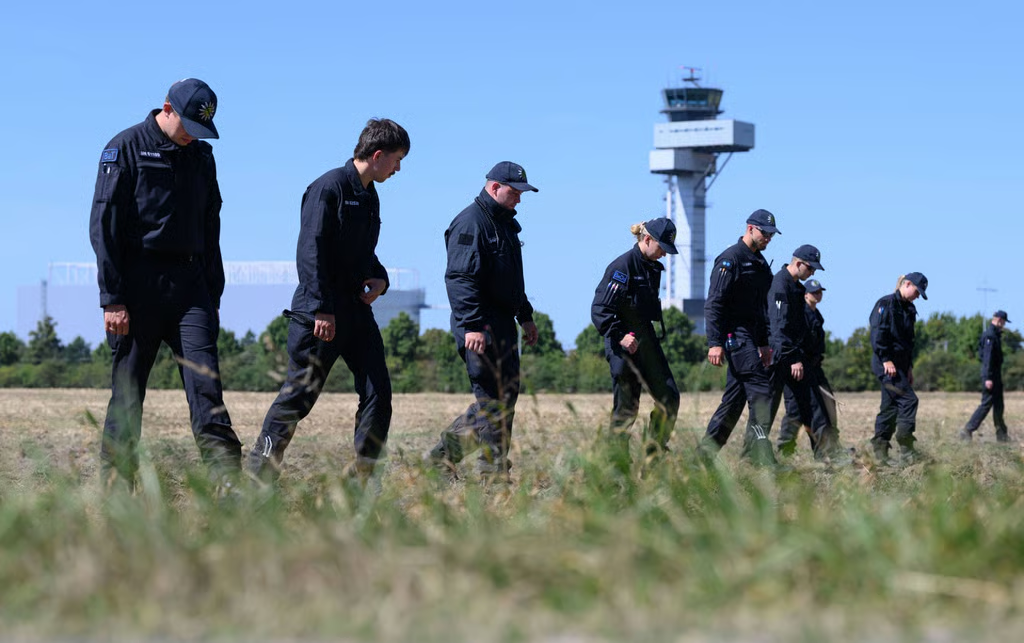

Germany is preparing a broader national security package against drones, cyberattacks and sabotage after authorities blamed Russia for an attempted explosive-drone attack at Leipzig/Halle Airport.
Interior Minister Alexander Dobrindt said the government wants a comprehensive protection system against what Berlin increasingly describes as hybrid attacks targeting airports, energy networks and other critical infrastructure.
The move follows an incident during the night of August 4 to 5, when authorities discovered a drone carrying explosives at Leipzig/Halle Airport.
Germany later formally attributed the attempted attack to Russia, citing intelligence findings, police investigations and the pattern of the incident. Moscow has rejected the allegation.
Proposal for Conducting Cyber Crisis Drill, Tabletop Exercise (TTEx) & CCMP Readiness Exercise
Germany Says the Threat Has Changed
The Leipzig incident appears to have accelerated security planning already underway in Germany.
The government has classified the current threat level as “high”, saying attacks could occur at any time, although authorities have also stressed that there is no specific immediate threat to the general public.
Dobrindt told Bild that Germany now faces a mix of explosive drones, agents operating inside the country, cyberattacks and sabotage against physical infrastructure.
The government sees these as part of a wider pattern of hostile activity that does not fit neatly into the traditional categories of war or peacetime crime.
That is why the response is likely to involve police, intelligence agencies, cyber-defence authorities and, in limited circumstances, the military.
What Does an ‘Anti-Sabotage Shield’ Actually Mean?
The phrase does not refer to one physical shield or one single technology.
It is better understood as a collection of defensive measures.
For drones, that can include systems that detect, track and identify aircraft approaching restricted areas.
Depending on the legal authority and threat, counter-drone systems can then interfere with communications, force a drone away from a protected site or physically neutralise it.
Germany has already expanded legal powers in this area.
In February 2026, the government highlighted changes to the Aviation Security Act allowing the armed forces to support police in countering dangerous drones. Armed force can be used as a last resort when a threat cannot otherwise be stopped.
The government has also been reforming the Federal Police Act to strengthen federal counter-drone powers.
The wider anti-sabotage push is expected to go beyond drones.
Cyberattacks, attacks on power networks, interference with railways and covert operations against industrial or military-linked infrastructure are all part of the threat authorities are trying to address.
Leipzig Attack Was Treated as a Major Escalation
The government has described the Leipzig drone incident as a new level of threat.
On August 7, Germany’s National Security Council met specifically to discuss the case.
By September 1, Berlin said it had concluded that Russia was responsible for the attempted attack. The German government said the attribution was based on the attack pattern, police work and intelligence information.
Germany responded with diplomatic measures and also pushed for wider European action.
Russia has denied involvement and accused Berlin of making false allegations.
The dispute has sharply increased tensions between the two countries.
Power Grids, Railways and Industry Are Also Being Targeted
The airport incident is not Germany’s only concern.
Authorities are investigating a series of attacks and suspected sabotage incidents involving electricity infrastructure, railway systems and industrial sites.
In early September, police launched a manhunt after a string of suspected attacks on the power grid. Investigators also found items believed to be explosives at the home of a man who had allegedly claimed responsibility, although officials said it remained unclear whether he had actually carried out the attacks.
Germany has also seen arson and sabotage incidents affecting power infrastructure, along with suspected Russian-linked plots involving parcels and covert operatives.
Federal prosecutors have taken over several cases because of their possible national-security implications.
This is why authorities increasingly use the term hybrid threat.
A hybrid attack can combine cyber operations, physical sabotage, disinformation, espionage and covert action without formally crossing the threshold into conventional warfare.
Germany Has Already Created a Hybrid-Threat Centre
The country is not starting from zero.
In June 2026, Germany opened the Joint Centre for Countering Hybrid Threats, or GAZ Hybrid.
The centre is intended to help federal and state authorities coordinate responses to espionage, sabotage, disinformation and other hostile activity.
The new anti-sabotage measures are expected to build on that structure.
The challenge is speed.
A drone attack can unfold in minutes. A cyberattack can spread across networks even faster.
Security agencies therefore need both the technical capability to detect threats and clear legal authority to act before damage is done.
The420 Insight: Germany’s response shows how sabotage is moving into the space between cybercrime and conventional conflict. An explosive drone at an airport, a cyberattack on a network and an arson attack on a power substation may look unrelated, but governments increasingly see them as parts of the same security problem. The harder question will be how far Germany expands police and military powers without creating unclear lines of authority during fast-moving incidents.
https://www.linkedin.com/company/policetechnology/
Follow for daily updates on cybercrime, corporate fraud, DFIR, hacking, investigations, and digital forensics
