

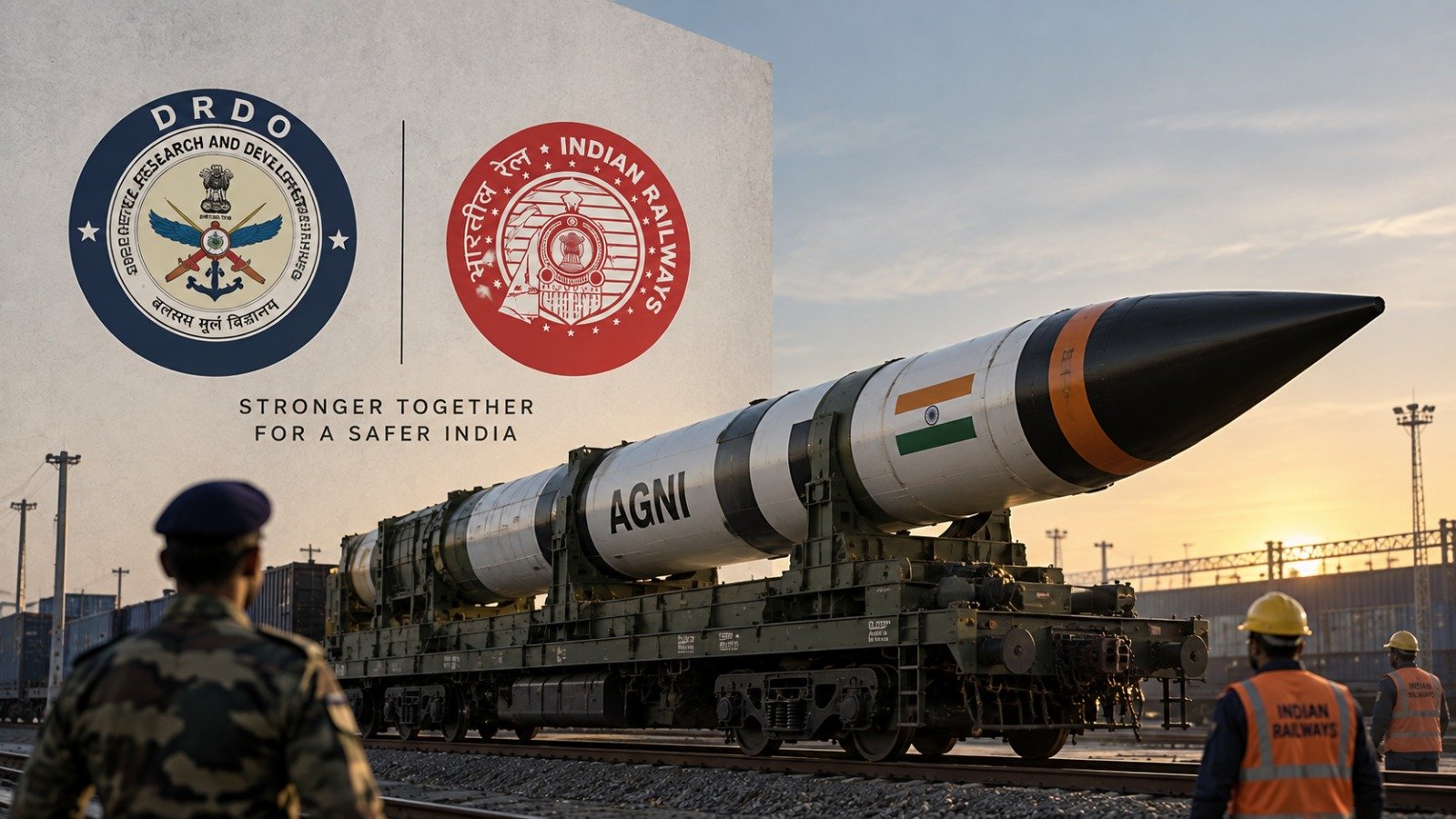

India has already demonstrated the ability to launch its nuclear-capable Agni-Prime ballistic missile from the railway network, putting the country among a small group with rail-mobile strategic missile technology.
The breakthrough came on September 24, 2025, when DRDO and the Strategic Forces Command successfully launched Agni-Prime from a specially designed rail-based mobile launcher under a full operational scenario.
The Defence Ministry said the launcher could move across the railway network without preconditions, operate independently and launch within a short reaction time while maintaining reduced visibility.
That changes the question around India’s rail-based missile programme.
The technology is no longer merely at the concept stage. The challenge now is whether India converts the successfully tested platform into an operationally deployed rail-mobile force.
Proposal for Conducting Cyber Crisis Drill, Tabletop Exercise (TTEx) & CCMP Readiness Exercise
Agni-Prime Rail Launcher Has Already Passed a Major Test
Agni-Prime, also known as Agni-P, is a new-generation ballistic missile with a range of up to 2,000 km.
Its road-mobile version had already been inducted into service before the rail test, according to the Defence Ministry.
The rail launcher adds another deployment option.
DRDO’s own October 2025 account describes Agni-P as a two-stage, solid-propellant, canisterised ballistic missile equipped with redundant navigation and guidance systems. The rail platform was designed with independent communications and protection systems needed for launch operations.
The Ministry said the successful trial would enable the induction of “futuristic rail based systems” into service.
It did not publicly announce how many launchers would be built, where they would be stationed or when operational deployment would begin.
What Does a Canisterised Rail Missile Actually Mean?
A canisterised missile remains sealed inside a protective container during storage and transportation.
Instead of assembling and preparing several missile components immediately before use, the weapon can remain protected inside the canister and be readied comparatively quickly.
A rail-mobile launcher takes that concept and places the missile system on a specially designed railway platform.
The advantage is mobility.
India has one of the world’s largest railway networks. A missile launcher able to move across that network potentially has far more locations available to it than a fixed launch site.
Rail mobility can also make persistent tracking more difficult.
The International Institute for Strategic Studies noted in February 2026 that rail deployment can improve dispersal, ambiguity and survivability. Its analysis said rail mobility is particularly relevant to India because of its terrain and extensive railway infrastructure.
The launcher revealed during the 2025 test was also designed externally in a form resembling a conventional freight wagon, according to defence analysis of publicly released imagery.
Why Mobility Matters for Nuclear Deterrence
Strategic missiles are valuable targets during a military crisis.
A missile permanently located at a known fixed site can theoretically be monitored and targeted.
A mobile launcher creates a harder problem.
If a missile can move hundreds of kilometres and reposition between locations, an adversary has to devote substantially more surveillance resources to determining where it is.
That improves what defence analysts call survivability.
For a nuclear deterrent, survivability matters because a country wants to ensure that its strategic forces cannot be eliminated in a first strike.
Rail mobility therefore contributes to the credibility of retaliation, although the exact operational doctrine governing India’s nuclear forces remains classified.
The Soviet Union famously deployed nuclear missile trains during the Cold War. Rail-mobile concepts have also been studied or pursued by China and North Korea.
India Has Worked on Agni Railway Hardware for Years
The idea itself is not new within India’s missile programme.
An older DRDO industry document lists specialised TCT and HTC wagons for Agni missiles among equipment developed for the organisation, along with tilting mechanisms and other missile-related railway hardware.
What changed in September 2025 was the public demonstration of an actual Agni-Prime launch from a purpose-built mobile railway system.
The Defence Ministry said the test met all mission objectives and placed India among a select group of countries capable of developing canisterised launch systems operating from railway networks.
That official record is important because some newer reports portray the programme as though experimental rail wagons are only now being created.
Publicly available evidence shows the programme has already moved considerably beyond that point.
What remains unclear is its scale.
There is no authoritative public confirmation of how many rail-mobile Agni-P launchers India intends to deploy, how many trains would form an operational unit or when such systems will formally enter service with the Strategic Forces Command.
Those details are likely to remain closely guarded because revealing deployment patterns could undermine the very mobility and uncertainty that make rail-based systems useful.
What this means for you: The development does not mean missile-carrying trains will routinely mix with ordinary passenger services. Its importance is strategic: India has demonstrated another way to keep part of its missile force mobile and harder to track during a crisis.
The420 Insight: India’s real milestone happened in September 2025, when Agni-Prime left the rail launcher successfully. The next phase is less about proving the engineering and more about converting it into a credible operational system. Numbers of launchers, deployment bases and movement patterns are exactly the details a strategic force has an incentive to keep secret. The absence of those details should not be filled with speculative regiment or train counts.
https://www.linkedin.com/company/policetechnology/
Follow for daily updates on cybercrime, corporate fraud, DFIR, hacking, investigations, and digital forensics
