

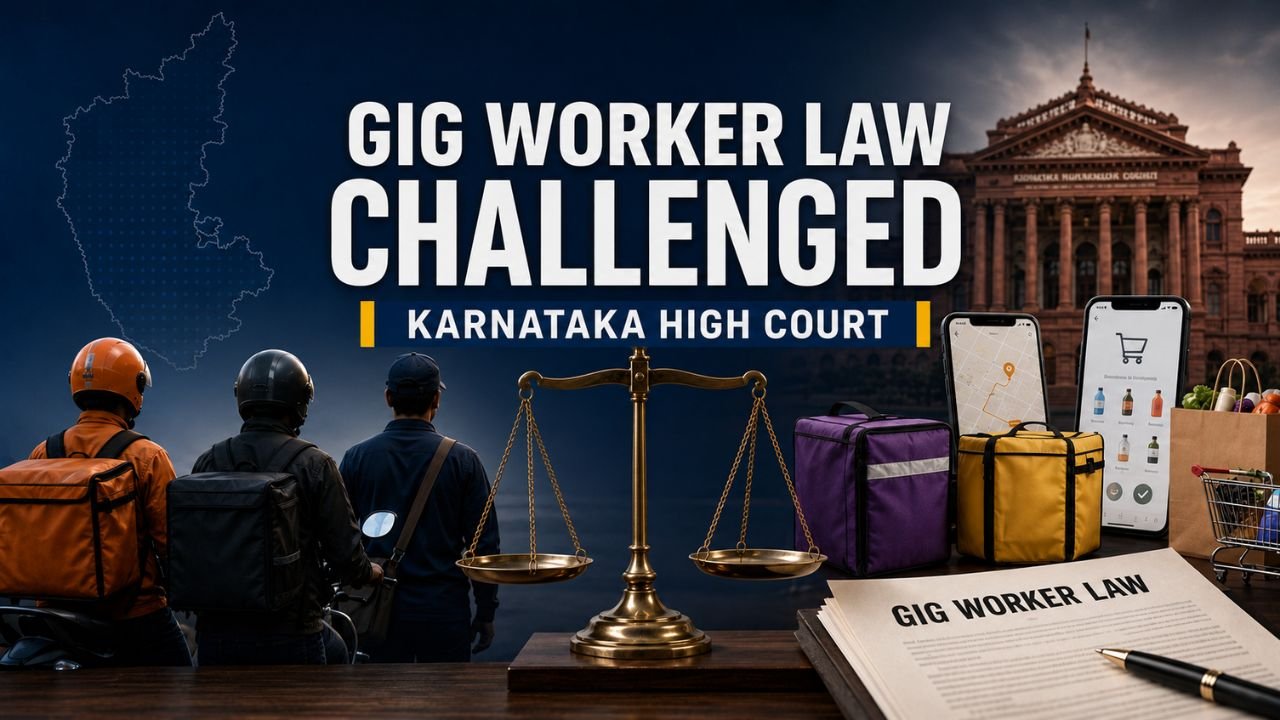

Bengaluru | A major legal battle has emerged over Karnataka’s gig worker welfare law, with several leading app-based platforms approaching the Karnataka High Court to challenge the constitutional validity of the State legislation and its associated rules.
The petition has been filed by the Internet and Mobile Association of India (IAMAI), along with platform aggregators including Swiggy, Zepto, Eternal Ltd, Urban Company and Valmo Transportation. The companies argue that the Central Government has already established a comprehensive legal framework for gig and platform workers through the Code on Social Security, 2020, and therefore the State cannot introduce a parallel regulatory regime.
FCRF’s Flagship Cyber Law Certification Returns With a New Four-Week Cohort
The petition seeks to declare the Karnataka Platform Based Gig Workers (Social Security and Welfare) Act, 2025, the rules framed under it, the notification constituting the Welfare Board, and the government order dated February 12, 2026, as unconstitutional. It also seeks to quash various notices issued under the Act.
At the heart of the dispute are new obligations imposed on platform companies, including the establishment of Internal Dispute Resolution Committees (IDRCs), payment of welfare fees for gig workers, and submission of statutory information to the State authorities. The companies contend that these provisions impose significant additional financial and administrative burdens.
The petition further argues that Parliament has already occupied the legislative field of social security through the Code on Social Security, 2020. As a result, the State law allegedly creates a conflict with the Central legislation, attracting the doctrine of repugnancy under Article 254 of the Constitution. According to the petitioners, two parallel legal frameworks governing the same subject would create operational confusion and legal inconsistencies.
Karnataka’s legislation is among the first State-level laws in India specifically aimed at providing social security and welfare benefits to app-based delivery partners, ride-hailing drivers and other gig workers. It provides for the creation of a Welfare Board and a Welfare Fund, financed through contributions from platform aggregators.
The petitioners have also challenged notices issued on May 21, 2026, directing companies to constitute Internal Dispute Resolution Committees, as well as welfare fee notices issued on June 22, 2026, requiring aggregators to deposit welfare contributions and submit compliance returns by July 5, 2026.
The companies have additionally argued that the State law is arbitrary and violates Article 14 of the Constitution, which guarantees equality before the law. The matter is yet to be listed before the Karnataka High Court, where the constitutional challenge will be heard.
