

When FCRF Academy first introduced its Certified Cyber Law Practitioner program, the premise was straightforward: India’s legal profession was entering a digital turn for which conventional legal education had not fully prepared it.
Cyber fraud complaints were rising. Courts were increasingly dealing with screenshots, metadata, electronic certificates and platform takedown requests. Businesses were struggling with privacy compliance, breach response and digital contracts. Lawyers, compliance officers and students were being asked to advise on systems they had not been formally trained to understand.
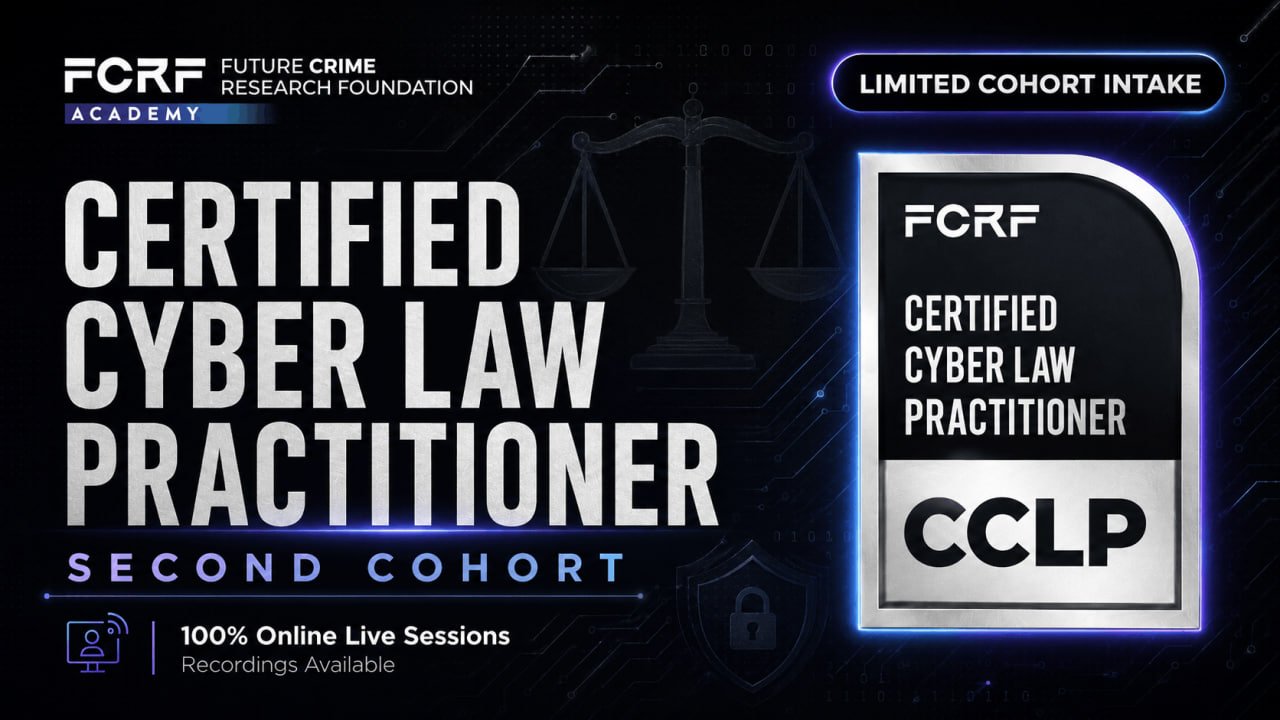
Now, after hundreds of senior professionals, cyber lawyers, compliance practitioners and students have already completed the certification, FCRF Academy is launching the second cohort of the Certified Cyber Law Practitioner, or CCLP, program. The next batch will begin live from June 6 and will follow the familiar four-week weekend format, designed for working professionals and students who need structured training without leaving their existing commitments.
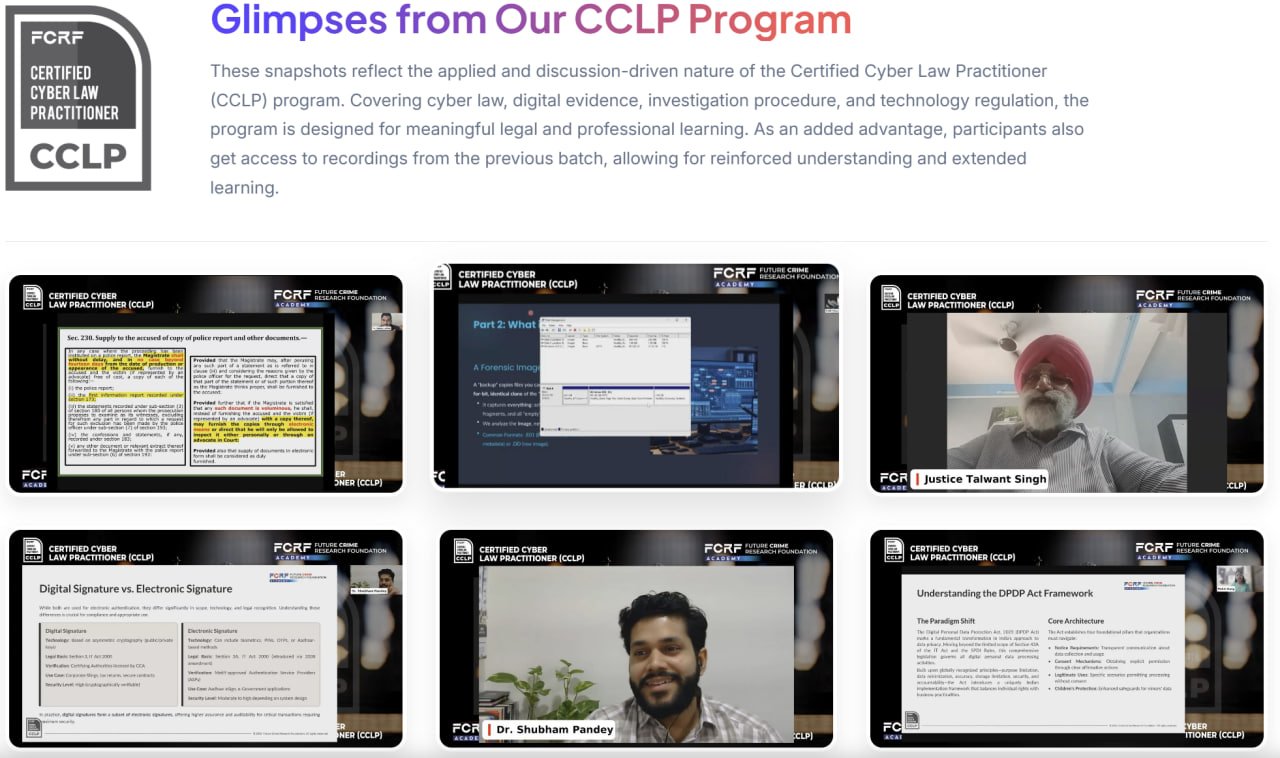
The second cohort also comes with an added advantage: participants will receive access to recordings from the previous cohort, giving them a broader learning archive in addition to the new live sessions. Interested participants can Click Here to register for the CCLP Program
A Cyber Law Course for a Profession in Transition
India’s legal and regulatory system is undergoing one of its most significant digital shifts. The Information Technology Act remains the foundation for many cyber disputes, but the legal field now also has to account for the Digital Personal Data Protection Act, 2023, the DPDP Rules, the Bharatiya Nyaya Sanhita, the Bharatiya Nagarik Suraksha Sanhita and the Bharatiya Sakshya Adhiniyam.
The result is a more complex legal environment, where a single incident may involve criminal law, evidence law, privacy law, platform liability, sectoral regulation and contractual obligations.
The first CCLP program was built to address that gap. It covered the IT Act, the DPDP Act and India’s new criminal codes, with sessions aimed at lawyers, compliance officers, regulators, investigators and students seeking to understand the intersection of cybercrime, privacy and digital evidence.
The second cohort deepens that approach. According to the revised syllabus, the new version has been redesigned as a “legal-first” and “practice-oriented” program for lawyers, compliance professionals, law students, cybercrime advisors, policy professionals and digital business teams. Its stated focus is on helping learners interpret cyber law, draft legal documents, advise clients, respond to incidents and manage regulatory exposure.
That redesign is significant. Instead of treating cyber law as a purely technical field, the new curriculum shifts the center of gravity toward legal interpretation, advisory practice, litigation readiness, platform and intermediary law, data protection, digital contracts, incident-response law and sectoral compliance.

What Changes in the Second Cohort
The 16-module program begins with the legal ecosystem of cyber law practice in India and moves through electronic records, digital signatures, civil liability under the IT Act, cyber offences under the IT Act and BNS, criminal procedure under BNSS and digital evidence under BSA.
Later modules cover platform and social media intermediary liability, blocking and interception powers, DPDPA and DPDP Rules, CERT-In compliance, sectoral cyber regulation, digital payments fraud, online content, AI, deepfakes, child safety, digital intellectual property, technology contracts and cross-border cyber law.
The final module is structured as a drafting lab and capstone advisory simulation, bringing together legal notices, police complaints, platform notices, BSA evidence checklists, privacy notices and incident response memos.
This structure reflects a practical reality. Many cyber law professionals are not expected to personally operate forensic tools. They are expected to know when evidence must be preserved, how to frame a complaint, how to advise a company after a breach, how to challenge or support electronic evidence in court, and how to communicate with platforms, banks, regulators and law enforcement. Interested participants can Click Here to register for the CCLP Program
Building on FCRF Academy’s Training Record
The second CCLP cohort also builds on FCRF Academy’s broader training ecosystem.
FCRF Academy is the educational arm of the Future Crime Research Foundation, which has positioned itself as a cybercrime and digital-risk capacity-building institution. FCRF is the organizer of the FutureCrime Summit and has institutional partnerships with bodies including NIELIT (MeitY), BIRD Lucknow, RMLNLU and UPSIFS.
The Academy’s track record has become central to how its programs are presented. Its Certified Cyber Crisis Management Professional program, conducted with CERT-In, trained senior officials from civil services, defence, cybersecurity and regulatory sectors in crisis response and national cyber resilience. Its Certified Data Protection Officer program drew professionals from government, banking, insurance and technology sectors.
FCRF Academy has also expanded into certifications such as Certified Fraud Investigator, Governance Risk & Compliance Professional and other domain-specific programs. Reporting on its Certified Fraud Investigator launch noted that FCRF had trained thousands of professionals through programs including CCMP, CDPO, CCLP and GRCP.
That portfolio matters because cyber law no longer sits in isolation. A lawyer advising on an online fraud case may also need to understand bank escalation, digital evidence, mule accounts and account-freezing procedures. A compliance officer handling a breach may need to understand DPDPA, CERT-In reporting, contractual liability and sectoral regulator expectations. A student entering the field may need to understand not only legal provisions but also how cyber disputes are documented and escalated in practice.
A Weekend Format With Added Access to Earlier Recordings
The second cohort will begin on June 6 and will run in a four-week weekend format. The model is designed to accommodate lawyers, in-house counsel, compliance officers, law students, cybersecurity professionals and other working participants.
The program’s earlier version was similarly positioned as a weekend-based certification, with live sessions, recordings and handouts made available through the FCRF Academy learning management system.
For the second cohort, access to the previous cohort’s recordings gives learners an additional benefit: they will be able to revisit earlier lectures, compare explanations across sessions and use the earlier batch as a supplementary learning library. In a field where laws, rules and enforcement practices continue to evolve, that archive can help participants build context before, during and after the live classes.
The revised syllabus also makes clear that each one-hour module is designed around a practical legal output. These include a cyber law issue-spotting checklist, an e-contract validity checklist, a compensation and adjudication note, an offence-mapping matrix, a cybercrime complaint, a platform takedown notice, a privacy notice, a breach-response template, a legal incident response memo, a sectoral compliance heat map and a cross-border evidence request checklist.
That design marks the second cohort’s central promise: not simply to explain cyber law, but to train professionals to use it.
For India’s legal and compliance community, the timing is important. The country’s digital governance framework is entering a phase where laws are no longer abstract. They are being tested in courtrooms, corporate boardrooms, cyber cells, regulatory filings and platform grievance channels. The second cohort of CCLP arrives in that moment, offering a structured route for professionals who want to move from general awareness to practitioner-level confidence in cyber law. Interested participants can Click Here to register for the CCLP Program.
Follow for daily updates on cybercrime, corporate fraud, DFIR, hacking, investigations, and digital forensics
