

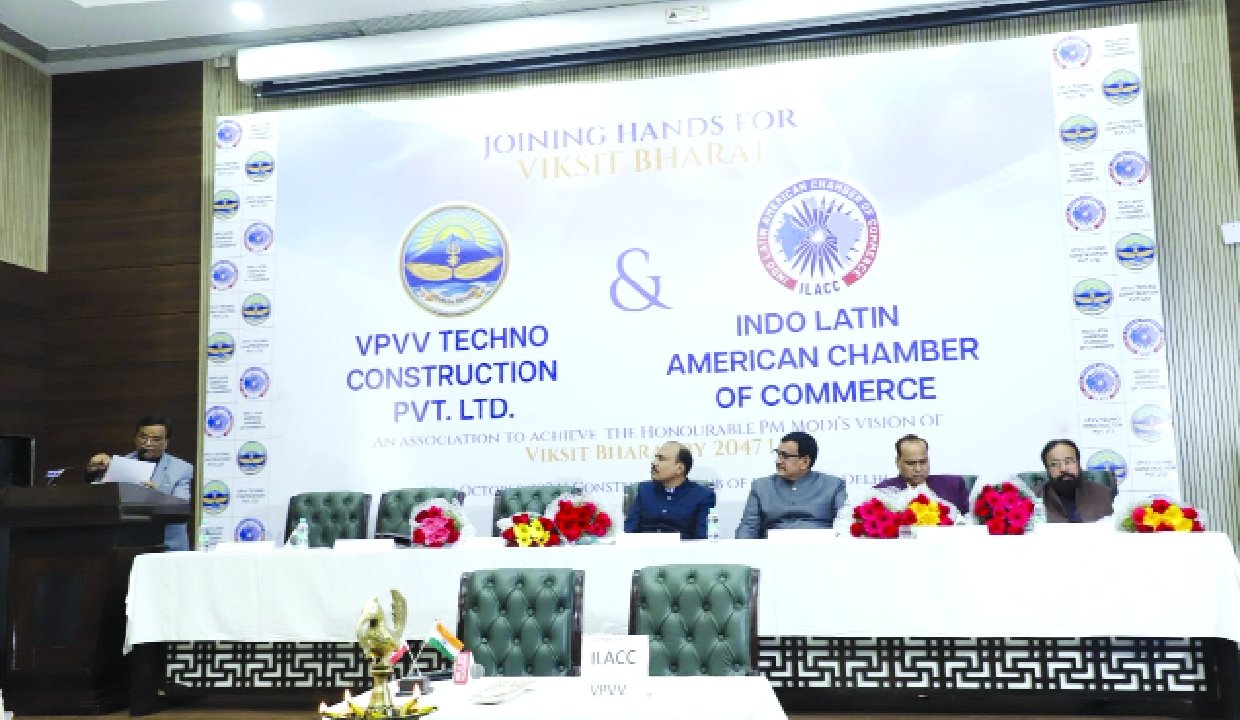

As the investigation into the alleged VPVV Techno Construction investment scam progresses, multiple allegations have emerged claiming the company used forged documents, fabricated defence projects and staged associations with official institutions to mislead hundreds of investors across India. Multiple agencies are examining the case for alleged financial fraud, money laundering and possible national security implications, though no court has yet held any accused guilty and the allegations remain under investigation.
A Fictitious Treaty Worth ₹83,000 Crore
According to investigation documents and complaints, the company claimed for several years that it had secured a contract to manufacture military equipment for the US Department of Defense under a purported “Indo-US Pacific Peace Treaty,” a supposed deal reported to be worth roughly ₹83,000 crore. A response obtained under the Right to Information Act from the Indian Embassy in Washington reportedly confirmed no such treaty exists, stating the Government of India had not entered into, recognised or acknowledged any agreement by that name. Following that disclosure, investors reportedly began seeking refunds and questioning the company’s claims, though by then the scheme had allegedly already collected close to ₹700 crore from investors across Delhi, Mumbai, Kerala, Karnataka and Tamil Nadu.
Investigators say the company was structured as VPVV Techno Construction, an acronym drawn from founders Vinod Varrier, Pradeep Kumar and Venkitta Venkit, with Venkit eventually positioned as chairman and public face while the others distanced themselves from daily operations. Recruits were reportedly told a figure known only as “Doctor Saab” served as the company’s mysterious patron, and were made to take an oath of secrecy administered personally by him, on the premise that all information relating to the company constituted classified “official secrets” of both nations.
Borrowed Legitimacy Through Public Spectacle
To sustain investor confidence, the company allegedly staged elaborate public theatre. It reportedly associated itself with India’s Navy Day celebrations by leveraging a contract awarded to a private event management firm, and organised events attended by diplomats, retired officials and public figures, with photographs and videos from these programmes circulated widely to reassure prospective investors. At one gathering, investors were allegedly shown a man introduced as a naval “defence expert” who claimed to have just returned from a secret submarine mission, followed by a display of what was described as radioactive material handed over by the Pentagon. Complaints also refer to a Visakhapatnam event where attendees were allegedly shown similar “enriched uranium” props tied to a supposed confidential defence programme.
Retired defence personnel and other individuals were reportedly offered employment on purported defence projects after paying training fees, only for the promised jobs and salaries to never materialise. Investigators allege the company used a multi-level recruitment structure in which existing investors earned rising commissions for bringing in new ones, allowing trust to spread through families, religious institutions, and business and friendship networks, with individual investments reported as high as ₹5.25 crore from a single Thrissur-based investor.
Financial Trails, Alleged Police Complicity and an Emerging Pakistan Link
Financial investigators are separately examining the company’s monetary flows, noting that despite modest declared resources, it allegedly handled disproportionately large financial movements through cash collections, hawala channels, shell companies and overseas transfers. Complainants have alleged that two retired Kerala Police officers of Superintendent rank played a role in the money chain operations, using their influence to derail investigations and dilute FIR charges when victims initially approached police.
The probe has since taken a more serious turn. Central intelligence agencies have reportedly found that funds were transferred from one of VPVV’s bank accounts in Delhi’s Vasant Vihar to a bank branch in Gujranwala, Pakistan, and that the alleged mastermind travelled to Pakistan on a forged passport. Investigators are also examining forged defence contract documents that appear to have been modelled on genuine official paperwork, raising questions about whether the forgery required capabilities beyond what a routine printing press could provide. Key figures, including the alleged mastermind and VPVV’s chairman, remain untraceable, with investigators believing at least one may be hiding in Hyderabad.
Prof. Triveni Singh, the former IPS officer and cybercrime specialist, said major investment frauds often rely not only on forged documents but on the misuse of credibility associated with government institutions, national security and influential personalities. He advised investors to independently verify any claims involving government contracts or defence partnerships before committing funds, and said real-time coordination among financial intelligence, enforcement and cyber investigation agencies remains essential to combating organised fraud of this scale. Courts have directed a detailed inquiry into the complaints, and the investigation continues across multiple states, with the final determination of guilt or liability to follow only once the judicial process concludes.
