
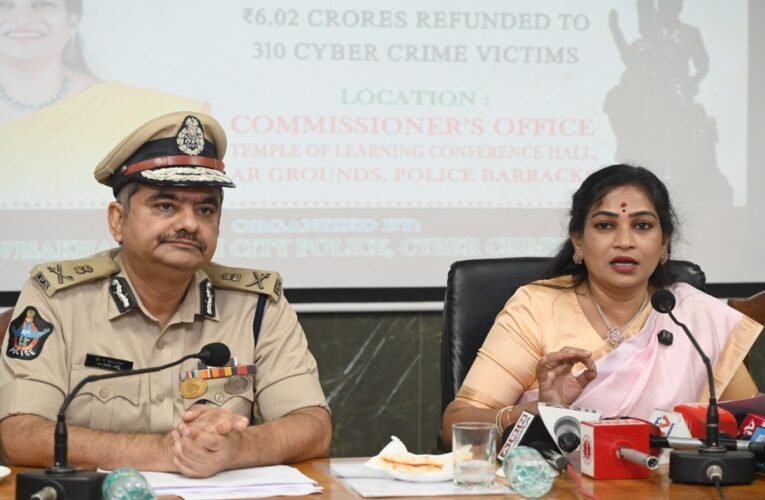

The Visakhapatnam city police Commissionerate distributed refund cheques worth Rs 6.02 crore to 310 cyber fraud victims on Monday under Refund Mela 3.0, the third edition of an initiative designed specifically to trace, freeze and return money lost in online financial scams.
The cheques were handed over by Andhra Pradesh home and disaster management minister Vangalapudi Anitha in the presence of city police commissioner Shankhabrata Bagchi. The occasion was more than a disbursement event. It was a public signal that recovery from cyber fraud, long considered an unlikely outcome for most victims, is being treated as an operational priority by the state police machinery.
With this latest round, the cumulative total refunded across all three editions of the Refund Mela has reached Rs 28.49 crore, benefiting 1,550 victims. Refund Mela 1.0 returned Rs 4.63 crore to 150 victims. The second edition disbursed Rs 17.83 crore to 1,090 victims. The scale has grown with each iteration, reflecting both expanding investigative capacity and a more systematic approach to freezing fraudulent transactions before funds disappear into layered networks.
How Recoveries Are Made
Commissioner Bagchi attributed the recoveries to two factors working in tandem: prompt reporting by victims and close coordination with banks, payment gateways, financial institutions, and courts. The mechanics of cyber fraud recovery depend almost entirely on the speed at which the money trail is frozen after a complaint is filed.
National recovery rates improved from roughly 10 to 11 per cent in 2024 to 24 per cent in 2025, with prompt reporting within six hours significantly increasing recovery chances. Speed matters more than the amount involved. Once fraud proceeds travel across multiple accounts or are converted into other instruments, the window for recovery narrows sharply.
The national helpline 1930, which Anitha urged citizens to use, is central to this process. Through 3,61,000 cyber fraud complaints, the Central government has successfully safeguarded Rs 8,189 crore. By December 2025, around 62 banks and financial institutions had joined this mechanism, with a target to onboard all banking and financial institutions before December 2026.
The Ministry of Home Affairs issued a standard operating procedure in January 2026 to speed up the resolution of cyber financial fraud cases, laying down a coordinated framework involving banks, financial institutions, law enforcement agencies, and other stakeholders to facilitate quicker restoration of funds. The Supreme Court has also directed High Courts across the country to ensure its implementation.
The Wider Challenge
The Vizag refund programme functions against a backdrop of rising fraud volumes. Minister Anitha noted that cybercrime cases have increased sharply in the post-Covid period and stressed the need for greater public awareness alongside stronger enforcement. The Central government has been scaling up its response infrastructure in parallel. The Union Budget 2025-2026 allocated Rs 782 crore for cybersecurity projects, and over 9.42 lakh SIM cards and 2,63,348 IMEI numbers linked to cyber frauds have been blocked.
Yet the recovery figures, however encouraging, still represent a fraction of the total losses. The Citizen Financial Cyber Fraud Reporting and Management System, operational through helpline 1930 and the National Cybercrime Reporting Portal, has saved approximately Rs 4,386 crore involving 13.36 lakh complaints. Against estimated annual losses running into tens of thousands of crores, the gap between what is lost and what is recovered remains substantial.
What Makes Vizag’s Model Work
The Refund Mela format, by bringing victims, police, and administrators together in a structured public event, serves a purpose beyond financial restitution. It builds institutional credibility at a time when many victims remain unaware of their right to pursue recovery or skeptical that such efforts will yield results.
Commissioner Bagchi cautioned the public against responding to suspicious phone calls, investment offers, and unknown digital links, a reminder that prevention remains the most effective tool. But for those already defrauded, the initiative demonstrates that the system, when it functions with coordination across banks, courts, and law enforcement, is capable of delivering at least partial justice.
The Citizen Financial Cyber Fraud Reporting and Management System has helped recover hundreds of crore rupees by enabling early intervention before money can be fully transferred out. It is considered one of the more practically effective interventions in recent years. Visakhapatnam’s Refund Mela, now in its third edition and growing in scale, is evidence of what that intervention looks like when it reaches the victim’s hands.
Follow for daily updates on cybercrime, corporate fraud, DFIR, hacking, investigations, and digital forensics
