
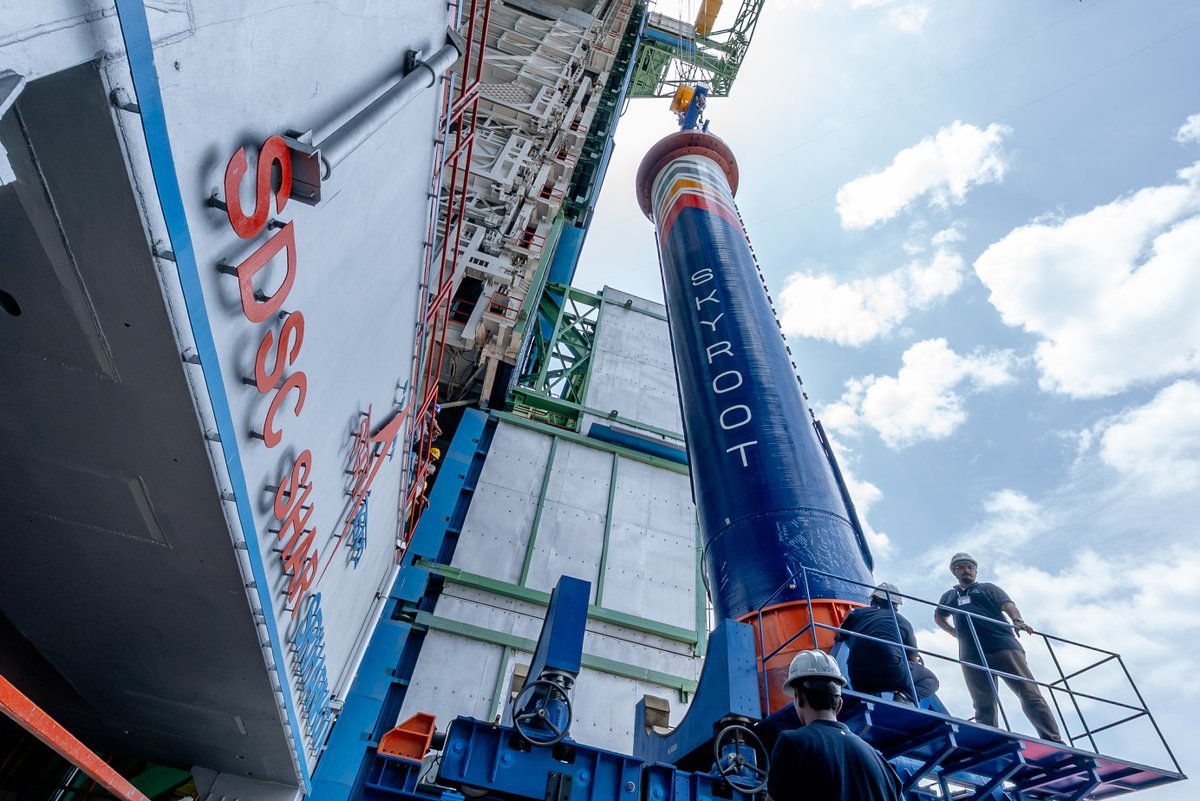

India’s private space sector is approaching a defining moment, with Skyroot Aerospace set to attempt the country’s first privately developed orbital launch using Vikram-1 later this month. The Hyderabad-based company announced on July 2 that it will attempt the launch between July 12 and August 4, subject to the completion of assembly and testing operations at the launch site in the Satish Dhawan Space Centre at Sriharikota.
The mission builds directly on Skyroot’s earlier breakthrough: the successful launch of Vikram-S, India’s first privately built rocket to reach suborbital space, in November 2022. Vikram-1 represents a considerably larger step, designed to place payloads of up to 350 kg into low-Earth orbit. If successful, it would mark India’s first privately executed orbital launch, placing Skyroot among a small group of companies worldwide capable of both developing and operating orbital-class rockets. Founded in 2018 by former ISRO scientists Pawan Kumar Chandana and Naga Bharath Daka, Skyroot became India’s first space startup to reach a $1 billion valuation after raising $60 million from GIC and Sherpalo Ventures.
Skyroot Is Not Racing Alone
While Vikram-1’s launch window has drawn the most immediate attention, Skyroot is one of several companies building toward the same commercial opportunity, each pursuing a distinct technical approach. Chennai-based Agnikul Cosmos is developing Agnibaan, a customisable small-satellite launch vehicle capable of carrying payloads of up to 300 kg to orbit. In 2024, the company conducted the country’s second private rocket launch and became the first Indian startup to launch from its own privately built launchpad at Sriharikota, doing so with a largely 3D-printed semi-cryogenic engine, the world’s first single-piece 3D-printed engine to fly, in May 2024.
Established defence and engineering giants are entering the field as well, moving beyond their traditional roles as component suppliers. Larsen & Toubro, long associated with ISRO as a supplier of launch vehicle hardware, propulsion systems and ground infrastructure, is now looking to expand into rocket manufacturing outright, leveraging decades of aerospace expertise built through work on Indian missiles, Mars and lunar missions, satellites and artillery. State-run Hindustan Aeronautics Limited, best known for aircraft and defence manufacturing, has similarly announced plans to enter rocket manufacturing as part of a broader diversification of its space business. Both companies have long been involved in building the Polar Satellite Launch Vehicle through a consortium, and HAL formalised its shift toward independent production in September 2025 by signing a Rs 511 crore technology transfer agreement with NSIL, ISRO and IN-SPACe for the Small Satellite Launch Vehicle, covering design, manufacturing, integration and launch operations, with plans to mass-produce six to ten SSLV rockets annually.
The Policy Shift Making This Possible
This wave of private and quasi-private entrants is the direct result of a deliberate policy opening. India opened its space sector to private players in 2020, and the regulatory liberalisation has continued steadily since. The Indian Space Policy 2023 permits up to 100 per cent foreign direct investment in the manufacturing of satellite components and subsystems, while satellite manufacturing and operations are permitted up to 74 per cent FDI under the automatic route and launch vehicles and spaceports up to 49 per cent, changes formalised through a February 2024 Cabinet decision that shifted a previously approval-only regime onto the automatic route for most of the sector.
The government has backed this liberalisation with direct capital as well. A Rs 1,000 crore venture capital fund dedicated to space startups was approved in October 2024, complementing IN-SPACe’s broader role as the sector’s single-window regulatory authority. The Union Budget for 2026-27 allocated Rs 13,705.63 crore to the Department of Space, with capital expenditure rising by more than Rs 1,000 crore over the previous year’s revised estimate, a signal that India’s space programme is moving from preparatory planning into the hardware-realisation phase of its most ambitious missions, including the Gaganyaan human spaceflight programme.
The Scale of the Opportunity Ahead
The momentum comes as India seeks to expand its space economy from about $8.4 billion today to $44 billion by 2033. According to the Economic Survey 2025-26, the sector currently accounts for around 2 per cent of the global space economy, with future growth expected to be driven by launch services, satellite communications, Earth observation, navigation, and an increasingly vibrant private sector. India’s push to open the space sector mirrors a broader global shift toward greater commercial participation in launch services, one in which the country is positioning itself as a cost-competitive alternative rather than a peripheral player.
The global demand backdrop is significant. Global private launch activity has been climbing steadily, with roughly 219 private launches expected worldwide in 2025 alone, according to industry estimates cited by Skyroot, underscoring the scale of the commercial small-satellite launch market that Indian companies are now competing to capture. With more than 400 registered space startups now operating in India and government demand programmes such as the Rs 27,000 crore Space-Based Surveillance-3 initiative feeding private manufacturing capacity, the ecosystem taking shape around Vikram-1’s launch attempt reflects a broader structural shift: from an ISRO-led model of space access toward a genuinely diversified commercial launch industry, with startups and legacy aerospace manufacturers now building in parallel toward the same orbital ambitions.
Follow for daily updates on cybercrime, corporate fraud, DFIR, hacking, investigations, and digital forensics
