

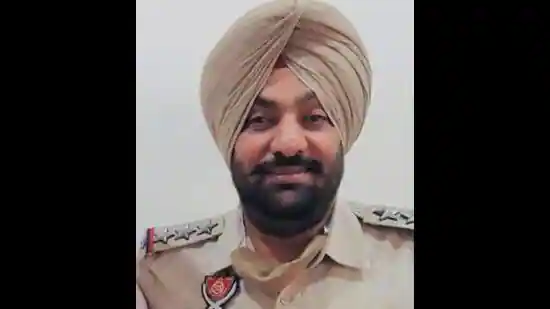
The United States Department of Justice, working in tight alignment with the Federal Bureau of Investigation (FBI), has unsealed a sweeping federal indictment against Gurinderjit Singh Nagra, a Station House Officer (SHO) of the Punjab Police. International enforcement commands formally charged Nagra, who recently headed the Tanda Police Station in Punjab’s Hoshiarpur district, with conspiracy to commit racketeering, extortion, and material obstruction of foreign commerce. The global dragnet exposes a highly organized institutional compromise where high-ranking local desk officers allegedly worked hand-in-glove with the jailed gangster Jaggu Bhagwanpuria’s syndicate, weaponizing official state machinery to extract $400,000 (approximately ₹3.3 crore) from an Indian-origin family residing in Los Angeles, California.
Registration Begins for FutureCrime Summit 2026, India’s Largest Cybercrime Conference
Transnational Collusion and the Golden Hour Intimidation
The structural parameters of the extortion matrix went live after Gurlal Singh, an alleged 22-year-old operational lieutenant of the Bhagwanpuria gang living as an illegal immigrant in Stockton, California, funneled detailed personal telemetry data regarding the target family straight to the inspector in Punjab. Armed with internal operational manifests, Nagra allegedly initiated a series of high-pressure communication strings targeting the victim’s father in India.
The rogue enforcement officer managed the institutional shakeup through three continuous operational sequences:
The corrupt official initiated the campaign by contacting the victim’s elderly father, aggressively threatening to formally rope the entire family unit—including a US-based daughter—into an active, high-profile murder file. Moving directly into the structural extraction sequence, the SHO demanded an immediate upfront settlement of $400,000, issuing strict ultimatums that failure to clear the financial transit would result in immediate arrests and non-bailable warrants. The sequence reached its final stage when Nagra led an official police press conference in Punjab to publicly name the California-based family as contract-killing suspects, using the raw authority of state media to terrify the victims before secretly messaging them the next day to offer partial name removals in exchange for immediate cash.
Operation Hard Ball and the Multi-Agency Framework
The exposure of the inspector’s dual-role operations marks a definitive victory for “Operation Hard Ball”—a multi-year, multi-national law enforcement initiative targeting India-based organized crime syndicates executing violent operations across North America. Organized by the FBI’s Los Angeles Field Office alongside the Royal Canadian Mounted Police (RCMP) and European enforcement units, the joint task force executed 34 synchronized search warrants across California, culminating in the arrest of 24 high-level gang operatives.
Federal grand jury registries document a vast, interconnected network where the Lawrence Bishnoi enterprise, the rival Bhagwanpuria cartel, and the Canada-based Dhanda group systematically used corrupt public servants in India to cultivate a climate of fear among diaspora communities. The macro-level investigation has simultaneously processed sweeping charges covering contract killings, international arms smuggling, and the cross-border trafficking of over 1,000 kilograms of commercial-grade cocaine.
The Miani Village Assassination Blueprint and Judicial Leverage
Forensic document audits reveal that Nagra intentionally exploited a genuine tragedy to provide complete material credibility to the cartel’s extortion demands. On January 15, 2026, three motorcycle-borne syndicate hitmen opened fire at the Satkartaar Hardware Shop in Miani village, assassinating its owner, Balvinder Singh, and severely wounding a bystander. Nagra, who personally supervised the initial First Information Report (FIR) under Section 103 of the Bharatiya Nyaya Sanhita, used his unmonitored access to the live homicide file to inject the names of the California family into the official suspect pool without any underlying physical or digital evidence.
The FBI’s technical tracking division completely dismantled this judicial setup by intercepting encrypted text data and mapping cell tower registries linking Nagra directly to the syndicate’s operational dashboards. Grand jury files note that while the inspector was publicly pushing the contract-killing narrative via official state channels, his personal mobile devices were logged into chat rooms complaining to gang handlers that the victims had not yet cleared the full payment totals.
Cross-Border Extradition Filings and Systemic Cleanups
The international exposure of the police-gangster nexus has triggered severe political and administrative tremors across Punjab. Following formal alerts delivered by the US Attorney’s Office for the Central District of California, the Punjab Police command immediately stripped Nagra of his active field deployment, executing emergency orders to transfer the officer to the Hoshiarpur Police Lines pending a full departmental inquiry. While the officer has claimed complete innocence to regional media, the Office of the DIG, Jalandhar Range, has authorized a specialized investigation unit to audit Nagra’s historic case files and map his unexplained personal asset portfolios.
Concurrently, US federal prosecutors have officially activated cross-border extradition frameworks under existing international treaties to physically transfer the Indian inspector to American soil. First Assistant United States Attorney Bill Essayli confirmed that federal authorities will pursue Nagra’s arrest and custody with absolute aggression, making it clear that sovereign borders will not protect corrupt public officials who trade in global extortion. As the global crackdown scales up—including the deployment of a $50,000 FBI bounty targeting fugitive gangster Goldy Brar—national security analysts are demanding zero-trust oversight panels to permanently prevent localized police rosters from being co-opted by transnational syndicates.
