
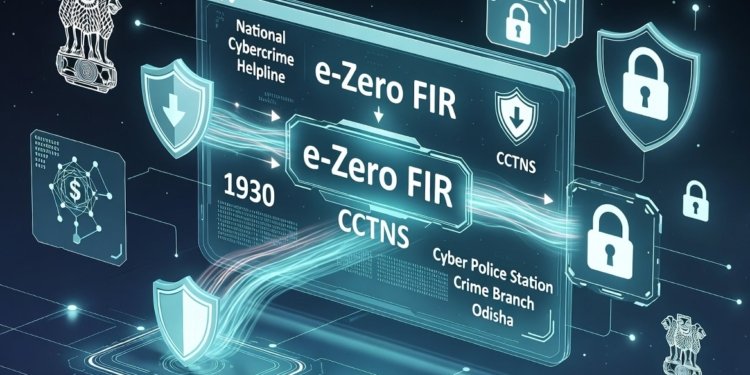

The Odisha Police has launched an e-Zero FIR system for online financial fraud cases, integrating the National Cybercrime Helpline 1930 directly with the state’s Crime and Criminal Tracking Network & Systems, or CCTNS. Director General of Police Y. B. Khurania inaugurated the mechanism on Wednesday at police headquarters in Cuttack, describing it as a step toward faster, more transparent and citizen-centric policing.
How the Automated Trigger Works
Under the new mechanism, any cyber financial fraud complaint of ₹10 lakh or more registered through the 1930 helpline will automatically generate an e-Zero FIR request within CCTNS, regardless of where in the state the crime occurred. The request is then routed to the Cyber Police Station under the Crime Branch, which examines the facts before deciding how to proceed. Depending on the merits of the case, the police may register a regular FIR and begin investigating, transfer the matter to the appropriate jurisdictional cyber police station, register a Zero FIR and forward it to the relevant territorial station, link it to an FIR that already exists, or close the request if it does not meet the prescribed criteria. Officials say the automation removes duplicate data entry between the helpline and the police record system, a friction point that has historically slowed down cybercrime registration across states.
Part of a Wider National Rollout
Odisha’s launch extends a framework that began life as a Delhi pilot. The Union Home Ministry’s Indian Cybercrime Coordination Centre introduced the original e-Zero FIR initiative in May 2025, with Union Home Minister Amit Shah stating at the time that complaints above ₹10 lakh filed through the National Cybercrime Reporting Portal or the 1930 helpline would be automatically converted into Zero FIRs at Delhi’s dedicated e-Crime Police Station, with the system designed to be extended nationwide. The initiative draws on provisions of the Bharatiya Nagarik Suraksha Sanhita, under which a Zero FIR can be filed at any police station irrespective of where the offence occurred, removing jurisdictional delay as an obstacle to registration. Complainants are typically expected to visit a police station within three days to have the electronic filing converted into a conventional FIR.
Odisha’s version localises that architecture, linking the same 1930 helpline data directly into the state’s own CCTNS infrastructure so that cases involving Odisha residents or Odisha-based bank accounts are routed to the state’s Cyber Police Station without waiting on the Delhi node. The State Crime Records Bureau carried out the technical integration behind the launch.
Why the First Hours Matter Most
Speed is the entire rationale behind the system. Prof. Triveni Singh, the former IPS officer and cybercrime specialist, said the first few hours after a fraud are the most critical window investigators have. When complaints are registered and shared with the relevant agencies without delay, he said, the odds of freezing fraudulent transactions and recovering stolen funds rise sharply, since money that escapes early detection is quickly layered through multiple mule accounts and becomes far harder to trace. This “golden hour” principle, whereby a bank can be asked to place a temporary lien on a suspect account within minutes of a verified complaint, is precisely what automated Zero FIR routing is meant to preserve, since it collapses the earlier multi-step process of manually filing at a station into something that begins the moment a victim calls the helpline.
Khurania urged citizens to report cyber financial frauds immediately, noting that prompt reporting substantially improves the likelihood of freezing transactions before losses become permanent. For a state grappling with the same nationwide surge in UPI and investment-related fraud that has driven complaint volumes into the millions each year, the success of the e-Zero FIR system will likely be measured less by its technical elegance than by a simpler metric: how much money it manages to freeze before it disappears.
Follow for daily updates on cybercrime, corporate fraud, DFIR, hacking, investigations, and digital forensics
