

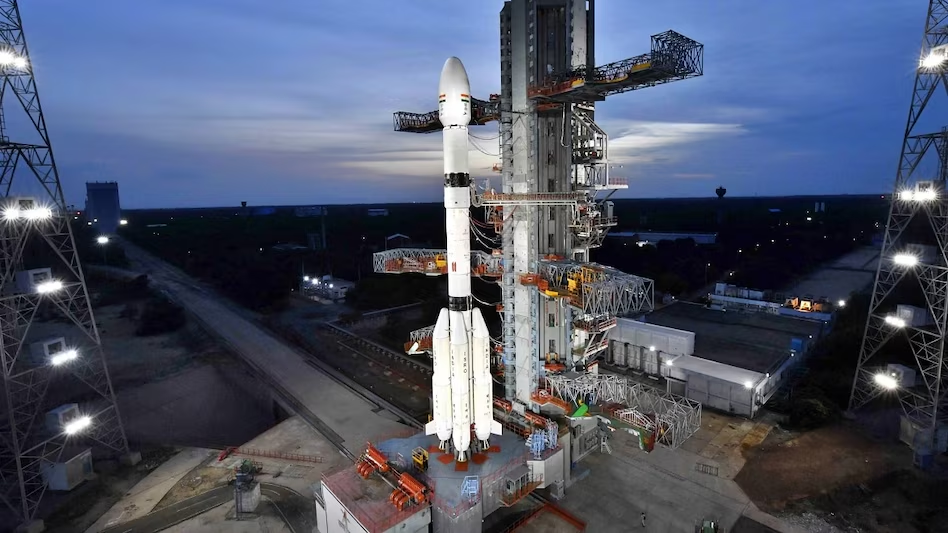

ISRO has categorically rejected reports suggesting that the agency could be privatised or have its role reduced, saying it will remain India’s principal institution for advanced space research and strategic missions.
The clarification came on September 6 after growing debate over the government’s push to expand private-sector participation in India’s space industry.
ISRO said reports suggesting that the reforms were designed to diminish its role were “completely baseless and incorrect”.
The agency said the real objective is to shift mature and scalable activities towards industry while allowing its scientists and engineers to concentrate on more complex technologies and national missions.
Proposal for Conducting Cyber Crisis Drill, Tabletop Exercise (TTEx) & CCMP Readiness Exercise
Private Participation Will Expand, But ISRO Says It Is Not Withdrawing
India began opening its space sector more aggressively to private companies in 2020.
That process was later formalised through the Indian Space Policy 2023, which created clearer roles for ISRO, IN-SPACe, NewSpace India Limited and private companies.
Under the model, industry and start-ups are being encouraged to work across launch vehicles, satellites, propulsion, communications, Earth observation and other space services.
ISRO said this should not be interpreted as privatisation.
Instead, the agency described it as an expansion of the overall national space ecosystem.
The distinction is important.
A private company taking over production of a mature technology does not necessarily mean ISRO is abandoning that area completely.
It means routine manufacturing or commercial scaling can move outside the agency while ISRO redirects its technical manpower towards research that industry may not yet be capable of carrying out independently.
What Will ISRO Continue to Control?
ISRO’s clarification specifically identifies the areas where it intends to remain the lead institution.
These include advanced research and development, strategic space capabilities, human spaceflight, next-generation launch technologies, lunar and planetary exploration and national missions.
It will also remain central to India’s long-term plans for the Bharatiya Antariksh Station, which is targeted for establishment by 2035.
India has also set a goal of sending an Indian astronaut to the Moon by 2040.
Reusable launch systems and more advanced propulsion technologies are part of the same roadmap.
These projects require long development cycles, high research expenditure and capabilities that cannot easily be transferred to commercial companies in the short term.
That is the role ISRO says it wants to concentrate on.
Why Did ISRO Have to Issue This Clarification?
The statement followed concerns raised by employee associations within the organisation.
Nine employee bodies wrote to ISRO Chairperson V Narayanan seeking written clarification over reports about the transfer of manufacturing and operational functions to private companies.
They also raised questions about ISRO’s future mandate, staff prospects and recruitment.
The concerns intensified after IN-SPACe Chairman Pawan Goenka spoke publicly about industry taking over more mature operational and manufacturing activities.
Goenka later stressed that ISRO would continue to remain the “bedrock” of India’s space sector.
The disagreement therefore appears to be less about whether ISRO will disappear and more about how quickly responsibilities should shift to industry and what that transition will mean for employees.
What Do IN-SPACe and NSIL Actually Do?
India’s new space structure separates policy, research, regulation and commercial activity more clearly than before.
ISRO remains the main research and technology-development organisation.
IN-SPACe, or the Indian National Space Promotion and Authorisation Centre, facilitates and authorises private and non-government participation in the sector.
NewSpace India Limited, or NSIL, handles commercialisation and industry-led use of mature space capabilities.
The Department of Space provides overall policy direction.
The aim is to prevent ISRO from having to do everything itself, from advanced science to commercial production.
That becomes more important as India tries to expand its share of the global space economy.
India Wants a $44 Billion Space Economy by 2033
ISRO said India’s space economy is currently estimated at around $8.4 billion.
The country wants that figure to rise to about $44 billion by 2033.
ISRO argues that such growth cannot come from government funding and its own workforce alone.
Private investment, start-ups, manufacturing capacity and global commercial access will have to play a much larger role.
India now has more than 450 space start-ups, compared with only a small number before the reforms began, according to ISRO-linked reporting.
That creates an opportunity for the country to build a broader supply chain instead of relying almost entirely on the government agency.
It also creates tension.
As commercial companies take over work that was historically performed inside ISRO, questions about job roles, recruitment and institutional control are likely to continue.
The Real Change Is in ISRO’s Role, Not Its Importance
ISRO’s statement does not mean the organisation will operate exactly as it did a decade ago.
Its role is clearly changing.
More production and commercial activity will increasingly be handled by industry.
But the agency’s own description makes clear that it intends to move further towards the difficult end of the technology spectrum rather than shrink.
That includes missions where commercial viability is uncertain but strategic or scientific value is high.
In that sense, the reforms are designed to make ISRO less of a universal manufacturer and more of a high-end research and mission organisation.
Whether that transition works smoothly will depend on how responsibilities are divided and how well concerns inside the organisation are addressed.
What this means for you: India’s space programme is not being handed over wholesale to private companies. The bigger shift is that commercial firms will increasingly build and scale mature technologies, while ISRO concentrates on advanced missions, research and strategic capabilities.
The420 Insight: The controversy shows the difficult side of India’s space-sector reform. Building a private space industry requires ISRO to give up some work it historically performed, and that naturally creates anxiety inside the organisation. The policy itself is not privatisation in the conventional sense. The real test will be whether India can expand private capability without weakening ISRO’s technical depth, institutional knowledge or ability to execute strategic missions that the commercial market may never prioritise.
https://www.linkedin.com/company/policetechnology/
Follow for daily updates on cybercrime, corporate fraud, DFIR, hacking, investigations, and digital forensics
