

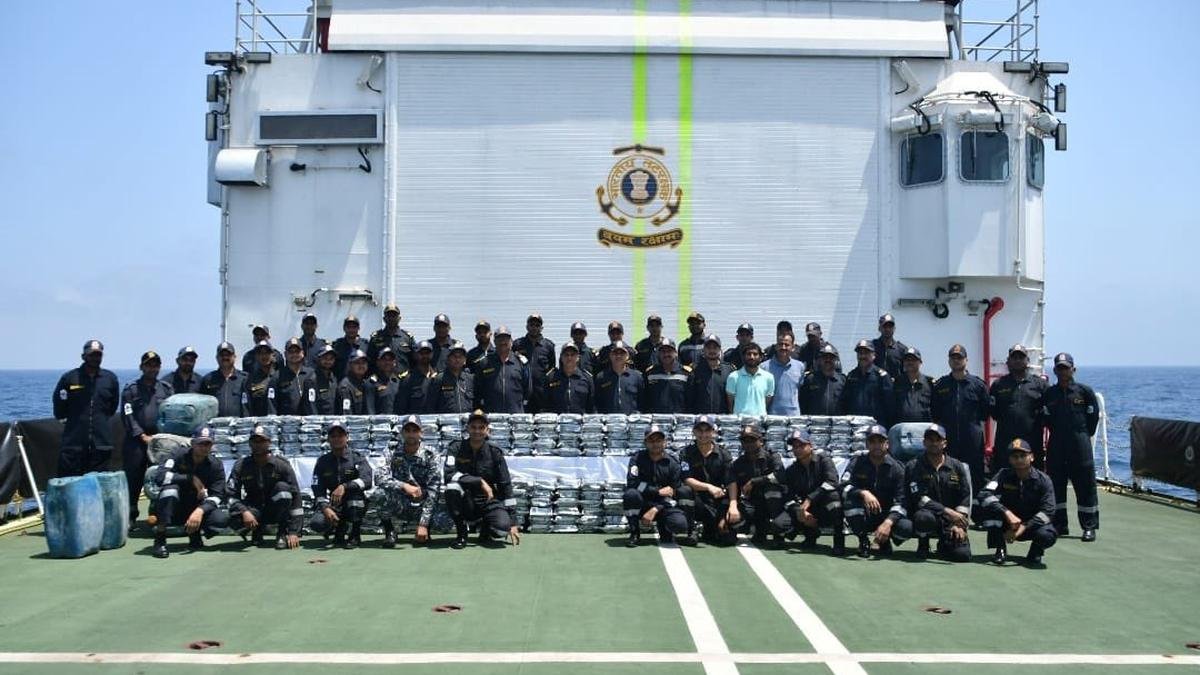

In a major joint operation off the western coast, the Indian Coast Guard, Gujarat Anti-Terrorism Squad, and central intelligence agencies intercepted an Iranian dhow in the Arabian Sea west of Lakshadweep, seizing 526 kilograms of narcotics valued at over ₹3,000 crore. Five Pakistani nationals found aboard the suspicious vessel were detained and brought to Mumbai along with the intercepted boat for comprehensive interrogation and legal processing.
Interception off Lakshadweep followed targeted intelligence
The coordinated action unfolded after intelligence wings alerted maritime forces to an Iranian vessel operating suspiciously in the Arabian Sea. Coast Guard units tracked the craft, monitoring its navigational pattern closely before initiating a high-seas pursuit. Upon closing in, maritime teams intercepted the boat and carried out a thorough search, uncovering a combined haul of 526 kilograms of heroin and methamphetamine. Investigators are questioning the detained crew to uncover their exact responsibilities aboard, the ownership details of the dhow, and their ties to the contraband. Central to the ongoing probe is mapping the maritime transit corridor, pinpointing the port of origin, and identifying the intended delivery points.
Advanced communication gear and Starlink setup seized
Beyond the contraband, boarding teams seized a suite of sophisticated communication and navigation instruments. The confiscated gear includes Starlink satellite internet terminals, an ICOM high-frequency radio set, and a specialized marine GPS device. Forensic specialists and digital analysts are now scrutinizing this equipment to reconstruct the vessel’s logged travel history, examine communication trails, and recover plotted sea coordinates. The discovery of Starlink hardware has drawn heightened attention from security establishments. While the satellite venture holds an operating licence in India, commercial services remain inactive pending final regulatory and security approvals, prompting authorities to investigate how the equipment was procured and configured for use at sea.
Surveillance stepped up against international sea syndicates
The seizure is being treated by law enforcement as a significant disruption of an international drug pipeline targeting Indian shores through the sea. It comes amid expanded joint vigilance by federal and state agencies, which have stepped up surveillance across land, air, and ocean corridors to halt illicit drug movements. Gujarat in particular has recorded several major coastal drug busts in recent years, reflecting continuous enforcement pressure in northern and central Arabian Sea routes. Interrogators are continuing efforts to trace the financiers, handlers, and domestic distribution networks connected to the shipment.
Follow for daily updates on cybercrime, corporate fraud, DFIR, hacking, investigations, and digital forensics
