

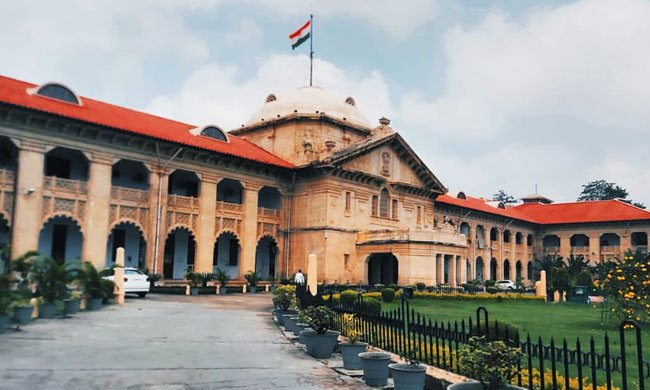
Prayagraj: The Allahabad High Court has expressed serious concern over the functioning of the Uttar Pradesh Police, observing that the force appears to consider itself above the law and assumes that its actions will go unquestioned.
The court remarked that police personnel seem to believe they have the authority to act arbitrarily, that nobody will question their mistakes and that, even if challenged, they can escape accountability by offering excuses.
A division bench comprising Justice Atul Sreedharan and Justice Achal Sachdev made the observations while declaring the detention of Deepak, a resident of Gautam Buddh Nagar, before the registration of an FIR to be completely illegal. The court ordered his immediate release and directed that adverse entries be recorded in the service records of the concerned Assistant Commissioner of Police (ACP), Kamlesh Kant, and investigating officer Anuj Kumar.
The court expressed concern that the police were repeatedly failing to follow statutory procedures. It observed that police documents were often prepared as a mere formality and contained serious discrepancies that directly raised questions about the legality of detention and arrest.
FCRF Launches CP-FRM to Build India’s Next Generation of Fraud Risk Professionals
Five Documents Contained Incorrect Dates
The case arose from a violent clash between two groups over a property dispute on August 23. According to the details considered by the court, the police took Deepak into custody at around 4 pm that day, while the FIR was registered at 9:39 pm. However, official records subsequently showed his arrest as having taken place at 2:57 pm on August 24.
Documents relating to the arrest and personal search contained the date August 23 at five different places, even though the official arrest was recorded as having taken place the following day.
Police officials described the discrepancies as clerical errors. However, the court questioned why the dates had not been corrected through properly authenticated amendments.
The court also found that the amount column in the bond had been left blank. Furthermore, the section meant to record the officer’s decision to accept or reject the bond did not contain the officer’s signature, date or time.
These irregularities led the bench to express a prima facie apprehension that the documents might have been completed later. The court also raised the possibility that Deepak’s signatures had been obtained on blank sheets of paper and that the grounds for his arrest might have been added subsequently.
Court Says Statutory Procedures Cannot Be Ignored
The High Court clarified that preventive arrest under Section 170 of the Bharatiya Nagarik Suraksha Sanhita (BNSS) cannot be used after an offence has already been committed. It emphasised that even a tense or volatile situation does not exempt police personnel from complying with mandatory legal procedures.
The bench also identified serious deficiencies in informing the accused of his right to legal assistance at the time of arrest. The court questioned the functioning of the concerned magistrate as well, observing that the documents submitted by the police had not been subjected to adequate scrutiny at the judicial level.
The observations highlighted the importance of judicial oversight in cases involving personal liberty and the need for authorities to ensure that arrest and detention procedures comply with the law.
DGP Directed to Improve Police Training
The High Court directed the Director General of Police (DGP), Uttar Pradesh, to improve the training system for police personnel to ensure that they understand and follow statutory requirements.
The court issued a stern warning against unlawful practices such as keeping suspects at police stations for more than 24 hours and subsequently releasing them without following the prescribed legal process. It made clear that such conduct could no longer be justified by claiming ignorance of procedural requirements.
The bench further observed that any such action would be presumed to be mala fide unless the police produced sufficient and credible evidence before the court to establish otherwise.
The court’s directions place renewed emphasis on police accountability, accurate documentation and compliance with safeguards governing arrest and detention.
Accountability for Unlawful Detention
The ruling underscores that police powers are subject to legal limits and that procedural safeguards cannot be treated as optional formalities. Errors in arrest records, incomplete documentation and failure to inform an accused of legal rights can raise serious concerns about whether the law has been followed.
By ordering Deepak’s release, directing adverse service-record entries against the two police officers and calling for improvements in police training, the High Court sought to address the specific violations identified in the case.
The court’s observations also serve as a warning that procedural lapses cannot automatically be dismissed as clerical mistakes when they affect the legality of a person’s detention.
The directions to the state police chief are aimed at improving awareness of legal requirements and preventing similar violations in the future.
Follow for daily updates on cybercrime, corporate fraud, DFIR, hacking, investigations, and digital forensics
