

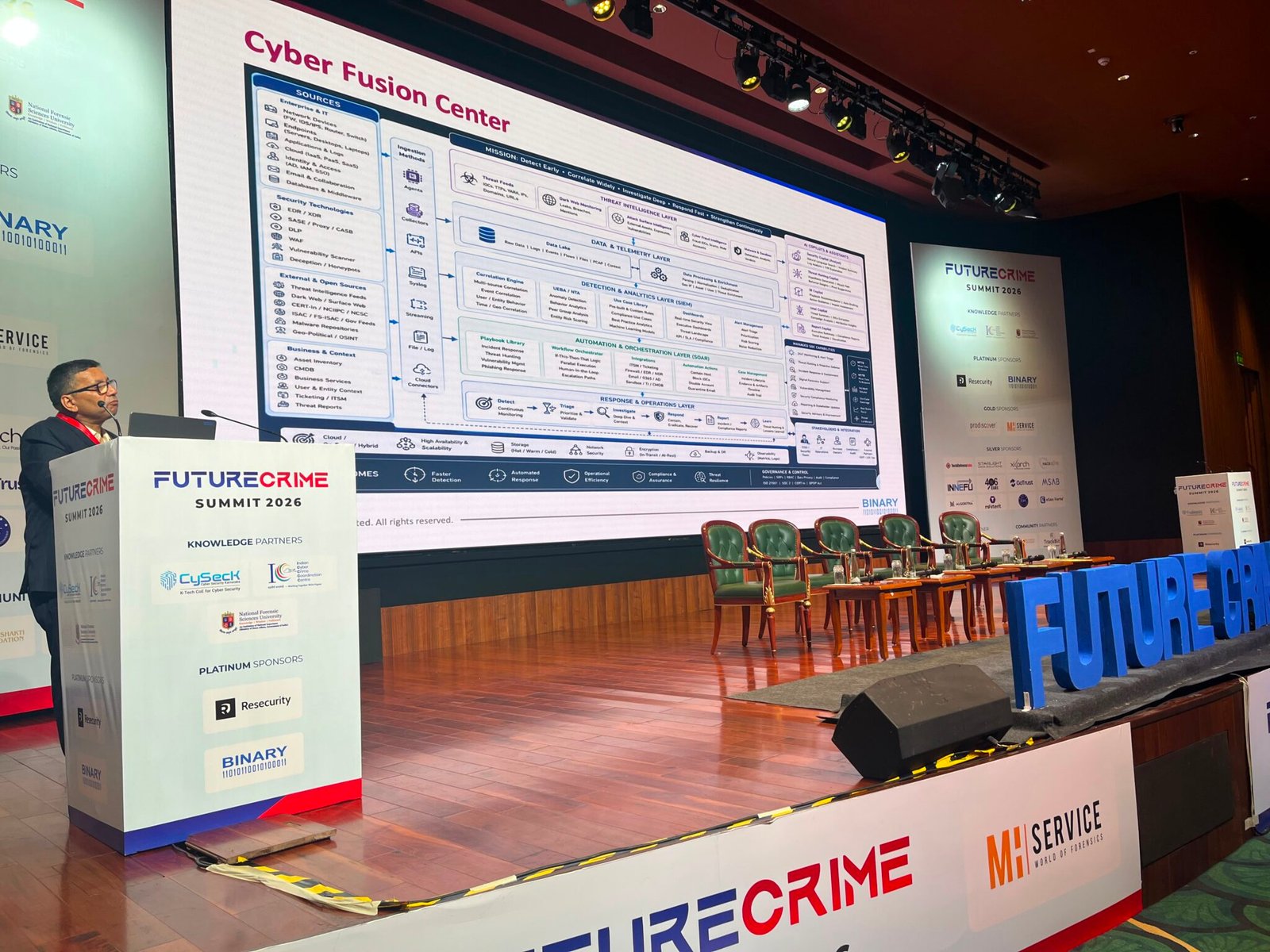
New Delhi: Demonstrating a comprehensive blueprint for modernizing national security and law enforcement infrastructure, Binary Global Limited took the stage for a platinum sponsor session at the FutureCrime Summit 2026. The presentation outlined integrated architectural frameworks designed to secure critical national assets and power next-generation state police operations through artificial intelligence.
Critical Asset Defense and the Inner Core Model
The presentation opened with an emphasis on the convergence of physical and cyber security to protect critical infrastructure. Binary Global presented an “Inner Core” security model designed to safeguard essential public assets—including state data centers, emergency response platforms, police communication networks, and smart-city infrastructure. To defend this inner core, the firm detailed a multi-layered protective ring consisting of Network Segmentation and Zero Trust, Security Operations Center (SOC) and Network Operations Center (NOC) convergence, ransomware recovery and disaster recovery, cyber tabletop simulations, outer defensive layers, managed firewalls, and privileged access management.
The transition from isolated security monitoring to converged physical and cyber defense represents a fundamental requirement for modern public infrastructure. By wrapping critical data repositories and emergency response systems in multi-layered Zero Trust perimeters, defense architects ensure that perimeter breaches cannot compromise core state operations.
State Police AI Reference Architecture and Data Integration
Moving from infrastructure protection to active law enforcement modernization, Binary Global unveiled its State Police AI Reference Architecture. Designed as an integrated, interoperable, and secure ecosystem, the model maps out the digital flow of public safety from citizen input channels—such as Emergency 112 calls, CCTV feeds, body cams, and drones—through dedicated API gateways. The architecture integrates core policing databases, including CCTNS, ICJS, and I4C platforms, feeding into a centralized State Police AI & Data Platform. Supported by advanced analytics engines capable of computer vision, link analysis, predictive policing, and dark web monitoring, the system deploys specialized AI copilots to assist investigators, cyber analysts, and legal teams with automated report drafting and real-time threat intelligence.
The operational strategy under review relies on consolidating fragmented state policing databases into a unified processing platform. Streamlining real-time telemetry from video surveillance and emergency dispatch directly into central AI analytics engines accelerates case building while maintaining strict operational chain-of-custody standards.
Cyber Fusion Centers and Automated Threat Containment
To complete the operational workflow, the firm presented its Cyber Fusion Center framework, designed around the core mission to “Detect Early, Correlate Widely, Investigate Deep, Respond Fast, and Strengthen Continuously.” By ingesting telemetry across enterprise IT, security technologies, dark web sources, and geopolitical intelligence feeds into unified SIEM and SOAR automation layers, the Cyber Fusion Center reduces mean time to detect and respond. Embedded with specialized AI copilots for threat hunting and incident triage, the unified platform ensures operational continuity, automated threat containment, and strict compliance across state and enterprise defense networks.
