

Centre for Police Technology Launches a 31-Day Cybersecurity Knowledge Series for Police, LEAs, Corporate Investigators, Digital Forensics, Fraud, Cyber Risk and Security Professionals
October 1, 2026: October is observed globally as Cybersecurity Awareness Month, making it an appropriate moment to move beyond conventional cybersecurity discussions and examine the technologies reshaping both cyber defence and cybercrime.
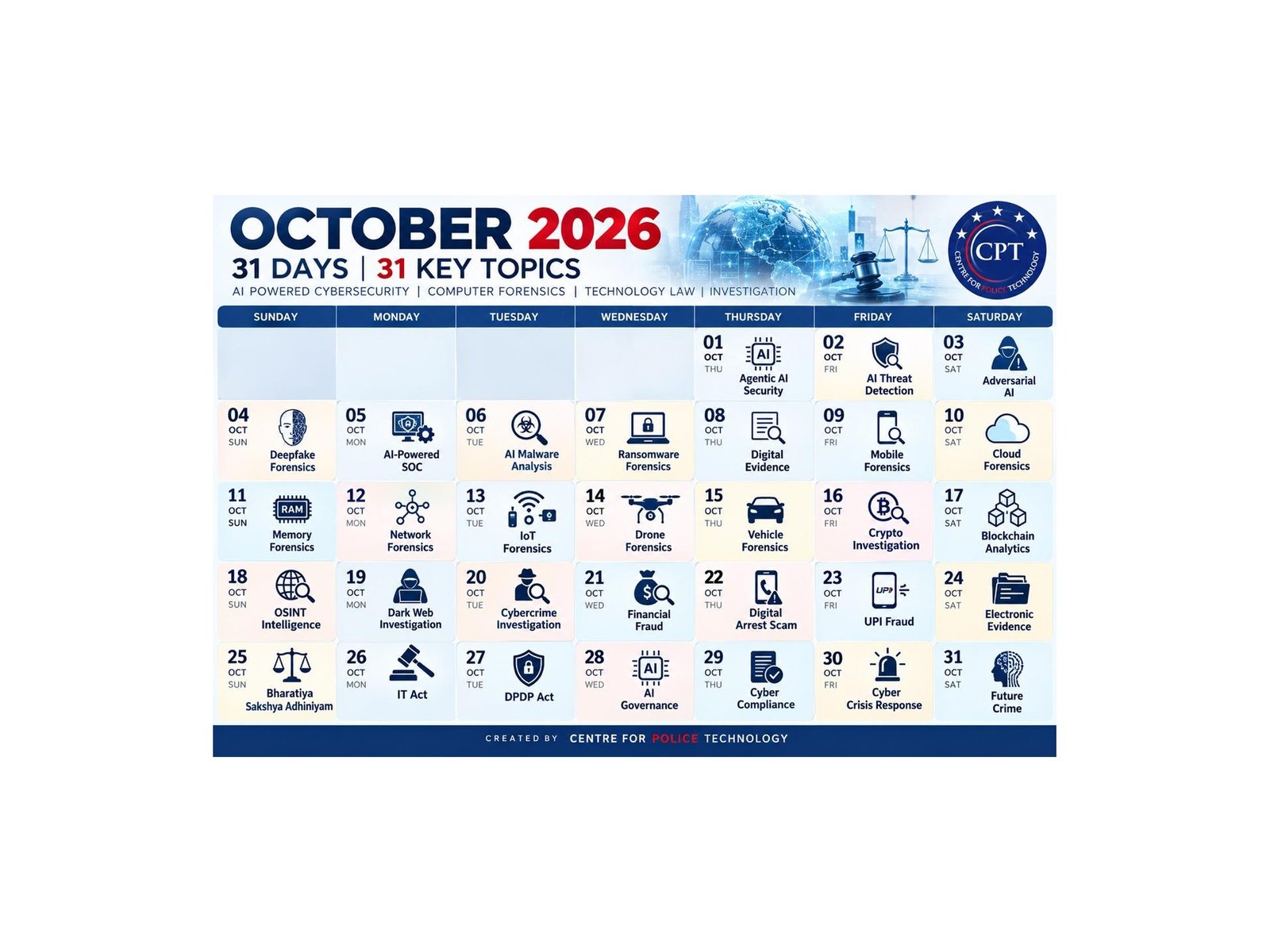
On this occasion, the Centre for Police Technology (CPT) is launching a 31-Day Cybersecurity Knowledge Seriescovering AI-powered cybersecurity, computer forensics, technology law and investigation.
From October 1 to 31, 2026, one important subject will be explored each day, specifically from the perspective of police and law-enforcement agencies (LEAs), corporate investigators, forensic practitioners, fraud investigators, cyber-risk professionals and cybersecurity teams.
The first topic is one of the most consequential emerging areas: Agentic AI Security.
What Is Agentic AI Security?
Traditional generative AI generally waits for a human prompt and produces an answer. An AI agent can go considerably further.
Depending on how it is designed and authorised, an AI agent may interpret a goal, break it into tasks, select and invoke tools, retrieve information, interact with software or APIs, maintain context and take actions with limited human intervention.
Agentic AI Security is therefore about securing the entire environment in which these autonomous or semi-autonomous AI agents operate.
The challenge is no longer merely:
“Can someone manipulate what the AI says?”
It increasingly becomes:
“Can someone manipulate what the AI decides to do?”
That distinction is critical.
Imagine an enterprise AI agent authorised to read emails, examine documents, access a CRM, query databases and prepare financial reports.
A malicious instruction hidden inside an email, webpage or document could potentially influence the agent. If permissions and safeguards are weak, the consequences could extend beyond an incorrect answer to unauthorised data access, information leakage or unintended actions.
FCRF Launches CP-FRM to Build India’s Next Generation of Fraud Risk Professionals
The Technology Behind Agentic AI
An agentic system typically combines a Large Language Model (LLM) with several supporting technologies.
The LLM provides reasoning and language capabilities. Retrieval-Augmented Generation (RAG) connects the agent with organisational knowledge. APIs and tool or function calling allow it to interact with external systems.
Memory components preserve relevant context, while planning and orchestration frameworks enable multi-step workflows. Identity and access-management mechanisms determine which resources an agent can reach.
This creates a new security architecture:
Human → AI Agent → Model → Memory/RAG → Tools/APIs → Enterprise Systems → Action
Every connection in that chain can become a potential attack surface or control point.
The New Agentic Attack Surface
Security professionals should pay particular attention to:
- Prompt injection and indirect prompt injection
- Excessive agency
- Insecure tool use
- Poisoned knowledge sources
- Sensitive-data disclosure
- Compromised credentials
- Malicious plugins or external integrations
- Supply-chain risks
- Privilege escalation
- Inadequate monitoring of agent actions
A particularly important principle is least privilege.
An AI agent should receive only the permissions necessary for its task—not unrestricted access simply because automation makes such access convenient.
High-impact actions should also require appropriate human approval, particularly where an agent can transfer money, delete information, change security configurations, communicate externally or affect evidence and investigations.
Practical Applications in Daily Life
Agentic AI is not restricted to laboratories.
A personal AI assistant could organise calendars, summarise messages and coordinate travel.
In a corporate environment, an agent could examine alerts, prepare compliance reports, investigate suspicious transactions or automate routine security workflows.
For a Security Operations Centre (SOC), an AI agent could correlate alerts from multiple sources, enrich indicators with threat intelligence, examine logs and recommend containment measures.
For fraud-risk teams, agents could connect transaction anomalies, customer information, device intelligence and historical cases to generate investigation leads.
For police and LEAs, carefully governed agentic systems could assist with OSINT collection, large-volume document review, case-data correlation, cybercrime triage, digital-evidence analysis and investigative lead generation.
The important word is assist.
AI-generated conclusions should not automatically be treated as established evidence or investigative fact. Provenance, validation, legal authority, auditability and human oversight remain essential.
Proposal for Conducting Cyber Crisis Drill, Tabletop Exercise (TTEx) & CCMP Readiness Exercise
Why Security Professionals Must Understand Agentic AI
Agentic AI changes cybersecurity because the protected entity is no longer simply a user, endpoint, network or application.
Organisations may increasingly need to secure digital actors capable of making decisions and initiating actions.
This raises fundamental questions:
- Who authorised the agent?
- What identity is it using?
- Which data can it access?
- Which tools can it invoke?
- Can an attacker manipulate its instructions?
- Who approves consequential actions?
- Are all actions logged?
- Can investigators reconstruct exactly what the agent saw, decided and executed?
- Who remains accountable when an autonomous workflow causes harm?
For cybersecurity professionals, this means traditional controls such as IAM, Zero Trust, logging, DLP, API security, secure software development and incident response must increasingly be extended to AI identities, models, prompts, context, memory, tools and autonomous workflows.
For digital-forensic investigators, a new class of artefacts is also emerging.
These may include:
Prompts → Model Outputs → Tool Calls → Agent Logs → Memory Records → Retrieved Documents → API Transactions → Human-Approval Trails
These records could become important when investigators need to reconstruct how an AI-enabled system reached a particular action or outcome.
From Cybersecurity to Agentic Security
The coming challenge is not simply securing AI models.
It is securing AI systems that can observe, reason, access tools and act.
That is why Agentic AI Security deserves attention from CISOs and SOC analysts as much as from police investigators, forensic specialists, fraud-risk teams, regulators and technology-law professionals.
As AI moves from “answering” to “acting,” cybersecurity must evolve from protecting systems against malicious instructions to ensuring that intelligent systems themselves cannot be manipulated into becoming instruments of attack.
Day 1 — Agentic AI Security
31 Days | 31 Key Topics | October 2026
A Cybersecurity Awareness Month Knowledge Initiative
Created by Centre for Police Technology (CPT)
Follow for daily updates on cybercrime, corporate fraud, DFIR, hacking, investigations, and digital forensics
