

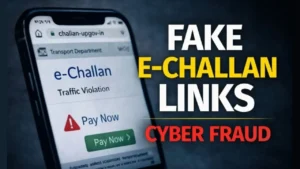
A shocking cyber fraud case has surfaced in Bihar’s Gaya district, where clicking on a fake e-challan link allegedly led to the theft of ₹5.17 lakh from three separate bank accounts belonging to the same family. Police have launched a technical investigation after the victim filed a complaint with the cyber police station.
The complainant, Suresh Prasad, a private land surveyor and resident of Lakhanpur village in Manpur, told police that he received a message on his mobile phone regarding payment of an e-bike traffic challan. Believing the message to be genuine, he clicked on the embedded link, after which his mobile phone was allegedly compromised.
According to the complaint, once the device was hacked, cyber criminals gained access to three different bank accounts belonging to Suresh Prasad, his wife, and his daughter. Within a short span, a total of ₹5,17,100 was fraudulently transferred from the three accounts through multiple transactions.
Registration Begins for FutureCrime Summit 2026, India’s Largest Cybercrime Conference
After discovering the unauthorized withdrawals, the victim lodged a written complaint with the Gaya Cyber Police Station. Investigators have begun examining digital transaction records, bank account activity, and technical evidence to identify the perpetrators.
The victim said the incident caused severe financial hardship for the family. He also revealed that the same mobile number was linked to his own bank account as well as those of his wife and daughter. He believes this enabled the fraudsters to gain access to all three accounts after compromising a single device.
He has urged people to consider linking separate mobile numbers to different family members’ bank accounts so that a compromise of one phone or number does not expose multiple accounts to cyber criminals.
Police are investigating the source of the fake e-challan message, tracing the beneficiary bank accounts that received the stolen money, and analysing the digital infrastructure used in the attack. Suspicious mobile numbers, transaction trails, and financial records are also under scrutiny.
Commenting on the incident, renowned cyber crime expert and former IPS officer Prof. Triveni Singh said cyber criminals increasingly rely on social engineering to trick people into clicking malicious links. He advised the public never to open links received through unsolicited e-challan, banking, or government messages without first verifying them through the concerned department’s official website or mobile application.
Police have also appealed to the public to avoid clicking on suspicious links, QR codes, or payment-related messages without verification. In case of suspected cyber fraud, victims should immediately report the incident through the National Cyber Crime Helpline 1930 or the National Cyber Crime Reporting Portal to improve the chances of freezing the stolen funds in time.
