

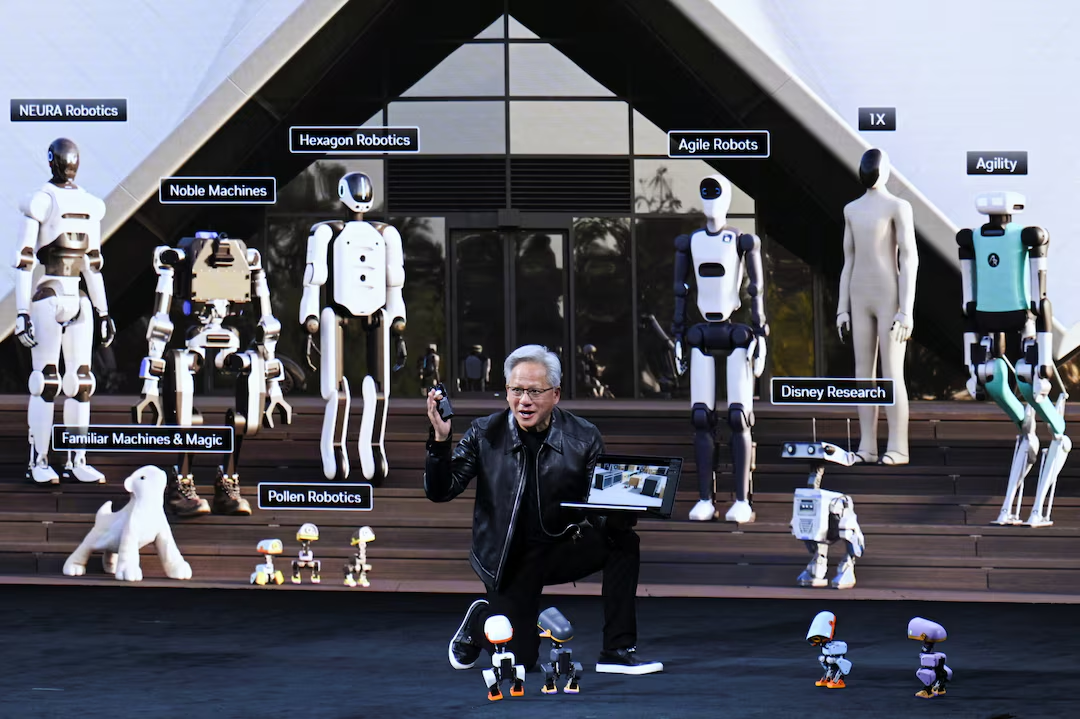

German robotics company Agile Robots plans to manufacture as many as 2,000 humanoid robots using Nvidia technology, as Europe pushes to turn artificial intelligence into machines capable of working inside factories and warehouses.
Chief Executive Zhaopeng Chen said the company expects the robots to be deployed primarily in industrial settings.
The project will use Nvidia’s computing, simulation and robotics software rather than rely on Nvidia to manufacture the machines themselves.
The announcement adds another major European company to the rapidly expanding race to commercialise humanoid robots.
FCRF’s Chief AI Officer Certification Returns on November 14 to Prepare Future AI Leaders
Agile Robots Targets Factory and Logistics Work
Agile Robots is focusing first on industrial environments, where repetitive physical tasks offer a clearer commercial case for humanoid machines.
Factories and warehouses are already highly automated.
But much of that automation depends on fixed machines designed for one specific task.
Humanoid robots are intended to be more flexible.
Because they have arms, hands and bodies designed around environments originally built for humans, they could potentially move between different jobs without companies rebuilding entire production lines.
A humanoid could, for example, pick components from shelves, move materials or operate equipment designed for human workers.
Agile Robots believes that flexibility could make the technology particularly useful in manufacturing and logistics.
The company has not disclosed a final production timetable for all 2,000 units or the price customers will pay.
Nvidia Provides the AI Brain and Simulation Tools
Nvidia’s role is centred on the technology needed to train and operate the robots.
Humanoid machines require large amounts of computing power to understand their surroundings, plan movements and react when conditions change.
Nvidia has been building a robotics ecosystem around its Jetson computing platforms, Isaac software and simulation tools.
Simulation is especially important.
Training robots entirely in the real world can be expensive, slow and potentially dangerous.
Instead, developers can create virtual factories where robots practise millions of movements before those behaviours are transferred to physical machines.
This approach allows engineers to test situations such as objects falling, people walking into a robot’s path or equipment appearing in an unexpected location.
AI models can then learn how to react before the robot enters a real workplace.
What Makes a Humanoid Robot Different
Not every industrial robot needs to look like a person.
Traditional factory robots often work more efficiently when they are designed around one task.
A mechanical arm that repeatedly welds the same part, for example, does not need legs or a human-shaped body.
Humanoid robots become more useful when companies want one machine to perform several activities in environments designed for people.
Stairs, doors, shelves, tools and workstations are generally positioned around human dimensions.
Building robots with similar physical capabilities means businesses may not need to redesign those environments.
The technical challenge is much greater, however.
A humanoid has to balance, move safely around workers and manipulate objects whose size and position may change constantly.
That requires strong AI perception and control systems alongside reliable mechanical engineering.
Europe Joins Global Humanoid Robotics Race
Companies around the world are investing heavily in humanoid robotics.
Tesla is developing its Optimus system for factory work.
US startup Figure is building general-purpose humanoids and has attracted billions of dollars in funding.
OpenAI is also building its own humanoid robot and expects to demonstrate an early prototype in 2027.
Chinese companies are expanding production quickly as Beijing promotes robotics as a strategic manufacturing sector.
Germany has a particular advantage in industrial automation because of its large manufacturing base.
Companies such as BMW, Mercedes-Benz and major industrial suppliers already operate highly automated factories.
That gives robotics developers access to environments where humanoid machines can be tested on practical production tasks rather than only in laboratories.
Agile Robots itself was founded in Munich and has expanded internationally, including in China.
Humanoid Robots Still Face Major Commercial Tests
Producing 2,000 robots would represent significant scale, but it does not mean humanoids are ready to replace large numbers of workers.
Cost remains a major hurdle.
The machines must also demonstrate that they can work reliably for long periods without requiring constant maintenance or human supervision.
Safety is another issue.
A robot working next to people must be able to stop quickly when something unexpected happens.
Errors in software become much more serious when an AI system controls heavy physical machinery.
Companies therefore need extensive testing before deploying robots widely.
For manufacturers, the economic question will be whether humanoids perform enough useful work to justify their purchase and operating costs.
The next phase of the robotics race will depend less on impressive demonstrations and more on whether these machines can deliver measurable productivity inside real factories.
What this means for you:
AI is increasingly moving from software into machines that can perform physical work. The first major impact is likely to appear in factories and warehouses, where businesses can more easily measure whether humanoid robots actually improve productivity.
Follow for daily updates on cybercrime, corporate fraud, DFIR, hacking, investigations, and digital forensics
