

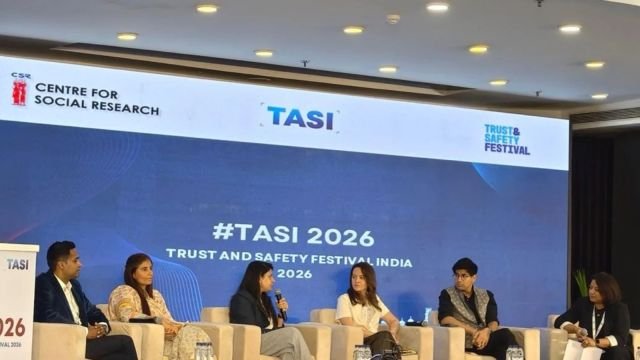
Senior executives from OpenAI, Google and Roblox have called for stronger safeguards around artificial intelligence, particularly in child protection, deepfake prevention and age verification, during a panel discussion at the Trust and Safety India (TASI) Festival 2026 in New Delhi on October 14.
The discussion focused on balancing technological innovation with user safety, regulatory oversight and the need for AI systems to operate responsibly in India’s diverse digital environment.
FCRF Launches CP-FRM to Build India’s Next Generation of Fraud Risk Professionals
Why Are AI Companies Calling for Stronger Safety Measures?
The panel brought together technology executives, policymakers and civil society representatives to discuss emerging challenges in online safety.
Participants examined how companies could manage risks through testing, voluntary collaboration and stronger accountability before releasing AI models and tools to the public.
The two-day conference, jointly organised by the Centre for Social Research (CSR) and TASI, explored industry, policy and civil society responses to online safety, inclusion and digital trust.
Speakers emphasised that safety principles must keep pace with increasingly capable AI systems rather than being introduced only after problems emerge.
Should AI Safety Come Before Innovation?
Pragya Misra, Head of Strategy and Global Affairs, India, OpenAI, said AI companies must treat safety as a priority while continuing to develop new technologies.
She acknowledged that safeguards could slow the release of new capabilities but argued that building trust was essential for long-term adoption.
Rohit Kumar, Founding Partner at The Quantum Hub (TQH), warned that companies often face incentives to prioritise innovation and competition over safety.
He argued that regulation must establish clear boundaries because commercial incentives alone may not adequately protect users.
How Are Google and Other Companies Testing AI Safety?
Snigdha Bhardwaj, Director and Global Head of Generative AI, Trust and Safety at Google, described the company’s approach to testing AI systems before public release.
She said Google maintains zero tolerance for child sexual abuse material and conducts repeated safety assessments, including adversarial testing known as red teaming.
According to Bhardwaj, the discovery of even minor prohibited content could delay a model’s launch until additional safeguards were implemented.
She also proposed an interoperable safety framework through which technology platforms could share risk signals while addressing privacy, intellectual property and competitive concerns.
The discussion also examined whether emerging technologies, including camera-equipped smart glasses, should undergo stronger testing or controlled trials before widespread deployment.
What Safeguards Are Needed to Protect Children Online?
Child protection emerged as a central concern, with speakers arguing that online safety should not depend entirely on parents configuring protective settings.
Nicky Jackson Colaco, Vice President and Global Head of Public Policy at Roblox, said platforms should make child safety the default rather than place responsibility on parents to activate safeguards.
Referring to Roblox’s age-verification measures, she said access to communication features and content should depend on a user’s age.
The panel suggested that stronger age-based restrictions and protective defaults could help reduce children’s exposure to inappropriate content and unsafe interactions.
Are AI Tools Affecting Children’s Critical Thinking?
Akash Pugalia, Chief Digital Officer at TP, raised concerns about children’s increasing dependence on AI tools for information and learning.
He said easy access to AI-generated answers could weaken the reasoning process if children relied on automated responses without independently examining information.
Pugalia also highlighted the growing sophistication of AI-generated audio and video deepfakes, warning that manipulated content was becoming increasingly difficult to distinguish from authentic recordings.
OpenAI’s Pragya Misra similarly referred to research indicating that learning had emerged as a major use case for AI in India.
She said the challenge was ensuring that AI tools supported the learning process rather than simply supplying answers and reducing opportunities for independent thinking.
Why Must AI Safety Reflect India’s Digital Environment?
The panel emphasised that AI safety systems developed for global markets must account for India’s linguistic, cultural and social diversity.
Speakers said safeguards should recognise local languages, cultural differences and variations in digital literacy among children and parents.
They also cautioned against safety measures that unnecessarily restrict access to information or freedom of expression.
Participants stressed the importance of designing protections that address genuine risks while allowing users to benefit from emerging technologies.
The420 Insight
The discussions at TASI 2026 highlight a growing recognition among technology companies that AI safety cannot remain an optional feature introduced after deployment.
Concerns over child protection, deepfake manipulation and excessive reliance on AI-generated answers demonstrate the need for safeguards throughout the development and deployment process.
For India, effective AI governance will require age-appropriate protections, stronger testing mechanisms and safety systems adapted to local languages and digital literacy levels. The challenge is to ensure that technological progress does not come at the expense of user protection, independent thinking or access to information.
Follow for daily updates on cybercrime, corporate fraud, DFIR, hacking, investigations, and digital forensics
