

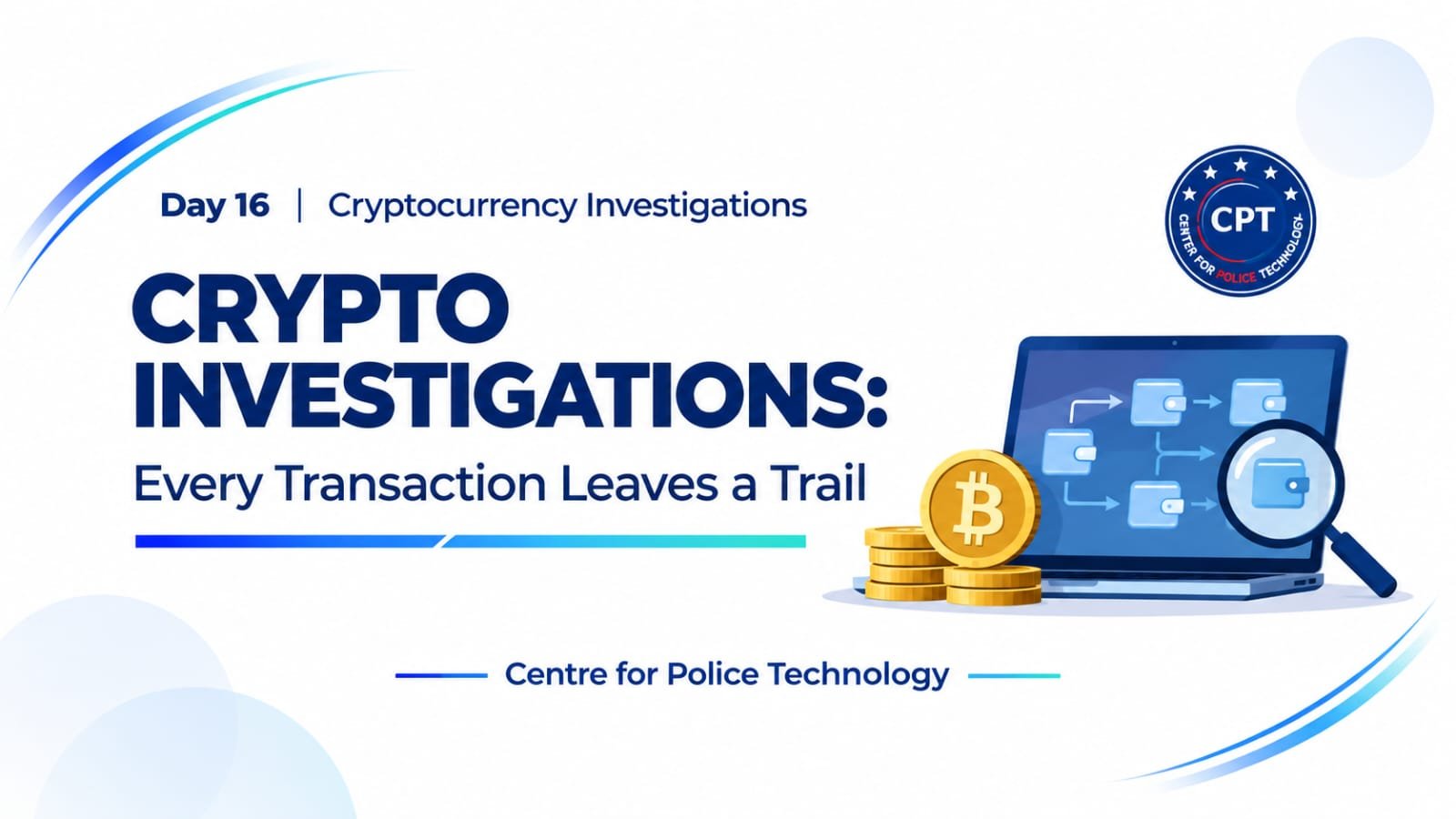
Centre for Police Technology (CPT) Presents a 31-Day Cybersecurity Knowledge Series for police personnel, law enforcement agencies (LEAs), corporate investigators, digital forensics professionals and cybersecurity practitioners.
October 16, 2026 | Day 16 of 31
A cryptocurrency transaction can cross borders in seconds, move through multiple wallets and pass between platforms without relying on traditional banking channels. For criminals, these features can make digital assets attractive for laundering proceeds of crime, collecting ransom payments and running investment scams. For investigators, however, blockchain records can also provide valuable clues.
Crypto investigations combine blockchain analysis, digital forensics, financial investigation and traditional police methods to trace suspicious transactions, identify possible links between wallets and gather evidence related to cryptocurrency-enabled crime.
What Is a Crypto Investigation?
A crypto investigation is the process of examining cryptocurrency transactions, wallet activity, exchange records and related digital evidence to investigate suspected offences.
Many public blockchains maintain transaction records that can be inspected using specialised analytical tools. Investigators may trace the movement of funds between wallet addresses, examine transaction timing and identify patterns that could connect separate transactions.
However, a wallet address is not automatically linked to a real-world identity. Establishing who controlled a wallet may require additional evidence, such as exchange account records, identity verification information, device data, communications or other legally obtained records.
Crypto investigations therefore involve more than following transactions. They require investigators to connect blockchain activity with people, devices, accounts and suspected criminal conduct.
What Evidence Can Investigators Find?
Cryptocurrency investigations may involve several types of evidence:
- Blockchain Transactions: Public transaction records can reveal transfers between addresses, amounts, timestamps and transaction identifiers.
- Wallet Information: Investigators may examine wallet addresses, transaction histories and evidence relating to wallet access or control.
- Cryptocurrency Exchange Records: Where available and lawfully obtained, exchange records may help connect accounts with verified identities, login activity, deposits and withdrawals.
- Device and Application Evidence: Computers and smartphones may contain wallet applications, transaction notifications, relevant files, browser histories or communications.
- Communication Records: Messages, emails and social media conversations may provide context about a suspected payment, investment scheme or demand for ransom.
- Financial Records: Bank transfers, payment receipts and exchange deposits or withdrawals may help establish how funds entered or left the cryptocurrency ecosystem.
The availability of evidence varies by blockchain, service provider, device configuration and data-retention practices.
How Do Criminals Misuse Cryptocurrency?
Cryptocurrency itself is not inherently criminal. However, criminals may exploit digital assets and related services to facilitate offences.
Investment and Trading Scams: Fraudsters may promise guaranteed returns, operate fake trading platforms or persuade victims to transfer cryptocurrency to wallets they control.
Ransomware Payments: Cybercriminals may demand digital assets in exchange for supposedly restoring access to encrypted files or preventing the release of stolen data.
Money Laundering: Criminals may move proceeds through multiple addresses, services or jurisdictions in an attempt to obscure the origin and destination of funds.
Pig-Butchering and Romance Scams: Fraudsters may build trust over time, persuade victims to invest through fake platforms and then disappear with their funds.
Extortion and Impersonation: Scammers may impersonate officials, businesses or technical-support personnel and demand cryptocurrency payments under false pretences.
Sanctions Evasion and Illicit Marketplaces: Digital assets may be used in transactions connected to prohibited activities or attempts to evade financial restrictions.
Criminals may also use intermediaries, compromised accounts or third-party services to distance themselves from transactions. Yet movement through multiple wallets does not automatically prove laundering, and investigators must establish the circumstances and purpose of the activity.
How Can Police and LEAs Conduct Crypto Investigations?
Effective cryptocurrency investigations combine blockchain analysis with conventional investigative techniques.
1. Trace Transaction Flows: Investigators can examine relevant blockchain records to map the movement of funds, identify connected addresses and locate potential points where funds reach identifiable services.
2. Preserve Transaction Evidence: Transaction hashes, wallet addresses, timestamps, relevant blockchain details and screenshots may help document investigative leads. Investigators should retain verifiable records and avoid relying solely on screenshots.
3. Identify Relevant Service Providers: If funds reach a cryptocurrency exchange or another identifiable service, investigators may seek relevant account and transaction records through appropriate legal processes and cooperation channels.
4. Examine Digital Devices: Forensic analysis of phones and computers may reveal wallet applications, communications, account access information or other evidence connecting individuals to transactions. Private keys and recovery phrases must be handled securely to avoid compromising assets or evidence.
5. Follow the Fiat Trail: Bank statements, payment records and exchange transactions may help connect cryptocurrency movements with real-world financial activity and potential victims.
6. Coordinate Across Jurisdictions: Cryptocurrency transactions can involve services and individuals in multiple countries. Investigators may need international cooperation, timely preservation requests and coordination with financial intelligence and cybercrime units.
7. Preserve Chain of Custody: All evidence must be collected and documented according to applicable law and forensic procedures. Investigators should record how information was obtained, preserve original records where possible and maintain an auditable trail.
Blockchain analysis tools can identify patterns and generate leads, but their findings require careful interpretation. Attribution to a person should be supported by independent evidence rather than inferred from a wallet address alone.
How Can Ordinary People Protect Themselves?
Anyone using cryptocurrency should treat unexpected investment offers and urgent payment demands with caution.
- Verify Platforms Independently: Research an exchange or investment service before transferring funds. Do not rely solely on links, testimonials or screenshots shared by promoters.
- Avoid Guaranteed Returns: Promises of risk-free profits, unusually high returns or pressure to invest immediately are major warning signs.
- Never Share Recovery Phrases: Keep wallet seed phrases and private keys secret. Legitimate support personnel should not ask you to disclose them.
- Verify Wallet Addresses: Double-check the recipient address and network before sending funds. Cryptocurrency transfers may be irreversible.
- Beware of Recovery Scams: After a loss, criminals may pose as investigators, lawyers or recovery specialists and demand advance fees to retrieve cryptocurrency.
- Preserve Evidence: Save transaction IDs, wallet addresses, messages, emails, platform URLs and payment records. Do not delete conversations or make further payments to suspected scammers.
- Report Promptly in India: For suspected cyber financial fraud, contact the national cybercrime helpline 1930 as soon as possible and report the incident at cybercrime.gov.in. Also inform the relevant exchange or financial institution, if applicable.
Prompt reporting may help authorities take timely action, although recovery is not guaranteed.
How Can Organisations Strengthen Crypto-Related Controls?
Businesses handling digital assets should implement strong access controls, multifactor authentication, secure key management and documented transaction-approval procedures. Organisations should monitor suspicious activity, maintain reliable audit logs and establish incident-response plans for suspected wallet compromise or fraudulent transfers.
Exchanges and other relevant service providers should apply appropriate customer due diligence, transaction monitoring and suspicious-activity reporting obligations in accordance with applicable law. Staff should also receive training on impersonation, social engineering and cryptocurrency-enabled fraud.
The Future of Crypto Investigations
As digital assets, decentralised finance platforms and cross-chain services evolve, investigators face increasingly complex transaction networks. Privacy-enhancing technologies, fragmented records and cross-border service providers can create additional challenges, while improved analytics may help identify suspicious patterns and connect related cases.
The most effective approach combines technical expertise with financial intelligence, traditional investigation, legal cooperation and careful evidence handling.
Cryptocurrency may move across digital networks, but every traceable transaction can offer a lead. The challenge is to follow that lead, establish who is responsible and turn technical findings into reliable evidence.
Day 16 — Crypto Investigations
31 Days | 31 Key Topics | October 2026
Follow Centre for Police Technology (CPT) for the complete 31-Day Cybersecurity Knowledge Series.
Follow for daily updates on cybercrime, corporate fraud, DFIR, hacking, investigations, and digital forensics
