

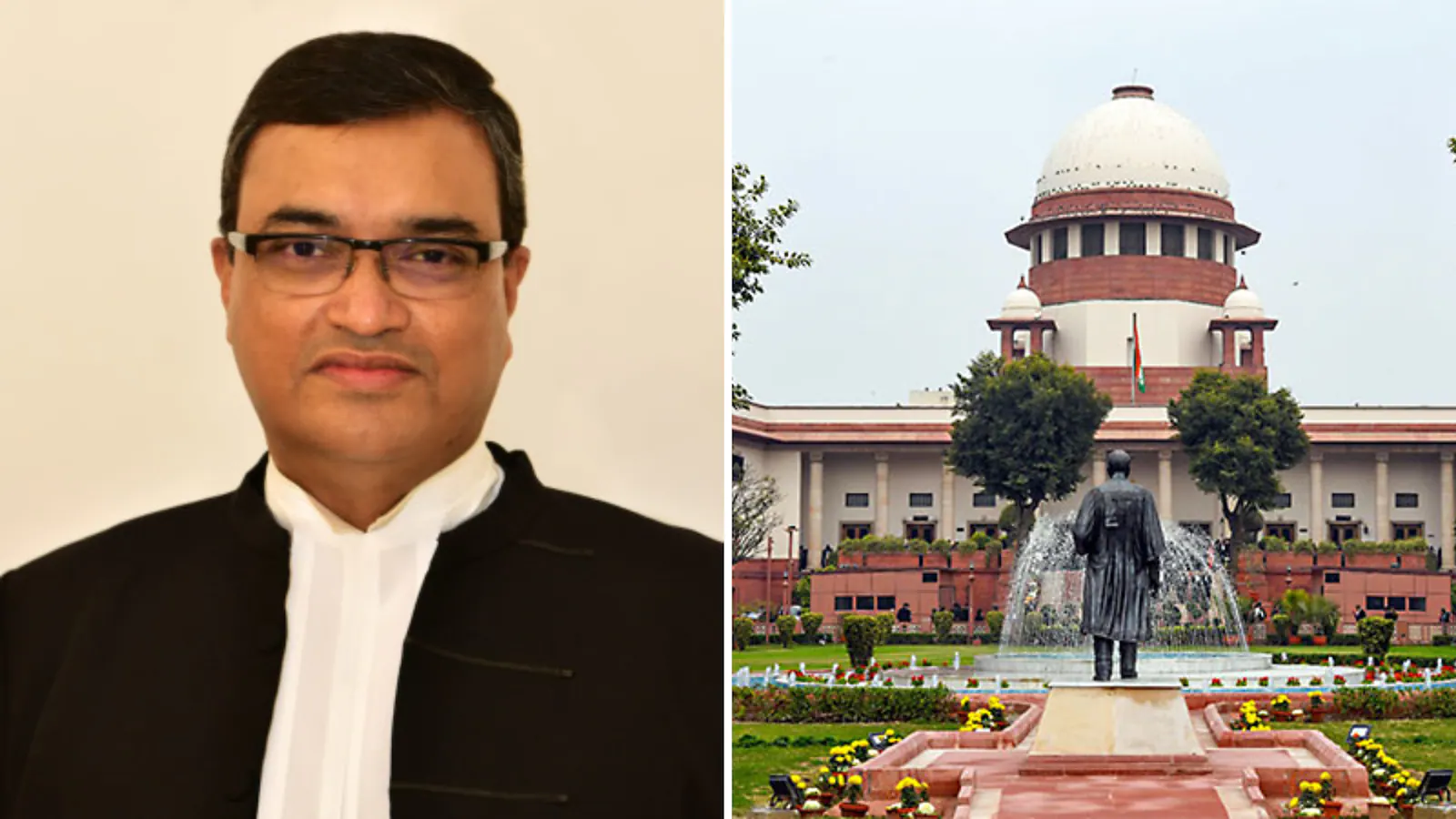

Supreme Court Justice Dipankar Datta has rejected the commonly used description of India’s Collegium system as one in which “judges appoint judges”, while questioning the Union government’s practice of selectively clearing recommendations for judicial appointments.
Justice Datta made the observations on September 23 during proceedings concerning challenges to the Chief Election Commissioner and Other Election Commissioners (Appointment, Conditions of Service and Term of Office) Act, 2023. The law changed the composition of the committee that selects Election Commissioners by replacing the Chief Justice of India with a Union Cabinet Minister.
The remarks arose after Solicitor General Tushar Mehta referred to the judicial appointment process while responding to concerns over executive influence in the selection of Election Commissioners.
Justice Datta said portraying the Collegium as a system where judges alone appoint other judges ignored the role played by the executive during the appointment process.
Proposal for Conducting Cyber Crisis Drill, Tabletop Exercise (TTEx) & CCMP Readiness Exercise
Justice Datta questions ‘judges appoint judges’ description
Justice Datta said the phrase had created an inaccurate public perception about how appointments actually take place.
He observed that Collegium recommendations do not automatically translate into appointments because the Union government remains involved at several stages before a candidate is formally appointed.
According to his opinion, blaming the Collegium alone whenever an unsuitable judicial appointment is made overlooks the wider constitutional and administrative process involved.
He also said no appointment system can guarantee that every human choice will ultimately prove correct.
The judge’s broader point was that judicial appointments involve consultation and executive action rather than a closed process controlled entirely by sitting judges.
Government’s selective clearance comes under criticism
Justice Datta also referred to situations where the government clears some names recommended by the Collegium while leaving others pending.
He said such selective action can affect the seniority and order in which recommended judges eventually enter office.
The issue is not purely theoretical.
Earlier this month, the Supreme Court Collegium recommended eight judicial officers for appointment as Delhi High Court judges. The Centre subsequently notified seven appointments, while one recommended name had not been notified at the time of reporting.
Justice Datta said the judiciary has at times avoided escalating disagreements over appointments because a direct confrontation with the executive could create an institutional or constitutional crisis.
That observation places the current debate within a long-running disagreement between the judiciary and successive governments over how much control each branch should exercise in judicial appointments.
How the Collegium system actually works
The Collegium is not expressly created by a single constitutional provision.
It developed through a series of Supreme Court judgments commonly known as the Judges Cases.
For appointments to the Supreme Court and High Courts, senior judges recommend candidates through the Collegium process. Those recommendations are then sent through the government before the President formally makes the appointment.
The government can return a recommendation for reconsideration.
Under the established process, if the Collegium reiterates a recommendation, the convention is that the government should accept it, although disputes over delays and pending names have repeatedly reached the Supreme Court.
The Supreme Court separately publishes Collegium resolutions identifying recommendations for appointments and transfers. Its September 10 resolutions, for example, included recommendations concerning the Delhi, Karnataka, Jharkhand and Jammu & Kashmir and Ladakh High Courts.
Justice Datta’s remarks therefore focus on the gap between recommending a judge and actually appointing one.
Comments came during Election Commissioner appointment case
The Collegium issue surfaced during a different constitutional dispute.
Petitioners are challenging the 2023 Election Commissioners appointment law, particularly the removal of the Chief Justice of India from the selection committee.
The current statutory panel includes the Prime Minister, a Union Cabinet Minister nominated by the Prime Minister and the Leader of Opposition in the Lok Sabha.
Justice Datta expressed concern in his separate opinion that this arrangement gives the executive a dominant role in the selection process. In another part of the same proceedings, he described the Leader of Opposition’s role under the present structure as effectively limited because the two government representatives form a majority.
These observations form part of the judicial proceedings and should not be read as a final resolution of the constitutional challenge itself.
Supreme Court delivers split view on larger bench request
The September 23 proceedings also produced a split decision on the government’s request to refer the Election Commissioners case to a larger Constitution Bench.
Justice Datta rejected the request for reference, while Justice Satish Chandra Sharma favoured sending the issue to a larger bench.
That disagreement means the procedural future of the challenge will require further judicial consideration.
The larger debate over judicial appointments also remains unresolved.
Supporters of the Collegium argue that it protects judicial independence from political control. Critics have raised concerns about transparency, accountability and the lack of a formal selection framework.
Justice Datta’s comments do not eliminate those criticisms. They instead challenge one particular description of the system: that sitting judges exercise complete control over who becomes a judge.
Follow for daily updates on cybercrime, corporate fraud, DFIR, hacking, investigations, and digital forensics
