

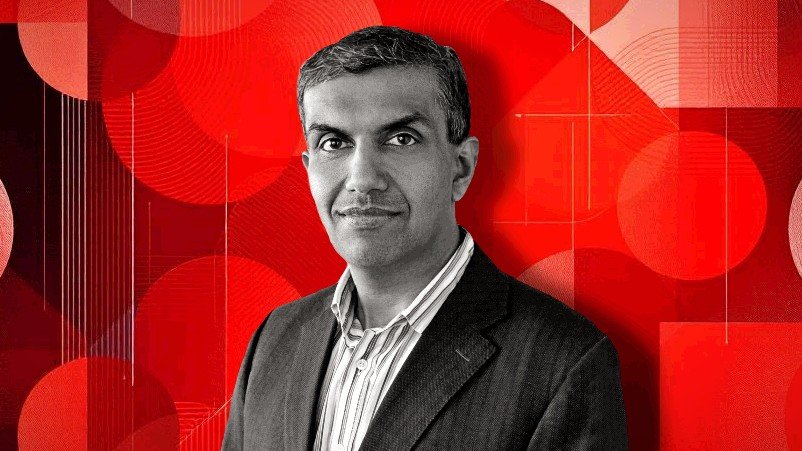

Adobe has chosen Indian-origin technology executive Anil Chakravarthy as its next Chief Executive Officer, handing him responsibility for one of Silicon Valley’s best-known software companies at a time when artificial intelligence is reshaping the creative industry.
Chakravarthy will become Adobe’s President and CEO on December 1, 2026, and will also join the company’s board. Shantanu Narayen, who has led Adobe since 2007, will step down as CEO and become Executive Chair.
The transition marks the end of an 18-year CEO tenure during which Narayen transformed Adobe from a company selling packaged software into a subscription-driven cloud business.
For Chakravarthy, the challenge is different.
He must now convince customers and investors that Adobe can remain central to creativity and digital work even as AI tools make image generation, design and content creation dramatically easier.
Proposal for Conducting Cyber Crisis Drill, Tabletop Exercise (TTEx) & CCMP Readiness Exercise
From Varanasi to MIT and Silicon Valley
Chakravarthy’s career began with a BTech in Computer Science and Engineering from the Institute of Technology, Varanasi, now IIT (BHU).
He later completed a Master of Science and PhD at the Massachusetts Institute of Technology.
Before joining Adobe, he worked at McKinsey & Company and held senior roles at VeriSign and Symantec. He later spent four years as CEO of Informatica, the enterprise cloud data-management company.
He joined Adobe in January 2020 as Executive Vice President and General Manager of its Digital Experience business.
Within months, he also took responsibility for Adobe’s worldwide field operations. In 2021, he was promoted to President of Digital Experience and worldwide field operations.
Adobe credits him with helping expand its customer-experience business and developing products including Adobe CX Enterprise, GenStudio and Brand Visibility.
He also played a major role in scaling Adobe Experience Platform and in the acquisitions and integration of Workfront and Semrush.
Why Adobe’s Next CEO Faces a Very Different Battle
Narayen’s defining challenge was moving Adobe away from one-time software purchases.
Chakravarthy’s defining challenge could be AI.
Generative AI tools can now create images, video, graphics and marketing material from simple text instructions. That threatens the traditional assumption that sophisticated creative work requires specialised software and significant technical skill.
Adobe still has enormous strengths.
Photoshop, Illustrator, Acrobat and Creative Cloud remain deeply embedded in professional workflows, while Adobe has built its own generative AI technology through Firefly and added AI features across its products.
But competition has changed.
Canva has made design far easier for casual users. Figma has become a major force in collaborative interface design. AI companies are also increasingly offering tools that can produce usable creative content directly.
Reuters reported that Adobe shares fell around 21% in 2025 and another 18% in 2026 before the leadership announcement, reflecting investor concern over whether AI could weaken parts of Adobe’s traditional business.
The company has nevertheless continued reporting strong demand for AI-enabled products and raised its annual profit forecast in June.
What Does ‘Agentic Software’ Mean?
Chakravarthy said he wants Adobe to lead the next era of “agentic software” for creativity, productivity and customer experience.
The term sounds technical, but the idea is straightforward.
Traditional software waits for a user to perform each step.
An AI agent can be given a broader goal and then carry out several tasks on the user’s behalf.
For example, a designer might normally resize an image, rewrite copy, create several advertising versions and prepare them for different platforms manually.
An agentic system could potentially perform those steps as part of a single workflow, while the user supervises the result.
Adobe is already building technology in this direction.
Its Experience Platform Agent Orchestrator is designed to coordinate AI agents performing different marketing and customer-experience tasks.
That explains why Adobe’s new CEO is talking about something beyond ordinary generative AI.
The company does not simply want AI to create an image. It wants software capable of helping complete entire creative or business processes.
Narayen Leaves Behind a Very Different Adobe
Shantanu Narayen became Adobe CEO in 2007 after joining the company in 1998.
His most consequential decision was the transition from selling programmes such as Photoshop through perpetual licences to offering them through Creative Cloud subscriptions.
The shift initially frustrated some users, who preferred owning software outright.
Financially, however, it transformed Adobe.
Subscriptions created recurring revenue and made it easier for Adobe to continuously update products instead of relying on major software releases every few years.
Narayen also expanded Adobe beyond creative applications into digital documents, marketing technology and enterprise customer experience.
Adobe describes his tenure as one that established its cloud subscription model and built major new categories around digital documents and digital experience.
He will remain closely involved as Executive Chair after December 1.
The Market Is Already Judging the Transition
The succession comes during a sensitive period.
Adobe also announced the departure of Chief Financial Officer Dan Durn earlier this year, adding another leadership change as the company tries to reassure investors about its AI strategy.
The market reaction to Chakravarthy’s appointment was cautious. Adobe shares initially fell in after-hours trading following the announcement, and dropped further in the next session.
That does not necessarily reflect a judgment on Chakravarthy personally.
It reflects the scale of the task he inherits.
Adobe has already survived one enormous technological transition under Narayen: from packaged desktop software to cloud subscriptions.
Chakravarthy now has to manage another.
This time, the question is whether AI becomes a tool that strengthens Photoshop, Acrobat and Adobe’s enterprise products — or a technology that allows customers to bypass traditional creative software altogether.
What this means for you: Adobe users are likely to see more AI agents and automated workflows built directly into creative and productivity tools. The important question will be whether these features save meaningful time without reducing user control over creative work and data.
https://www.linkedin.com/company/policetechnology/
Follow for daily updates on cybercrime, corporate fraud, DFIR, hacking, investigations, and digital forensics
