

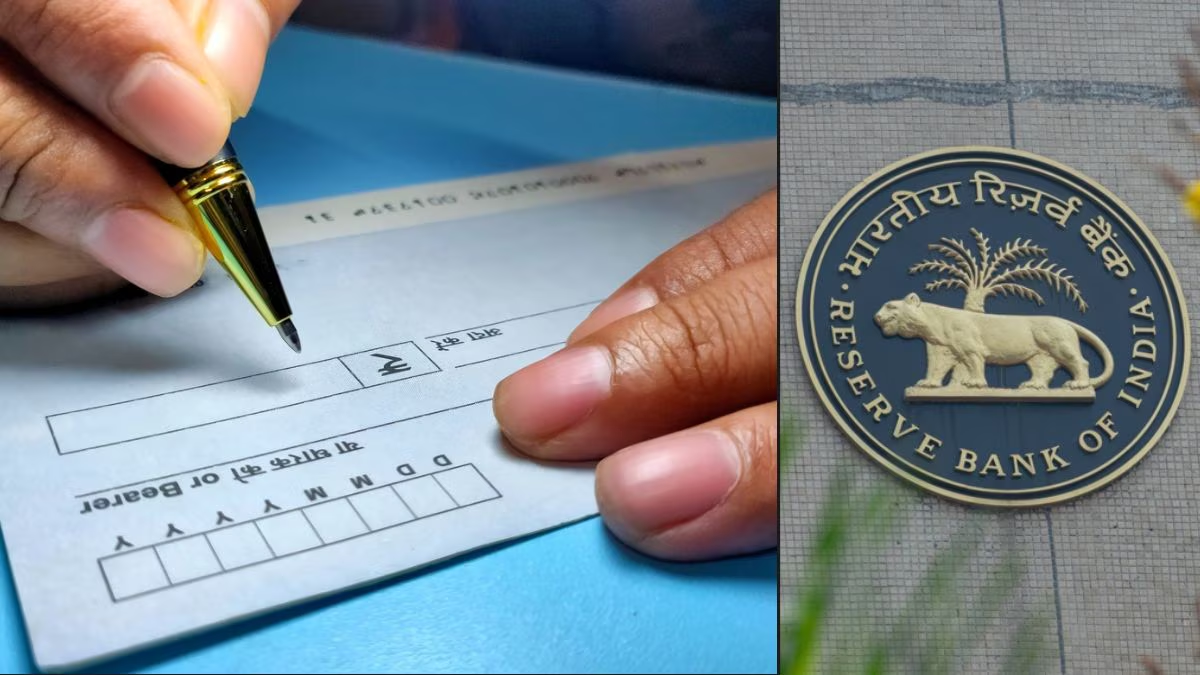

Bank customers across India are being asked to act on two significant regulatory changes arriving within months of each other, one tightening cheque security and the other overhauling how fixed deposit rates are disclosed. Bank of India and several other lenders have begun advising customers to replace their existing cheque books ahead of a new alpha-numeric code requirement, while the Reserve Bank of India’s revised deposit framework takes effect from October this year.
From 1 January 2027, cheque books will need to carry a prescribed alpha-numeric code as part of a broader security upgrade. Banks have set 31 December 2026 as the practical deadline for customers to obtain updated cheque books, since cheques of ₹50,000 or more lacking the required code will simply not be accepted once the new year begins.
Why the Alpha-Numeric Code Matters
The code functions as an additional authentication layer, combining letters and numbers that banks can use to verify a cheque’s legitimacy during processing. Bank of India first introduced a version of this security feature in its cheque book series back in September 2022, and the upcoming mandate effectively extends and standardises that protection across a wider base of instruments.
The urgency behind this measure reflects a persistent vulnerability in paper-based payments. Industry data has shown cheque fraud accounting for a substantial share of total banking fraud losses in recent years, ranking as the second-largest category after debit card fraud, a pattern that has kept regulators focused on hardening this instrument even as digital payments dominate transaction volumes nationally.
The Positive Pay System adds a further layer of protection specifically for higher-value cheques. Under Bank of India’s current policy, Positive Pay is available for cheques of ₹50,000 and above, and becomes mandatory for cheques worth ₹5 lakh and above, requiring customers to confirm key cheque details with their bank before the instrument is processed, allowing discrepancies to be caught before funds move.
Faster Clearing Through Digital Infrastructure
These security additions build on the Cheque Truncation System, which has already replaced the physical movement of cheques between branches with encrypted digital images processed through three clearing grids in New Delhi, Mumbai and Chennai. The RBI introduced continuous clearing under this system in 2025, shifting from batch processing to near real-time settlement and enabling many cheques to clear within hours rather than the days such transactions once required.
The combination of faster digital clearing and stronger authentication at the point of issuance reflects a dual strategy, using technology to both speed up legitimate transactions and close the gaps fraudsters have historically exploited in paper-based instruments.
Fixed Deposit Rules Bring Transparency, Not Automatic Rate Changes
Separately, the RBI’s revised deposit framework takes effect from 1 October 2026, requiring banks to apply greater consistency when setting interest rates for deposits sharing similar characteristics. Banks will need to publish applicable fixed deposit rates in advance on their websites, giving customers a clearer basis for comparison before committing funds.
Importantly, this transparency requirement does not guarantee that FD rates will rise or fall from October, since banks will continue setting rates based on market conditions and their own funding needs. The RBI has also permitted continued flexibility for bulk deposits, provided banks disclose the applicable criteria and daily rates clearly on their websites, ensuring depositors can track terms even for large-ticket placements.
With both changes converging over the coming months, customers replacing cheque books early and reviewing published FD rates before committing funds stand the best chance of avoiding disruption once the new rules take full effect.
