

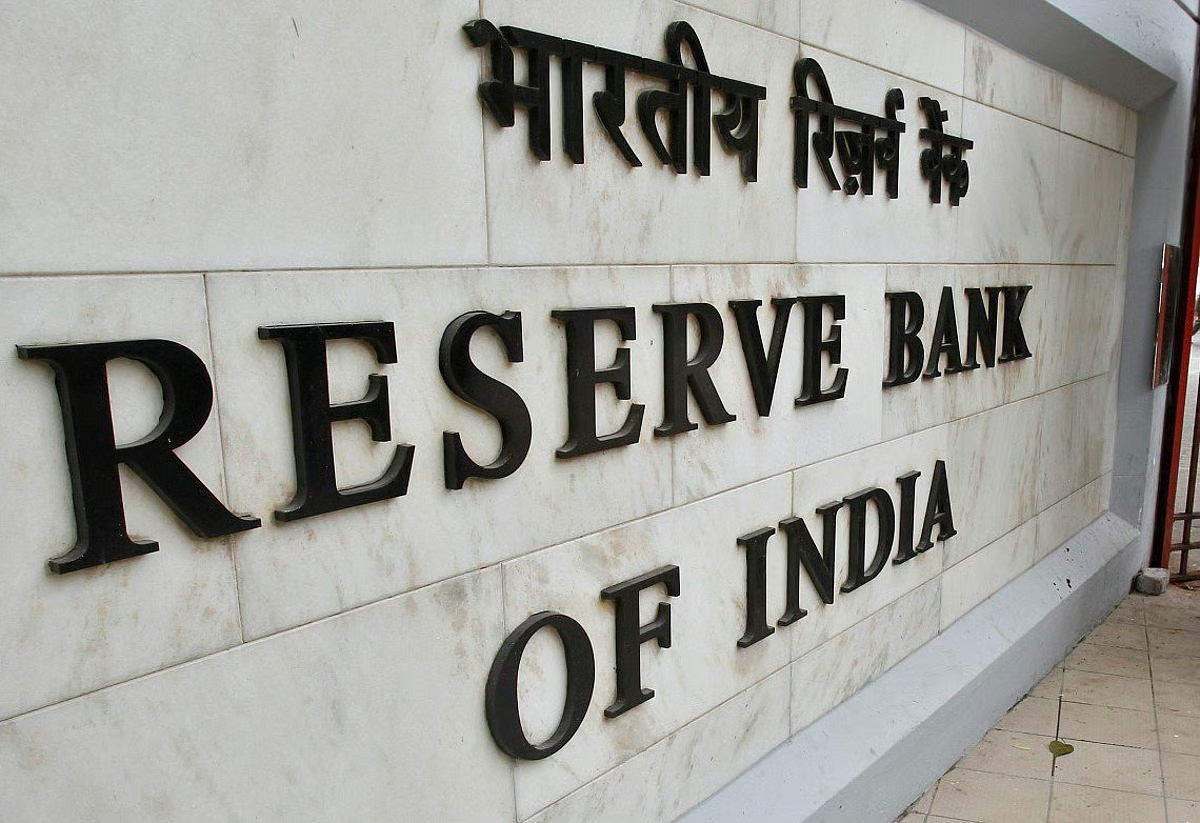

Reserve Bank of India Deputy Governor Shirish Chandra Murmu has outlined five core principles for the deployment of artificial intelligence across the domestic banking sector, emphasizing that financial institutions must preserve human accountability while adopting automated decision-making models. Delivering a keynote address titled “A Vision for Responsible AI, Resilient Banking,” the central bank leader signaled supervisory expectations designed to ensure that rapid technological adoption expands credit access without compromising financial stability, market fairness, or consumer protection.
The supervisory guidance arrives at a pivotal moment for Indian financial institutions. The domestic banking system enters this technological transition from a position of historical balance-sheet strength, characterized by capital adequacy ratios standing at 17.7 per cent and gross non-performing assets dropping to a multi-year low of 1.8 per cent. However, despite robust overall commercial credit growth, central bank data indicates a troubling structural trend, as the proportion of new micro and small enterprises entering the formal credit ecosystem declined from 52 per cent in 2022-23 to 42 per cent in 2025-26.
To reverse this downward trajectory, central bank leadership urged commercial lenders to leverage machine learning algorithms to evaluate credit-invisible borrowers who lack traditional physical collateral or established credit histories. By analyzing non-traditional data streams such as real-time cash flows, Goods and Services Tax filings, and recurring utility payment records, banks can safely integrate underserved economic segments into formal credit channels.
The Five Pillars of Responsible Banking Technology
To navigate this technological transition safely, the central bank established five foundational supervisory expectations for regulated financial entities. The first expectation focuses on financial inclusion, mandating that lenders utilize alternative data points to democratize credit access for small businesses and first-time borrowers. The second principle requires continuous organizational agility, compelling institutions to systematically upgrade their technical infrastructure, operational workflows, and workforce capabilities alongside evolving algorithmic models.
The third supervisory requirement enforces comprehensive transparency through exhaustive model inventories. Regulated institutions must maintain detailed registries of all internally developed and third-party artificial intelligence models, ensuring that risk management teams fully understand their underlying operational limits. The fourth pillar addresses operational resilience, instructing banks to subject automated tools to rigorous stress testing while maintaining non-automated, human-operated fallback mechanisms for critical banking functions. Finally, the fifth principle establishes strict explainability standards, guaranteeing that automated decisions impacting customer credit applications or risk scores can be audited, reviewed, and overridden by authorized personnel.
Mitigating Vendor Reliance and Systemic Risks
Beyond institutional governance, the Reserve Bank of India raised serious concerns regarding potential systemic risks created by widespread reliance on identical cloud platforms and third-party technology vendors. If multiple commercial banks deploy uniform credit scoring models or risk management algorithms supplied by a small group of tech providers, an unhandled software flaw or vendor outage could trigger simultaneous credit freezes or false defaults across the entire financial system. Central bank authorities reiterated that outsourcing technological capabilities does not dilute regulatory responsibility, confirming that financial institutions remain strictly accountable for all automated decisions.
This proactive stance reflects a broader regulatory convergence across India’s financial regulatory architecture. The Securities and Exchange Board of India has similarly introduced structured guidelines for automated trading systems, reinforcing that ultimate legal and operational responsibility must remain with human supervisors rather than autonomous software agents. As artificial intelligence becomes deeply embedded in daily banking operations, adherence to these five supervisory pillars will determine whether technological innovation strengthens or destabilizes the broader national economy.
