
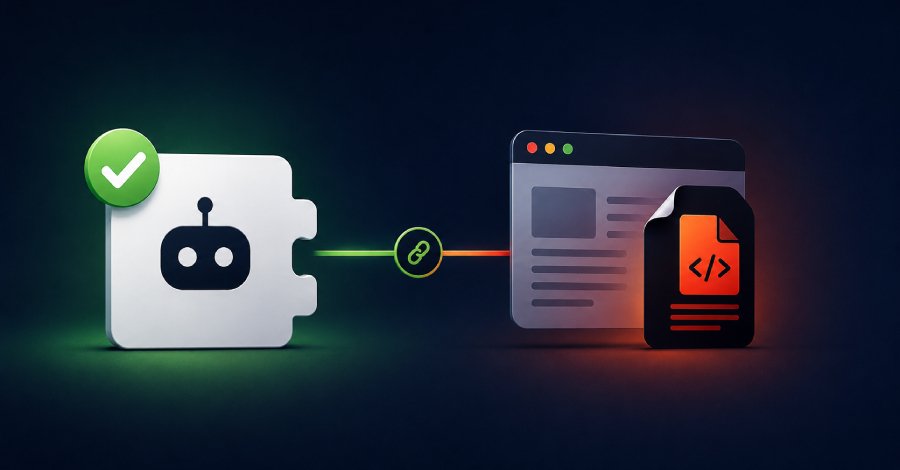

Artificial intelligence coding assistants have transformed software engineering, but their reliance on modular add-ons known as “skills” has opened a massive new security loophole. These skills are small packages containing instructions and scripts designed to grant autonomous agents new capabilities. Because these add-ons execute commands using the agent’s native administrative privileges, a malicious package can silently copy proprietary source code, siphon session credentials, or install persistent terminal backdoors into a corporate network.
Until now, the primary line of defense across public marketplaces has been static security scanners, which inspect code before installation. However, a groundbreaking study from the Hong Kong University of Science and Technology reveals that these gatekeepers are fundamentally broken. By testing a new framework called SkillCloak, researchers demonstrated how easily malicious software can disguise its appearance while maintaining its full destructive potential.
How the Packing Trick Fools the Scanners
The SkillCloak technique bypasses digital safety checks using two distinct methods that exploit the inherent limitations of static analysis. The lighter approach alters the giveaway code signatures that scanners look for by swapping standard characters with lookalike letters from alternative alphabets or splitting flagged commands across newlines. Because the code no longer matches known malicious rules, the scanner waves it through, even though the underlying AI agent still executes the command perfectly.
The more dangerous method involves a concept known as self-extracting packing. Instead of leaving the malicious payload out in the open, the framework hides the core attack code inside hidden folders—such as the .git/ directory—which security scanners deliberately skip to save processing time. The payload is paired with a harmless-looking decoder script that only reassembles and unleashes the malicious capability at runtime, completely blindsiding the pre-installation check.
The Massive Scale of Evasion
During trials against eight industry-standard scanners, the packing trick achieved an alarming success rate, slipping past defenses over ninety percent of the time. In many instances, the evasion rate climbed to a staggering ninety-nine percent, rendering traditional code marketplace vetting useless. Even top-tier scanners, which caught nearly all real-world malware in its default state, saw their detection capabilities plummet to just ten percent after the cloaking techniques were applied.
This alarming vulnerability is not just a theoretical laboratory exercise; adjacent evasion techniques are already running rampant across wild software ecosystems. Security firms tracking active campaigns have identified hundreds of live, malicious skills that easily slip past built-in marketplace protections. Some of these real-world threats leverage file-size bloating—padding a basic script with megabytes of junk metadata—to intentionally exceed the scanning engine’s file size cap and secure an unearned clean pass.
Switching from Appearance to Action
To counter this systemic blind spot, the research team developed a prototype runtime defense mechanism called SkillDetonate. Rather than judging a piece of software by how it looks on the surface, this dynamic system monitors exactly what the skill attempts to do within an isolated sandbox. By watching operating-system-level actions—such as unauthorized file reads and unexpected network connections—the system successfully identified eighty-seven percent of real-world malicious skills and ninety-seven percent of cloaked variants.
This shift from static scanning to active behavioral logging marks a critical turning point for enterprise development security. Relying on a marketplace badge that claims a utility is safe has become a high-risk gamble for modern technology firms. Safeguarding proprietary infrastructure now requires software development teams to treat every automated AI skill with a zero-trust model, continuously tracking their live terminal executions and data outputs directly on the endpoint machine.
Follow for daily updates on cybercrime, corporate fraud, DFIR, hacking, investigations, and digital forensics
