

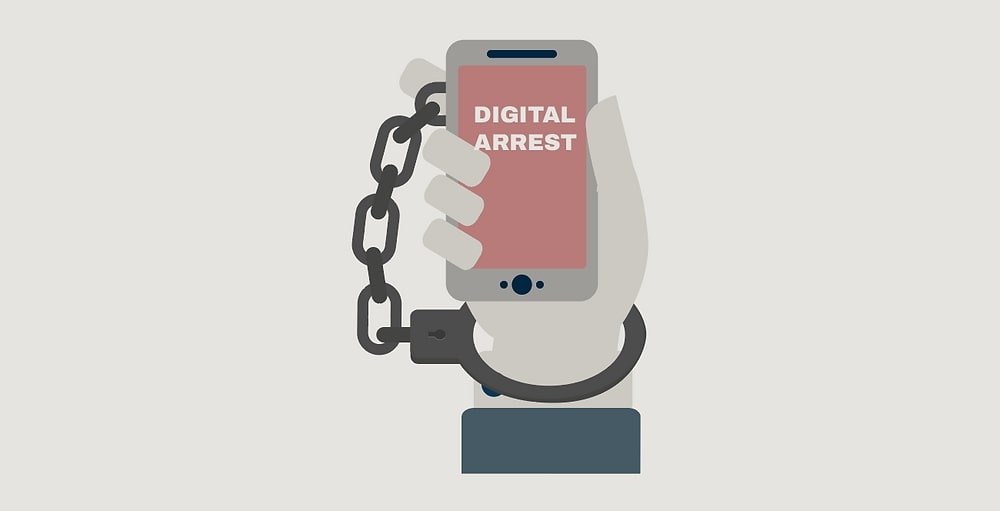
Cybercrime in India has crossed a critical threshold. What once appeared to be scattered incidents of online fraud has now evolved into a systemic, transnational threat undermining public trust, financial security and institutional credibility. As 2025 draws to a close, so-called “digital arrest” scams—a crime with no legal basis—have emerged as one of the most dangerous manifestations of this crisis.
In one of the most disturbing cases this year, a doctor in Gujarat was allegedly kept under continuous video surveillance for nearly three months and coerced into transferring ₹19 crore to fraudsters posing as law enforcement officials. Earlier, a retired Inspector General of Police from Punjab reportedly lost over ₹8 crore in an investment-linked cyber fraud; the psychological trauma is said to have driven him to shoot himself. These incidents have pushed digital arrest scams into the realm of psychological captivity, not merely financial crime.
Exploding Numbers, Escalating Risk
Data from the National Cyber Crime Reporting Portal (NCRP) illustrates the scale of the problem. In 2024 alone, India recorded 23 lakh cybercrime complaints, a 42% rise over the previous year. Even more alarming is the financial damage: losses are estimated at ₹23,000 crore, marking a 200% jump from ₹7,500 crore in 2023.
It is against this backdrop that the Supreme Court of India recently directed the Central Bureau of Investigation (CBI) to carry out a nationwide probe into digital arrest scams. Legal and cyber-security experts say the move was inevitable, given the sheer scale and complexity of these crimes.
Why State Policing Fell Short
A senior cybercrime officer in Delhi summed up the core challenge: “In digital arrest cases, the victim, the perpetrator and the money are rarely in the same location. This is an inter-state and international crime ecosystem that no single state police force can dismantle on its own.”
Funds extracted from victims are rapidly funnelled through mule bank accounts spread across multiple states. Money lost in Delhi, Gurugram or Bengaluru can reach accounts in West Bengal, Uttarakhand or Gujarat within hours, before being laundered abroad. By the time investigators reconstruct the transaction trail, the funds have often vanished into overseas networks.
FCRF: A Warning on Organised Digital Crime
The Future Crime Research Foundation (FCRF) has cautioned that digital arrest scams are no longer isolated frauds. In its recent assessment, the foundation described them as part of highly organised, transnational digital syndicates.
According to FCRF, cybercrime networks targeting India are increasingly linked to human trafficking operations, cryptocurrency laundering channels and fake call-centre ecosystems. Without centrally coordinated action, the foundation warns, cyber fraud volumes could rise by 30–40% over the next few years.
‘This Is the Murder of Trust’
Former IPS officer and noted cybercrime expert Triveni Singh believes digital arrest scams represent a fundamentally new category of crime.
“This is not a crime of technology; it is a crime of trust and terror,” Singh says. “Fraudsters weaponise the authority of uniforms, law and fear so effectively that even educated, senior and influential people collapse psychologically. Until citizens internalise that no law enforcement agency conducts arrests over video calls, this crime will continue unchecked.”
Singh also warns that the next phase could be even more dangerous, with AI-powered deepfake videos, voice cloning and synthetic identities making such scams harder to detect and dismantle.
From Domestic Hotspots to Global Syndicates
Within India, regions such as Jamtara in Jharkhand and the Bharatpur–Mathura–Nuh belt across Rajasthan, Uttar Pradesh and Haryana have long been associated with cyber fraud. However, enforcement agencies now see a far greater threat in Southeast Asia-based cybercrime syndicates.
Countries including Cambodia, Laos, Myanmar and Vietnam host industrial-scale scam compounds operating like call centres. Indian youths trafficked on the promise of overseas jobs are often coerced into defrauding their own countrymen. Investigators say Chinese criminal syndicates frequently provide the technical backbone—apps, VoIP systems and encrypted platforms.
Government’s Counter-Offensive: Technology vs Technology
The government has intensified its response through the Indian Cyber Crime Coordination Centre (I4C). Its Citizen Financial Cyber Fraud Reporting System has helped freeze ₹7,130 crore so far.
With support from NPCI, banks and UPI platforms now have enhanced real-time transaction blocking mechanisms. Authorities have blocked more than 11 lakh SIM cards and 3 lakh IMEI numbers linked to fraud. Tools such as Suspect Registry and Pratibimb are being used to digitally map criminal networks.
Why CBI Is Central to the Fight
CBI’s comparative advantage lies in its national mandate and international reach. Through Operation Chakra, the Bharatpol portal, and its role as India’s National Central Bureau for Interpol, the agency can coordinate directly with bodies such as the FBI and Europol.
Crucially, Section 75 of the IT Act grants CBI extraterritorial jurisdiction, enabling it to investigate any individual—regardless of nationality—whose digital actions impact systems in India.
The Road Ahead
India’s battle against digital arrest scams is no longer a state-versus-criminal contest. It has become a nation-versus-global cyber syndicates confrontation.
Experts from FCRF and Triveni Singh agree that only a CBI-led, centrally coordinated, technology-driven and internationally networked strategy can dismantle this digital hydra—before it inflicts even deeper economic and psychological damage on Indian society.
