

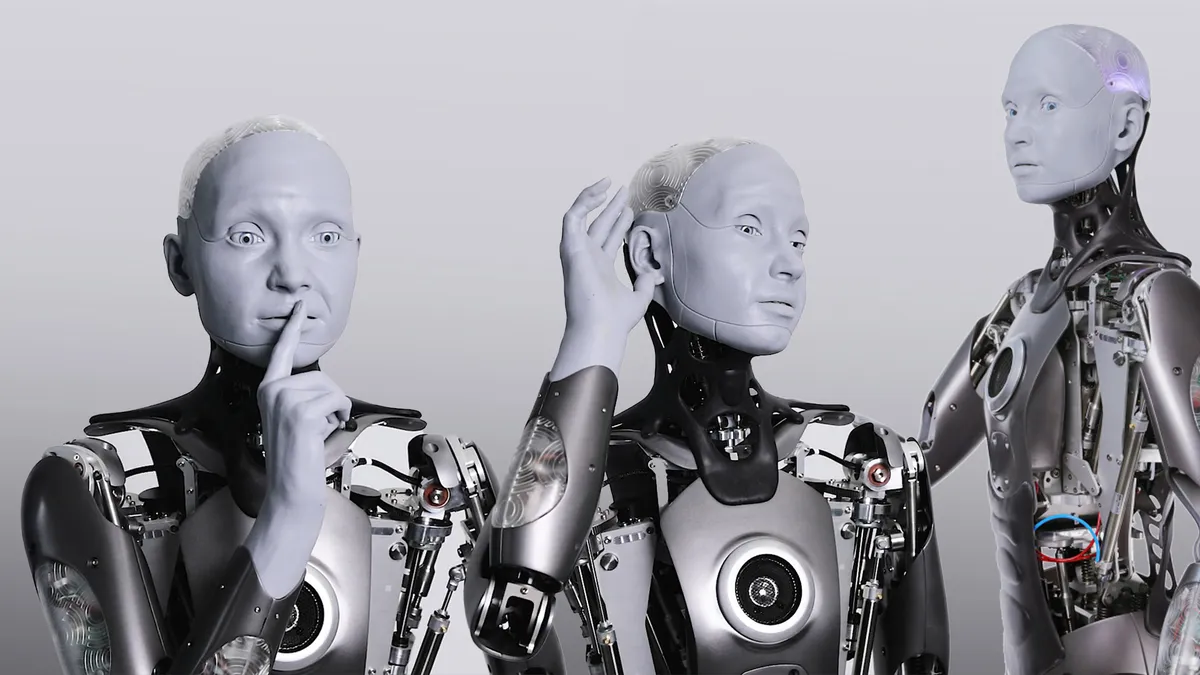

American schools are putting humanoid robots in classrooms. The investment is real. The results are not yet proven.
A charter school network in San Diego has invested $500,000 in two ChatGPT-powered humanoid robots as part of a pilot project to explore how artificial intelligence could be used in education. The main attraction is Ameca — a 6-foot-2 robot with a gray silicone face, blinking blue eyes, a transparent skull glowing with purple lights and exposed motors that move as it smiles, frowns and scans the room.
Officials at Altus Schools, which serves students working to recover credits and get back on track toward graduation, described Ameca as the world’s most advanced AI-powered humanoid robot. The school plans to place the robots at its in-person resource centres, where students already receive one-on-one academic support.
In an email to families, Altus dean of academic studies Cathryn Rambo described the project as an innovative opportunity for students to take part in a research-based learning experience. She added that the school is thrilled to be the first in the world to research the use of physical AI as a teaching partner.
Ameca can take on four different roles or personas: Sage the Teacher, Remi the Wellness Coach, Ari the College and Career Planner and Lexi the Translator.
New York’s Parallel Pilot
Separately, Realbotix has launched Optio, its AI-powered teacher’s assistant, at Salamanca City Central School District on the Seneca Nation Reservation in New York. The district is also deploying a Realbotix M-Series humanoid robot alongside the software to encourage interactive classroom learning. The pilot currently supports high school students in Woz ED AI and Robotics courses, a programme founded by Apple co-founder Steve Wozniak, and is expected to expand to approximately 500 students by fall 2026.
Optio allows students to interact with personalised AI avatars trained on district curriculum, offering concept revision, one-on-one tutoring and round-the-clock homework assistance in multiple languages.
“We are moving beyond lab demonstrations to deliver real, embodied AI directly into classrooms,” said Andrew Kiguel, CEO of Realbotix.
What The Experts Say
Not everyone is convinced the technology is ready for classrooms.
Wayne Holmes, a professor of critical studies of artificial intelligence and education at University College London, said there is no independent evidence at scale showing that the use of these tools is effective, safe or has a positive impact in classrooms. He added that there is increasing evidence suggesting the opposite.
The concern extends beyond academic performance. Even OpenAI, the company behind ChatGPT, has not fully solved the challenge of making AI chatbots safe for children — a significant caveat for schools deploying ChatGPT-powered physical robots in front of vulnerable students.
Privacy is another open question. Humanoid robots equipped with cameras, microphones and AI systems collect student data including facial expressions, voice recordings and behavioural patterns. Schools are responsible for ensuring compliance with privacy laws, but the regulatory framework for classroom robots remains underdeveloped.
A $500,000 Experiment With No Proven Playbook
The two pilots reflect a broader tension in education technology adoption. School officials describe the deployments as steps toward the future of learning. Critics question whether expensive, unproven experiments belong in classrooms serving students who are already behind.
The educational robots market is projected to reach $2.3 billion in 2026, growing to $4.3 billion by 2031. Capital is flowing fast. Independent evidence is lagging behind.
Whether Ameca in San Diego and Optio in New York deliver measurable benefits for students will shape how quickly the rest of the country follows.
Follow for daily updates on cybercrime, corporate fraud, DFIR, hacking, investigations, and digital forensics
