

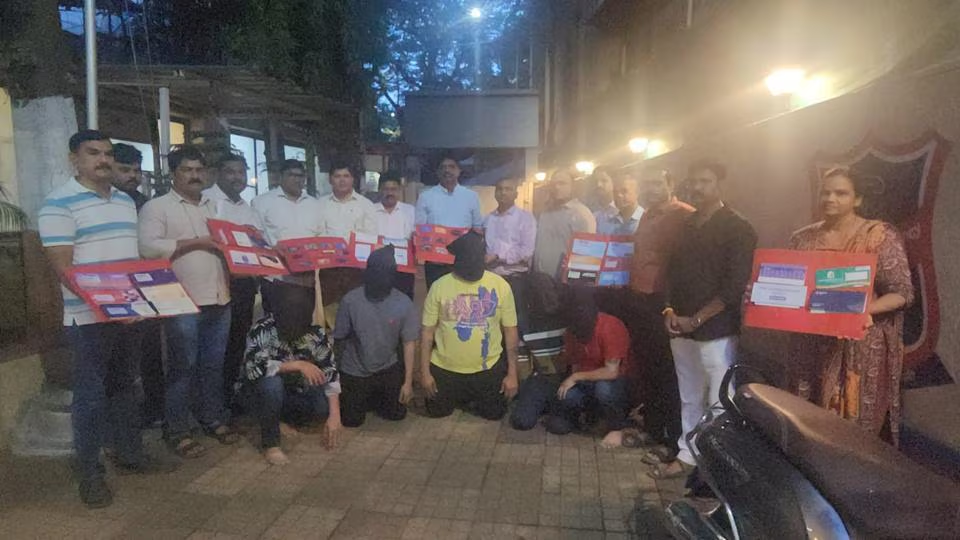

A routine raid on an illegal online betting and gaming operation in Ulhasnagar has led Thane Police to a far larger financial trail, with investigators now examining links between five arrested men and cyber fraud proceeds exceeding ₹58 crore. The Badlapur unit of the Thane Crime Branch has identified around 150 bank accounts connected to the accused, of which 97 have reportedly already surfaced in complaints registered on the national Cyber Crime Portal.
What began as a straightforward enforcement action against illegal gambling has evolved into an investigation with implications well beyond Maharashtra, as police say the suspected accounts and transactions carry links to cyber fraud cases reported in Delhi, Punjab and Odisha. The case illustrates a pattern that has become increasingly familiar to Indian law enforcement, in which illegal betting operations double as fronts or parallel channels for far larger organised financial crime.
From a Gaming Den Raid to a Banking Trail
The investigation began after police received information about an illegal online gaming and betting operation running out of a premises in Ulhasnagar. A raid conducted on July 31 led to the arrest of two individuals, alongside the seizure of three laptops, 21 mobile phones, 23 SIM cards, 155 ATM cards, 105 bank passbooks and ₹74,000 in cash, an inventory that immediately suggested the operation extended well beyond simple betting.
Questioning the initial suspects and examining the seized devices allegedly revealed a substantially wider network of bank accounts and suspicious financial transactions than police had anticipated. That discovery led to three further arrests, and investigators now believe the roughly 150 bank accounts linked to the five men functioned as a mule account network for a larger cybercrime syndicate operating well beyond the original Ulhasnagar premises.
A Familiar Structure: Deposits In, Cash Out Through ATMs
According to investigators, money was regularly deposited into the linked accounts before being withdrawn through ATM kiosks, a pattern consistent with how mule account networks typically operate across India’s cyber fraud landscape. Police suspect the five arrested men functioned as lower-level operators rather than principal figures behind the syndicate, providing or managing bank accounts and withdrawing cash on behalf of others directing the operation from elsewhere.
This structure, in which those actually handling the money at the ground level rarely control the fraud itself, has become a defining feature of organised cybercrime in India. Enforcement Directorate investigations into similar cases, including the probe into the Parimatch betting platform, have documented how illegal betting operations frequently launder funds by collecting deposits from duped users into mule accounts before layering the money through multiple payment aggregators and money transfer agents to obscure its origin.
Illegal Betting’s Uneasy Coexistence With Organised Fraud
The Ulhasnagar case arrives amid a sustained national crackdown on illegal online betting and gambling platforms following the Promotion and Regulation of Online Gaming Act, which came into force in October 2025 and banned all real-money gaming, betting and gambling activity nationwide. Government sources say the crackdown has already resulted in the blocking of nearly 8,400 illegal betting websites and applications, alongside the flagging of roughly 32 lakh mule accounts linked to financial fraud more broadly, underscoring the sheer scale of the infrastructure supporting these parallel economies.
What makes cases like Ulhasnagar’s significant is the demonstrated overlap between illegal betting operations and broader cyber fraud networks, where the same bank accounts, SIM cards and physical infrastructure used to run gambling operations are simultaneously repurposed to process stolen funds from unrelated victims elsewhere in the country. Investigators are now working to determine whether the betting operation itself was a genuine, if illegal, business, or primarily a cover designed to justify the unusual transaction volumes flowing through the linked accounts.
Piecing Together a Four-State Money Trail
Police are examining the complete transaction history of all 150 identified accounts to establish the origin of the funds, how money moved between accounts, and who ultimately withdrew or received the proceeds. The seized laptops, mobile phones and SIM cards are expected to yield communication records that could establish links to other members of the suspected syndicate, while the 155 ATM cards and 105 passbooks are being cross-referenced against account ownership records to map the network’s full extent.
The five arrested accused have been remanded to judicial custody, and police say the investigation will continue to focus on identifying who arranged the accounts, who issued withdrawal instructions, and where the physical cash was ultimately delivered once withdrawn.
Follow for daily updates on cybercrime, corporate fraud, DFIR, hacking, investigations, and digital forensics
