

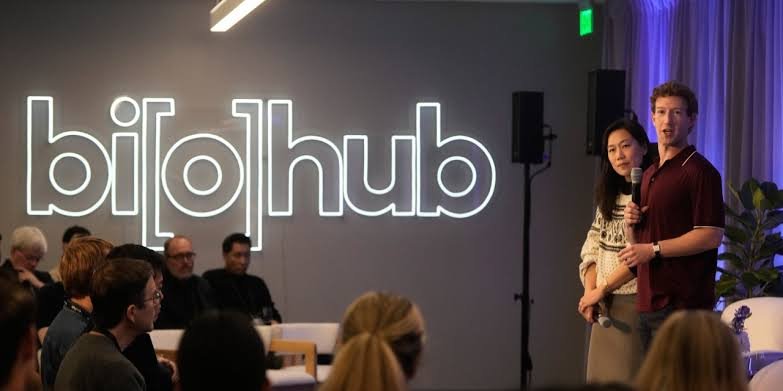

The US government, Google and Meta are joining a $1.8 billion initiative backed by Mark Zuckerberg and Priscilla Chan to build massive biological datasets for training artificial intelligence systems.
The project, called the Virtual Biology Initiative, is being coordinated by Biohub and aims to create AI models capable of predicting how cells respond to disease, drugs and environmental changes.
The long-term goal is to make biology more predictable and shorten the time needed to discover and test new medicines.
FCRF Launches CP-FRM to Build India’s Next Generation of Fraud Risk Professionals
$1.8 Billion Comes From Multiple Partners
The $1.8 billion figure is not a single cheque from one organisation.
Biohub had already committed $500 million to the initiative.
The US Department of Energy is expected to contribute more than $500 million over five years, while the National Institutes of Health will coordinate another $500 million in federal funding.
Meta, Google DeepMind and Isomorphic Labs are contributing another $300 million in funding, computing resources, data and measurement technologies.
Together, those commitments bring the overall initiative to roughly $1.8 billion.
The Goal Is to Build AI Models of Living Cells
Modern AI systems improve when they are trained on large, structured datasets.
Biology has historically lacked datasets on the scale available in areas such as text, images or internet search.
Biohub wants to change that.
Researchers plan to generate large quantities of biological data showing how cells behave under different conditions.
That could include how cells respond to drugs, genetic changes, environmental stress or disease.
The data would then be used to train AI models that try to predict biological outcomes before scientists perform every experiment physically.
Biohub Wants to Compress Decades of Research Into Five Years
Biohub says the project is designed to dramatically speed up biological research.
Its ambition is to accomplish in around five years work that might otherwise take decades.
The first major dataset is expected within roughly one year.
Biohub hopes that functional predictive models of biological systems could be available within five years.
That is an ambitious target.
The challenge is that biological systems are far more complex and less predictable than text or images.
AI models will therefore need extremely large and carefully measured datasets before their predictions can be trusted.
AI Could Help Drug Developers Fail Earlier
Drug development is expensive partly because many promising compounds fail late in the process.
Scientists may spend years testing a potential therapy before discovering that it does not work or causes unacceptable side effects.
AI models trained on detailed biological data could help researchers identify weak candidates earlier.
That could allow pharmaceutical companies to focus money and clinical resources on drugs with a higher probability of success.
The initiative is therefore not only about understanding biology.
It could directly affect how medicines are discovered and developed.
Google DeepMind and Isomorphic Labs Join the Project
Google DeepMind is already one of the best-known companies applying AI to biology.
Its AlphaFold system transformed protein-structure prediction by showing that AI could solve a scientific problem that had resisted researchers for decades.
Isomorphic Labs, another Alphabet-owned company, is focused specifically on AI-driven drug discovery.
Both are now participating in the Biohub initiative.
Their involvement adds advanced AI-model development to Biohub’s experimental biology infrastructure.
The project is therefore designed to connect laboratory measurements with large-scale AI training rather than treating them as separate research efforts.
Meta Is Also Contributing
Meta is another partner in the initiative.
The company has invested heavily in AI research and open model development.
Its involvement is especially notable because Biohub was originally founded by Meta CEO Mark Zuckerberg and his wife, physician and philanthropist Priscilla Chan.
The new initiative expands that philanthropic project into a much broader collaboration involving government agencies and rival technology companies.
US Government Becomes a Major Participant
The federal government’s role is substantial.
The Department of Energy plans to contribute more than $500 million over five years.
The department operates some of the world’s most powerful supercomputers and national laboratories.
Those computing resources could be particularly valuable for training large biological AI models.
The National Institutes of Health will also coordinate an additional $500 million in federal support.
That means the project combines private-sector AI expertise with government-funded scientific infrastructure.
Data Will Eventually Be Open
Biohub says the datasets generated through the initiative will ultimately be made publicly available.
That could allow universities, startups and researchers around the world to train their own models or test new biological hypotheses.
However, Reuters reported that funding partners may receive an initial period of exclusive access before the data becomes fully open.
That arrangement may become important as the project develops.
Open scientific data can accelerate research, but temporary privileged access could still create advantages for companies involved in the partnership.
The Project Will Use Advanced Measurement Tools
The initiative will rely on methods capable of collecting biological information at extremely high resolution.
One example is spatial transcriptomics.
This technique allows researchers to examine which genes are active in individual cells while still preserving information about where those cells are located inside tissue.
The project will also study how cells respond to environmental conditions and other biological changes.
These experiments can generate enormous datasets.
That is precisely the kind of information modern AI systems require.
AI Biology Is Becoming a Major Research Race
Biohub is not alone.
Technology companies and AI labs are increasingly trying to build models that can predict biological behaviour.
OpenAI and Anthropic are also exploring scientific applications for advanced AI systems.
Meanwhile, companies focused specifically on computational biology are attempting to model drug trials, proteins and cellular responses.
The race reflects a broader shift in AI.
After years of focusing on language, images and software code, researchers increasingly see biology as one of the next major areas where large models could have economic and scientific impact.
The Hard Part Is Reliable Prediction
AI can generate impressive biological predictions, but medicine requires a much higher standard than a chatbot response.
A model that produces an incorrect sentence may be inconvenient.
A model that incorrectly predicts how a drug affects a human cell could waste millions of dollars or contribute to unsafe decisions.
That means the Biohub initiative will need to prove that its models are accurate, reproducible and useful in real laboratory settings.
The goal is not simply to produce a model that sounds scientifically convincing.
It must make predictions that experiments can verify.
AI Will Not Replace Human Trials
Even if the project succeeds, biological AI models will not eliminate the need for laboratory research or clinical trials.
Predictions still need to be tested.
Human biology also involves variables that may not be captured completely in laboratory datasets.
The value of AI is more likely to be in narrowing possibilities and helping researchers choose better experiments.
That could make drug discovery faster and cheaper without removing the need for scientific validation.
AI Infrastructure Is Moving Into Life Sciences
The $1.8 billion initiative also shows how the AI investment boom is spreading beyond conventional technology companies.
Much of the current spending around AI has focused on data centres, GPUs and software models.
Biology requires another layer.
It needs laboratories capable of generating the physical data that AI systems can learn from.
That makes the project a combination of computing infrastructure and scientific infrastructure.
What this means for you
The next major breakthrough from AI may come from predicting how living cells behave rather than generating text or images. If Biohub’s approach works, AI could help scientists identify promising drugs and biological targets earlier, but those predictions will still need rigorous laboratory and clinical validation.
Follow for daily updates on cybercrime, corporate fraud, DFIR, hacking, investigations, and digital forensics
