

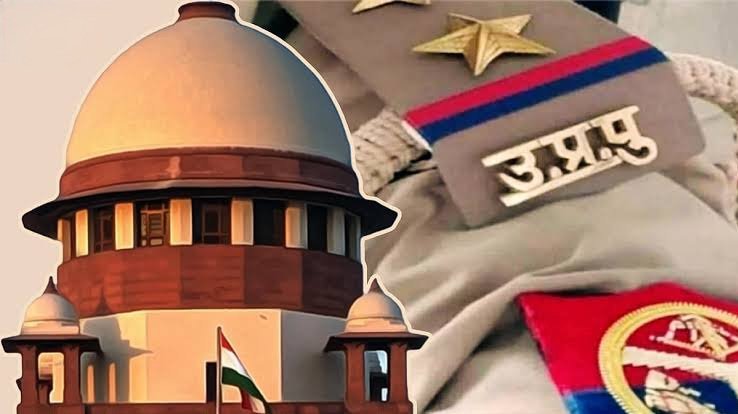

The Supreme Court has sharply questioned the functioning of the Uttar Pradesh Police after an accused in a Bulandshahr molestation case was allegedly apprehended at the spot but still listed as “unknown” in the First Information Report. A bench comprising Justice Sanjay Kumar and Justice Sanjeev Sachdeva, hearing a petition seeking the cancellation of the accused’s anticipatory bail, raised serious concerns over public trust in law enforcement. Taking strong exception to the omission, the bench remarked that it might be forced to consider disbanding the state police force if such practices continue, while also raising the possibility of transferring criminal investigations in Uttar Pradesh to the Central Bureau of Investigation.
Severe criticism over listing known accused as unknown
The matter arose from an incident in Bulandshahr where a woman alleged she was molested. After the accused obtained anticipatory bail, the complainant approached the top court directly to seek its cancellation. Appearing in person, she submitted that the accused had been caught at the scene immediately after the incident. Despite his immediate apprehension and known identity, the police registered the initial complaint against an unidentified individual. The bench observed that while procedural compliance is standard, attempting to shield or conceal conduct during the registration of an FIR cannot be accepted, stressing that facts recorded at the initial stage of an investigation must be treated with gravity.
Scrutiny surrounding late addition of name to police report
The petitioner also highlighted concerns regarding the subsequent addition of the accused’s name to the police records at a later stage of the proceedings. The judges questioned how the name could be missing initially if the accused was already secured on the spot, noting that such lapses directly undermine public confidence in the integrity of criminal investigations. The bench pointed out that listing an identified and apprehended suspect as unknown raises troubling questions about the conduct of the investigating officers and the transparency of the entire process.
State government directed to explain lapses in fresh affidavit
Directing the Uttar Pradesh government to submit a comprehensive fresh affidavit, the Supreme Court demanded a clear explanation of the circumstances under which the FIR was drafted without naming the suspect. The state must provide an account of the sequence of events and clarify why the police failed to record the identity of an accused who was allegedly in custody at the scene. The matter will be taken up for further hearing once the state files its response addressing these procedural lapses.
Follow for daily updates on cybercrime, corporate fraud, DFIR, hacking, investigations, and digital forensics
