

New Delhi, October 1, 2026: Marking Cybersecurity Awareness Month 2026, the Centre for Police Technology (CPT) has launched a month-long “31 Days | 31 Key Topics” knowledge initiative, focusing on AI-powered cybersecurity, computer forensics, technology law, cybercrime investigation and emerging digital threats.
October is internationally observed as Cybersecurity Awareness Month, while in India, CERT-In also observes October each year as National Cyber Security Awareness Month to promote awareness and technical capacity among stakeholders.
The CPT initiative is designed especially for Police and Law Enforcement Agencies (LEAs), cybercrime investigators, forensic professionals, corporate investigators, cybersecurity teams, fraud-risk professionals, lawyers, compliance professionals, researchers and students. Each day throughout October, CPT will spotlight one contemporary subject through knowledge content intended to connect technology with investigation and practical security.
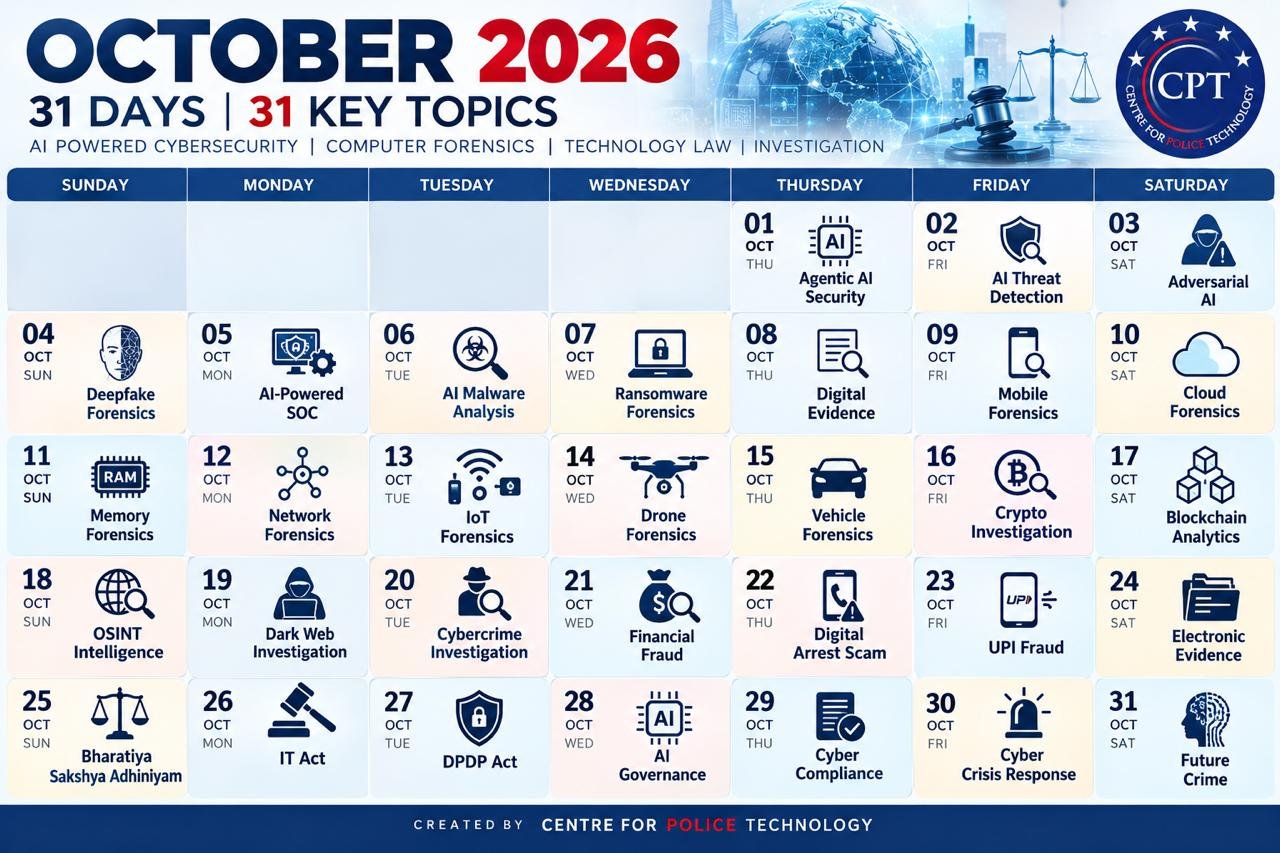
CPT’s 31 Days — 31 Knowledge Topics
- 1. Oct 1 – Agentic AI Security: Understanding autonomous AI agents, emerging attack surfaces, permissions, manipulation risks and security controls required for increasingly agent-driven digital environments.
- 2. Oct 2 – AI Threat Detection: Exploring how machine learning and AI can identify anomalies, malicious behaviour, suspicious activity and evolving cyber threats at greater speed.
- 3. Oct 3 – Adversarial AI: Examining attacks designed to deceive, manipulate or compromise AI models through adversarial inputs, poisoning, prompt manipulation and model exploitation.
- 4. Oct 4 – Deepfake Forensics: Understanding techniques for detecting manipulated video, cloned voices, synthetic images and AI-generated evidence increasingly encountered during criminal and fraud investigations.
- 5. Oct 5 – AI-Powered SOC: Exploring how AI strengthens Security Operations Centres through alert prioritisation, automated investigation, threat correlation, detection engineering and incident-response assistance.
- 6. Oct 6 – AI Malware Analysis: Examining AI-assisted techniques for identifying malicious code, behavioural patterns, malware families, suspicious binaries and previously unknown attack characteristics.
- 7. Oct 7 – Ransomware Forensics: Understanding forensic reconstruction of ransomware incidents, intrusion pathways, encryption activity, attacker persistence, data exfiltration and evidence required for investigation.
- 8. Oct 8 – Digital Evidence: Focusing on identification, acquisition, preservation, authentication and presentation of electronic evidence while maintaining integrity and defensible chain of custody.
- 9. Oct 9 – Mobile Forensics: Exploring extraction and examination of smartphones, applications, communications, location artefacts, deleted information and other mobile evidence relevant to investigations.
- 10. Oct 10 – Cloud Forensics: Understanding evidence acquisition and investigation across cloud infrastructure, virtual systems, logs, applications and distributed environments where traditional forensic boundaries disappear.
- 11. Oct 11 – Memory Forensics: Examining volatile RAM for processes, malware, credentials, network connections, encryption artefacts and other evidence that may never reach permanent storage.
- 12. Oct 12 – Network Forensics: Analysing network traffic, logs, sessions, protocols and communication patterns to reconstruct cyberattacks and identify suspicious infrastructure and attacker activity.
- 13. Oct 13 – IoT Forensics: Investigating connected devices, sensors, wearables and smart systems to discover digital traces capable of establishing activities, communications and timelines.
- 14. Oct 14 – Drone Forensics: Recovering flight records, coordinates, media, controller information and associated digital artefacts from unmanned aerial systems relevant to criminal investigations.
- 15. Oct 15 – Vehicle Forensics: Examining connected vehicles, infotainment systems, navigation information, event records and onboard digital systems as increasingly valuable sources of electronic evidence.
- 16. Oct 16 – Crypto Investigation: Tracing cryptocurrency transactions, identifying wallet relationships and combining blockchain evidence with investigative intelligence to examine fraud and financial crime.
- 17. Oct 17 – Blockchain Analytics: Using transaction graphs, clustering and attribution techniques to understand movement of digital assets across addresses, services and blockchain ecosystems.
- 18. Oct 18 – OSINT Intelligence: Transforming legally accessible open-source information into actionable intelligence through systematic collection, verification, correlation, preservation and analytical investigation techniques.
- 19. Oct 19 – Dark Web Investigation: Understanding dark-web ecosystems, marketplaces, threat actors and investigative methodologies while preserving evidence and maintaining appropriate operational security.
- 20. Oct 20 – Cybercrime Investigation: Integrating digital evidence, intelligence, financial trails, device examination, network records and legal processes into structured technology-enabled criminal investigations.
- 21. Oct 21 – Financial Fraud: Examining technology-enabled fraud, account compromise, social engineering, mule networks and transaction patterns through cyber, forensic and financial-investigation perspectives.
- 22. Oct 22 – Digital Arrest Scam: Understanding impersonation-driven cyber fraud in which criminals create fear and fabricated legal scenarios to manipulate victims into transferring money.
- 23. Oct 23 – UPI Fraud: Examining social engineering, malicious applications, credential theft and payment manipulation affecting India’s rapidly expanding instant digital-payment ecosystem.
- 24. Oct 24 – Electronic Evidence: Understanding collection, preservation, authenticity, admissibility and courtroom presentation of electronic records within contemporary investigation and judicial processes.
- 25. Oct 25 – Bharatiya Sakshya Adhiniyam: Examining India’s evidence framework with particular emphasis on electronic and digital records and their significance for technology-enabled investigations.
- 26. Oct 26 – IT Act: Revisiting India’s foundational cyber-law framework governing electronic transactions, cyber offences, intermediary issues and important aspects of the digital ecosystem.
- 27. Oct 27 – DPDP Act: Understanding India’s personal-data protection framework, organisational responsibilities and its growing relevance to cybersecurity, investigations, governance and privacy compliance.
- 28. Oct 28 – AI Governance: Exploring accountability, transparency, security, risk management and responsible oversight required as artificial intelligence becomes embedded within critical decision-making systems.
- 29. Oct 29 – Cyber Compliance: Connecting cybersecurity controls with regulatory obligations, governance, audits, risk assessment, incident reporting and organisational accountability across regulated sectors.
- 30. Oct 30 – Cyber Crisis Response: Understanding preparedness, incident command, containment, investigation, communication, recovery and coordination needed when organisations confront major cyber incidents.
- 31. Oct 31 – Future Crime: Looking beyond today’s threats toward Agentic AI, autonomous attacks, quantum technologies, synthetic identities and other technologies capable of reshaping future crime.
From Awareness to Investigative Capability
The month-long programme goes beyond conventional cyber hygiene. Cybersecurity Awareness Month traditionally promotes practical measures such as stronger passwords, multifactor authentication, phishing awareness and timely software updates. CPT’s initiative extends that conversation into the professional domains of AI security, digital forensics, financial fraud, electronic evidence, technology law and cyber investigation.
Through this 31-day knowledge series, the Centre for Police Technology aims to encourage continuous learning and closer understanding between technology, policing, investigation, law, forensics and corporate cyber-risk management.
31 Days. 31 Topics. One Mission: Building Knowledge for a Safer Digital Future.
Created by: Centre for Police Technology (CPT)
Follow for daily updates on cybercrime, corporate fraud, DFIR, hacking, investigations, and digital forensics
