
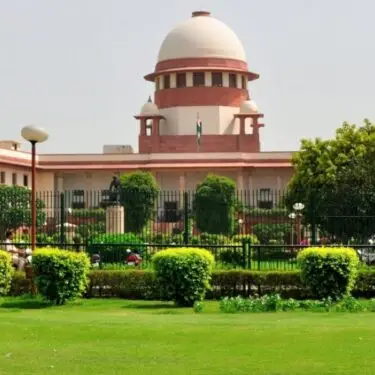
The Supreme Court has cancelled the anticipatory bail of three police officers accused of extorting money and gold from a jeweller. While passing the order, the apex court strongly condemned the misuse of official power, noting that when law enforcers turn into extortionists, ordinary citizens are left in deep dilemma. The court added that confronting the police under such circumstances risks immediate retaliation, leaving citizens with little choice but to silently submit to officers in uniform, even when subjected to clear misconduct.
Station Detention and Forced Gold Transactions
The underlying case involves a father, his minor daughter, and his brother-in-law who were travelling from Mumbai when they were detained by police personnel at a railway station. During a search of their luggage, officers recovered a 14-gram gold bar and ₹31,900 in cash. The family was then taken to a nearby room where they were allegedly forced to hand over cash in exchange for the gold bar. Following the incident, the father filed a First Information Report (FIR), after which a sessions court dismissed the anticipatory bail pleas of the involved officers.
The Bombay High Court subsequently overturned that decision and granted them relief during the investigation. The High Court based its decision on station CCTV footage, noting that the officers were wearing their identification tags, the father and daughter showed no visible signs of distress, and there was a delay in lodging the FIR.
Registration Begins for FutureCrime Summit 2026, India’s Largest Cybercrime Conference
Officers Led Victims to Unmonitored Room
The Maharashtra government challenged the High Court’s ruling by filing a Special Leave Petition in the Supreme Court. Representing the state, advocate Bharat Bagla argued that while standard guidelines mandate full video recording during search and seizure procedures, the accused officers intentionally led the father and daughter into a room equipped with no cameras. Bagla told the court that the state does not tolerate such excesses by uniformed officers against citizens, adding that all three officers have been dismissed from service following a proper inquiry.
The Supreme Court accepted the state government’s petition and expressed surprise at the High Court’s interpretation of the CCTV footage. The apex court observed that facial expressions were not clearly discernible in the video. It noted that while the two adults were moving forward, one was continuously gesturing with his hands while the child followed closely behind, which indicated signs of distress.
Return of Seized Property Strengthens Prosecution
The Supreme Court further stated that the time the victims spent inside the closed room provided a sufficient window for the actions described in the complaint to occur, a factor that must be evaluated during the criminal trial.
The court also rejected arguments made by the senior counsel for the accused, who claimed that the return of the gold bar disproved the extortion allegations. The apex court clarified that the act of returning the gold bar does not weaken the case but instead strengthens the prosecution’s claims against the dismissed officers.
