

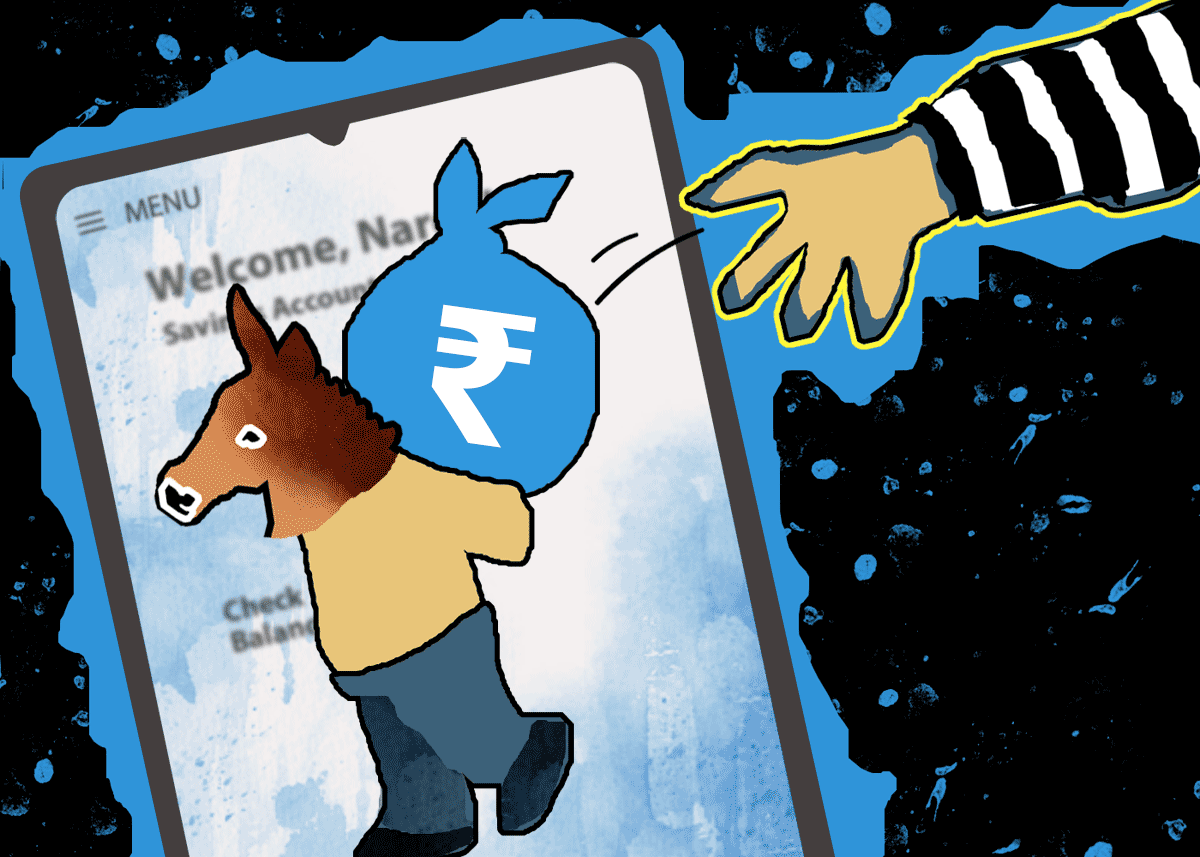

Police in Uttar Pradesh’s Siddharthnagar district have arrested a 20-year-old undergraduate student after investigators traced six bank accounts opened in his name to 17 cyber fraud complaints registered across multiple states, involving suspicious transactions worth nearly ₹22.55 crore. The case, which began as a routine review of flagged accounts, offers a detailed look at how ordinary bank accounts, often belonging to young, financially unremarkable individuals, have become the connective tissue of India’s organised cyber fraud economy.
How the Trail Led to a College Student
The Siddharthnagar cyber cell identified the accused, Nasim Ahmad, after cross-referencing suspicious accounts through the National Cyber Crime Reporting Portal and the Samanvaya Portal, a platform used for inter-state investigative coordination. Investigators initially found one account named in nine separate cyber fraud complaints filed during 2024 and 2025, together involving reported losses of more than ₹15.47 crore. Further scrutiny widened the net considerably, uncovering eight additional complaints tied to three more of Ahmad’s accounts, involving a further ₹7.08 crore in reported fraud.
Notably, police were careful to clarify that the full ₹22.55 crore figure represents the cumulative value of fraud reported across all connected complaints, not money that actually passed through Ahmad’s accounts. Only around ₹14 lakh has so far been identified in the accounts directly linked to him, a distinction that matters both for the accused’s eventual defence and for understanding how mule account networks typically function, as thin pass-through nodes in a much larger laundering chain rather than storage points for stolen funds.
Gaming Platforms as a Layering Tool
During interrogation, Ahmad allegedly told investigators he had received money suspected to be linked to cyber fraud through online gaming platforms, before routing it onward to other accounts to obscure its origin. Investigators found he had opened six accounts across Union Bank, an Urban Cooperative Bank, Punjab National Bank, Axis Bank, State Bank of India and India Post Payments Bank, a spread that itself suggests a deliberate strategy of fragmenting fraud proceeds across institutions to reduce the likelihood of any single bank flagging the pattern.
The use of gaming platforms as a laundering layer reflects a documented national trend. Analysts have noted that real-money gaming platforms process thousands of micro-transactions every minute, making it comparatively easy to disguise illicit fund movement as ordinary gameplay activity, a gap that has pushed India toward bringing such platforms under stricter anti-money laundering oversight.
A Pattern Playing Out Across the Country
Ahmad’s case mirrors a rapidly growing national problem. The Indian Cyber Crime Coordination Centre had already flagged more than 24.7 lakh Layer-1 mule accounts nationally as of early 2026, while a separate fraud-detection report found over five lakh suspected mule accounts and digital payment identities flagged in March 2026 alone. Just last week, a Lucknow operation under the state’s Cy-Vajra crackdown arrested nine young mule account operators, including a law student, a NEET aspirant and food-delivery workers, who had allegedly funnelled stolen funds into cryptocurrency for foreign handlers. Police in Haryana have separately flagged unemployed youth, students and homemakers as the demographic most frequently targeted for recruitment into these networks.
The recruitment pattern is strikingly consistent nationwide: fraudsters approach financially vulnerable individuals, often students, through social media or messaging platforms with promises of easy commissions in exchange for the use of their bank accounts, frequently without the account holder fully grasping the criminal exposure they are taking on.
The Legal Risk of “Just Renting an Account”
Prof. Triveni Singh, a well-known cybercrime expert and former IPS officer, said cybercriminals increasingly rely on mule accounts and gaming platforms specifically because they make it harder for investigators to identify the ultimate beneficiaries of fraud proceeds. He urged the public never to share bank accounts, ATM cards, chequebooks or banking credentials with others in exchange for money, warning that doing so can itself attract criminal liability regardless of whether the account holder personally profited from the underlying fraud.
Police have seized an iPhone, a Vivo smartphone, an HP laptop, four passbooks and five ATM cards from Ahmad, and say forensic examination of the devices is underway to identify further suspects and trace the broader movement of funds, with the investigation continuing to determine whether his role was limited to renting out accounts or extended further into the network.
Follow for daily updates on cybercrime, corporate fraud, DFIR, hacking, investigations, and digital forensics
