
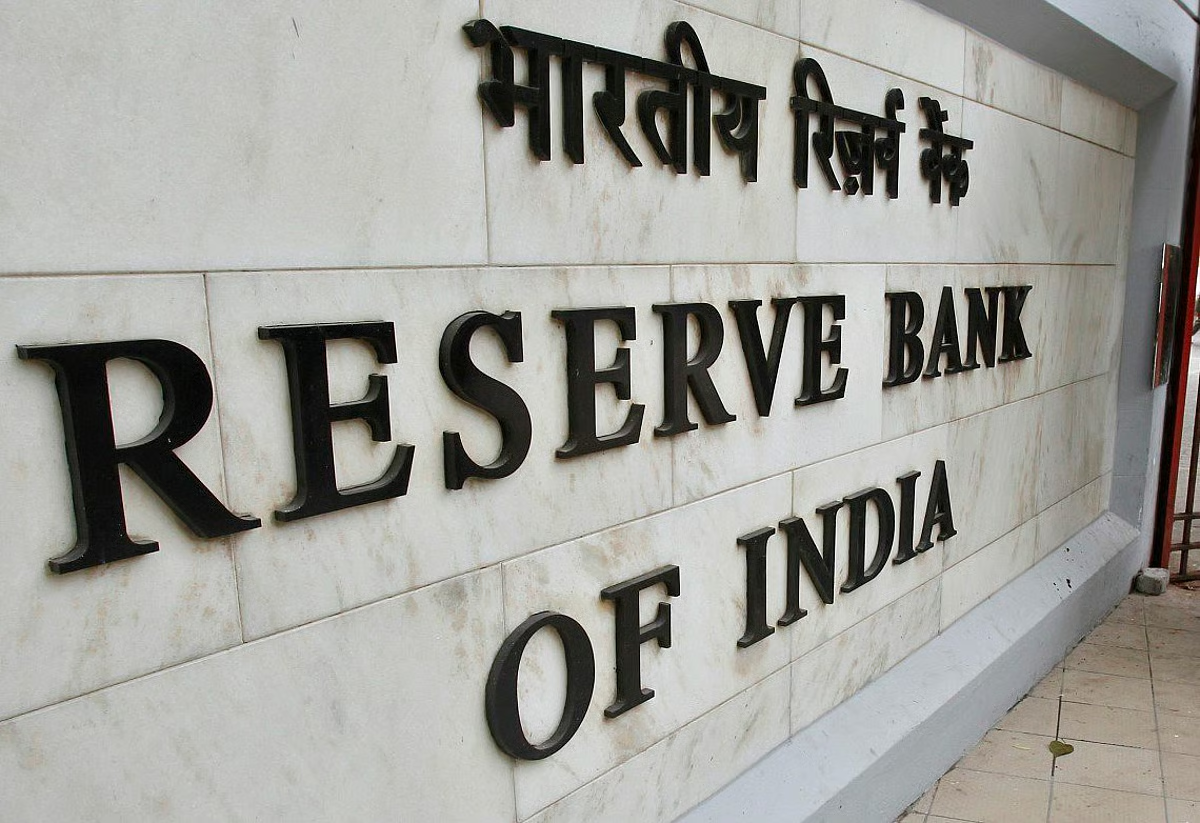

The Reserve Bank of India has intensified its regulatory surveillance over the domestic financial sector by hitting public sector lender Bank of Baroda and non-banking financial company GIC Housing Finance with a combined monetary penalty of 66.7 lakh rupees. Announced on July 3, 2026, the central bank clarified that these enforcement actions are based entirely on structural deficiencies in regulatory compliance discovered during statutory inspections of their financial positions as of March 31, 2025. The banking regulator explicitly noted that the penalties are purely administrative in nature and do not attempt to pronounce upon the validity of any separate commercial transactions or agreements entered into by these companies with their retail consumers.
Bank of Baroda Penalized for Overcharging and KYC Delays
State-run Bank of Baroda incurred the vast majority of the punitive action, drawing a fine of 63.6 lakh rupees. Following a detailed supervisory evaluation, the central bank sustained two primary charges against the major public sector lender. First, the bank was found to have collected interest rates higher than the formally agreed contracted rates across multiple customer loan accounts. This action directly violated the foundational guidelines of the Fair Practices Code for Lenders, which is engineered to ensure total transparency and protect borrowers from arbitrary rate hikes.
Second, Bank of Baroda failed to upload essential customer identification documents to the Central KYC Records Registry within the legally prescribed timelines. This registry acts as a centralized repository of customer data across the entire financial sector, designed to eliminate redundant verification steps across different firms. By failing to sync these records promptly, Bank of Baroda created unnecessary operational friction and slowed down the efficiency of the nationwide cross-institution onboarding network.
GIC Housing Finance Rebuked Over Risk Categorization Lapses
In a parallel enforcement action, the Reserve Bank of India penalized GIC Housing Finance Limited a sum of 3.1 lakh rupees. The penalty followed a detailed inspection of the mortgage lender’s operational books by the National Housing Bank, which subsequently forwarded its findings to the central bank. The evaluation revealed a structural gap in the company’s internal risk management architecture, specifically highlighting a failure to monitor account profiles properly.
The housing finance company failed to implement an internal mechanism for the mandatory periodic review of customer account risk categorizations. Regulatory guidelines mandate that these specific risk reviews must occur at least once every six months to identify unusual financial behaviors or changing risk profiles. For housing finance organizations, assessing these risk tiers is critical to keeping the overall loan book healthy, detecting early signs of defaults, and stopping fraudulent accounts before they damage the institution.
A Broader Wave of Financial Surveillance
This coordinated regulatory sweep reflects a broader enforcement posture adopted by the central bank throughout 2026 to ensure absolute compliance with anti-money laundering rules, fair customer treatment, and rigorous risk tracking. Multiple other banking entities, including YES Bank, Hinduja Housing Finance, and Canara Bank, have faced similar supervisory penalties within recent months. The RBI continues to send a clear signal that operational negligence and deviations from consumer protection codes will face immediate monetary consequences to insulate the domestic financial system from systemic vulnerabilities.
Follow for daily updates on cybercrime, corporate fraud, DFIR, hacking, investigations, and digital forensics
