
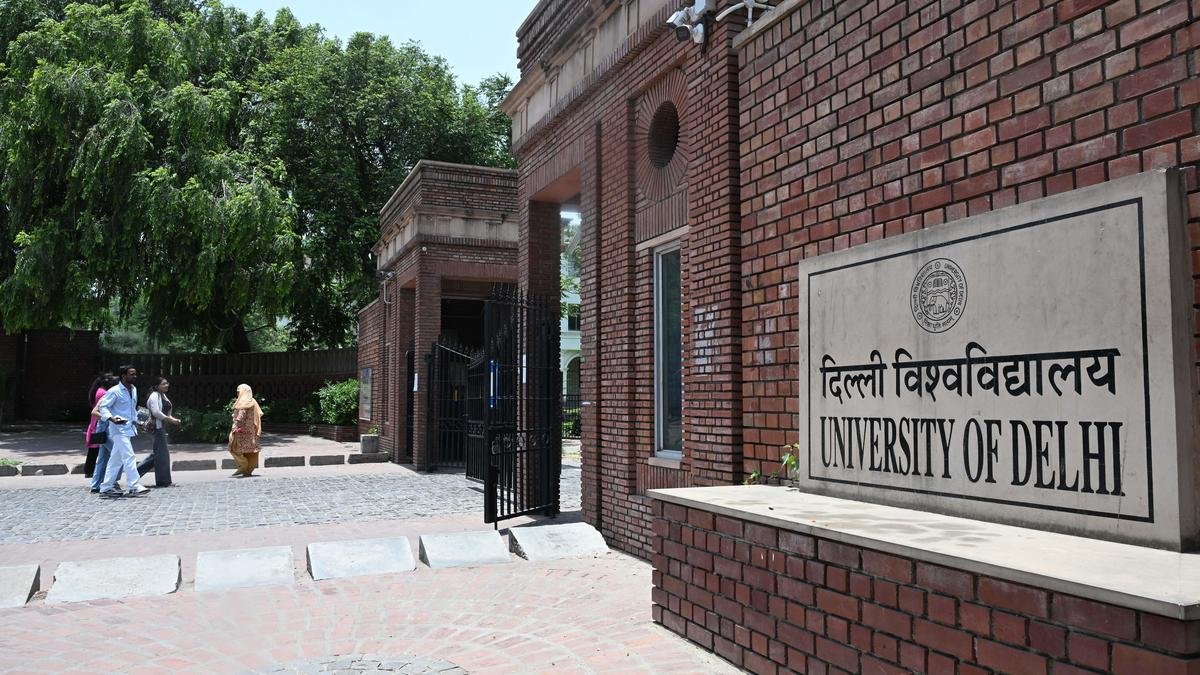

A Delhi court has issued a definitive directive to register a First Information Report (FIR) against three individuals, including two prominent associate professors affiliated with the University of Delhi (DU), following serious allegations of academic fraud, cheating, and forgery. Overturning an initial police report that dismissed the dispute as entirely civil in nature, Judicial Magistrate Gaurav Katariya ruled that the matter revealed a clear prima facie case of criminal intent. The court observed that the systematic fabrication of academic papers and credentials pointed directly to a dishonest and fraudulent state of mind across all three accused parties.
The judicial order, delivered at the Rohini Courts complex, explicitly directs the Station House Officer (SHO) of the Shalimar Bagh Police Station to initialize a comprehensive criminal investigation based on an operational complaint filed back on November 5, 2024. The localized police apparatus has been given a strict 30-day window to file an official compliance report mapping out their initial findings. The primary targets of the judicial order are identified as Sanjeev Kumar, Pramod Kumar (an associate professor at Dyal Singh College), and Luke Khanna (an associate professor at Bharati College).
The Genesis of the Academic Extortion Ring
The legal battle originated from a detailed criminal complaint submitted by Dr. Ankita Kilsen, a former assistant professor who previously taught within the Department of Political Science at Bharati College. According to Kilsen’s formal statement, the orchestrator of the initial interaction was Sanjeev Kumar, who introduced himself to her as a high-ranking Senior Medical Officer stationed at the All India Institute of Medical Sciences (AIIMS). Leveraging his purported institutional status, Kumar introduced Kilsen to the two DU associate professors in 2021, assuring her that their deep connections within the university’s administrative hierarchy would easily secure her a permanent teaching position.
The co-conspirators allegedly convinced Kilsen to pay an upfront sum of ₹1 lakh in cash, which they claimed was strictly necessary to cover journal publication charges, editing protocols, and related academic travel expenses. Furthermore, the accused took physical possession of her original draft research manuscripts under the explicit promise of getting them placed within peer-reviewed, high-impact international journals. Kilsen was subsequently handed photocopies of what appeared to be three successfully published research articles accompanied by formal publication certificates. Believing these documents to be entirely authentic, she included them in her official portfolio when applying for active teaching vacancies.
Institutional Exposure and Retaliatory Demands
The counterfeit nature of the credentials eventually unraveled after Kilsen successfully secured her appointment as an Assistant Professor at Bharati College in November 2023. In August 2024, the administrative board of the college informed her that an independent inquiry launched under the Right to Information (RTI) Act had flag-marked her academic file. The verification process with the listed publishers revealed that the research papers cited in her application were completely fabricated and did not exist in any legitimate academic archive.
Following a formal internal disciplinary inquiry, Bharati College officially terminated Kilsen’s teaching services in October 2024. The crisis intensified shortly after her termination when one of the primary accused reached out to her with a predatory proposition. The individual allegedly demanded a massive extortion payment of ₹25 lakh to “settle” the matter with senior university administrators, promising that the financial exchange would suppress the internal investigation, clear her record, and restore her academic position.
Court Rejection of Civil Claims and Next Steps
When Kilsen originally approached local law enforcement, the police department filed an action taken report that categorized the incident as a straightforward contractual or monetary dispute, advising against criminal intervention. Magistrate Katariya strongly rejected this characterization, emphasizing that the execution of a multi-layered deception campaign requires specialized police tools to uncover. The court noted that crucial elements can only be achieved through a formal state police infrastructure:
“What makes an act criminally liable is the presence of a fraudulent intention behind it. In this case, such an intention appears evident from the very outset. The alleged making of a false document points to a dishonest and fraudulent state of mind on the part of all three accused.”
The court further directed investigators to expand the scope of the probe to determine if the accused were operating an organized, large-scale racket targeting other desperate academic job seekers across the state. However, the court balanced the decree by clarifying that the order to file an FIR does not serve as an automatic mandate for immediate arrest. The investigative team has been instructed to act strictly in line with statutory provisions and the established guidelines laid down by the Supreme Court governing arrest procedures.
Follow for daily updates on cybercrime, corporate fraud, DFIR, hacking, investigations, and digital forensics
