
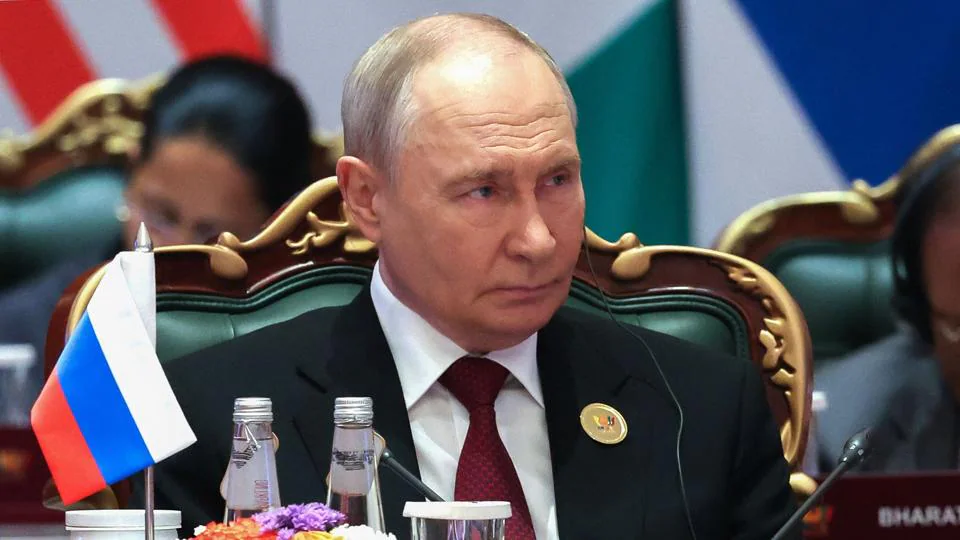

Russian President Vladimir Putin has proposed a joint BRICS grain market and a new insurance mechanism for trade, as Moscow pushes the grouping to build more of its own financial and commercial infrastructure.
Speaking at the BRICS Summit in New Delhi, Putin argued that stronger coordination in agriculture, logistics, payments and insurance could make trade between member countries more stable and less dependent on outside systems.
The proposals are not yet operational.
They are part of a broader Russian attempt to move BRICS from political coordination towards practical economic arrangements that can support trade between members even during periods of sanctions, geopolitical conflict or disruption to traditional financial channels.
Proposal for Conducting Cyber Crisis Drill, Tabletop Exercise (TTEx) & CCMP Readiness Exercise
Putin wants BRICS countries to coordinate a grain market
Agriculture was one of the areas Putin highlighted.
Russia has previously pushed the idea of a BRICS grain exchange or grain-trading platform that could bring together major producers and consumers within the grouping.
The economic logic is straightforward.
Several BRICS countries are major agricultural producers, while others are among the world’s biggest food importers.
A more coordinated market could potentially improve price discovery, long-term supply agreements and settlement between members.
Putin’s latest proposal appears to build on that idea by calling for a collaborative grain market rather than simply leaving agricultural trade to existing international commodity exchanges.
For Russia, there is another strategic benefit.
Much of global commodity pricing and clearing still passes through financial and trading centres outside BRICS.
Creating parallel mechanisms would give member countries more control over how agricultural products are priced, insured and paid for.
Why would BRICS need its own insurance mechanism?
Insurance may sound like a technical side issue, but it is critical to international trade.
A ship carrying grain, oil or fertiliser generally requires insurance before it can enter ports, obtain financing or operate commercially.
The cargo itself also needs protection against risks such as damage, accidents or loss.
For decades, much of global maritime insurance has been concentrated among Western insurers and protection-and-indemnity clubs.
That became politically important after sanctions were imposed on Russia.
Restrictions on insurance and related maritime services complicated Russian exports, particularly in energy and shipping.
A BRICS-backed insurance arrangement could, in theory, provide an alternative source of cover for transactions between member countries.
That would reduce reliance on Western companies.
But creating such a system would be difficult.
Insurance works because buyers trust that the insurer has enough capital to pay very large claims.
A BRICS mechanism would therefore need credible underwriting standards, capital reserves, dispute-resolution rules and recognition from ports, banks and shipping companies across multiple jurisdictions.
India could benefit, but it would have to manage risk carefully
For India, a more efficient BRICS commodity market could have practical advantages.
India is a major importer and exporter of agricultural products and relies heavily on international shipping.
A system that reduced transaction costs or improved access to alternative insurance could help businesses during periods when global trade routes are disrupted.
The country also has substantial trade relationships with several BRICS members.
India and Russia, for example, have been working to expand bilateral trade towards $100 billion by 2030. Their discussions at the summit included energy, fertilisers, infrastructure and other strategic sectors.
But India would have reasons to be cautious.
It maintains deep commercial relationships with Western financial centres and does not necessarily share Russia’s interest in creating systems primarily designed to bypass sanctions.
New Delhi has generally preferred a more flexible approach.
It supports alternative payment and trade mechanisms where they improve efficiency, while avoiding framing BRICS purely as an anti-Western economic bloc.
That same balancing act would likely apply to any insurance system.
The proposal fits a wider BRICS effort to build alternative infrastructure
Putin’s grain and insurance proposals are not appearing in isolation.
BRICS finance ministers and central bank governors are already examining greater interoperability between national payment systems and increased use of local currencies in cross-border trade.
Russia has also argued that the bloc should work more closely on infrastructure, investment and payment mechanisms.
Kremlin spokesperson Dmitry Peskov said ahead of the summit that around 90% of Russia’s trade with BRICS countries was already being conducted in local currencies, while insisting Moscow was not simply pursuing “de-dollarisation”.
China is simultaneously pushing deeper cooperation in artificial intelligence, trade and finance.
President Xi Jinping used the New Delhi summit to advocate a more integrated “Greater BRICS” economic framework and proposed several new cooperation initiatives.
Taken together, these moves show BRICS increasingly trying to create economic tools of its own rather than relying entirely on institutions developed elsewhere.
A grain market is easier to propose than to build
The biggest challenge will be implementation.
BRICS members have very different agricultural policies, currencies, banking systems and geopolitical priorities.
India, Brazil and Russia may all export agricultural commodities, but they also compete with each other in global markets.
Members would need to agree on pricing standards, settlement mechanisms, contract enforcement and regulatory oversight.
The same problem applies to insurance.
A politically supported insurance scheme will have little value unless global shipping companies, banks and ports trust the policies it issues.
That means the proposal will have to prove itself commercially, not just diplomatically.
BRICS itself also remains a diverse grouping.
Its expansion to include countries such as Iran, Egypt, Ethiopia, the UAE and Indonesia has increased its global weight, but it has also made consensus more complicated. Reuters estimates that the bloc now represents more than 40% of the world’s population and nearly a quarter of global GDP.
Putin’s proposal therefore marks the beginning of a negotiation rather than the launch of a new market.
The real test will be whether BRICS can turn political support for alternative trade infrastructure into systems that companies are actually willing to use.
What this means for you: There is no immediate change for consumers or businesses. But if BRICS eventually develops its own commodity-trading and insurance infrastructure, it could affect food prices, shipping costs and how Indian companies settle trade with major emerging economies.
The420 Insight: The grain proposal may sound agricultural, but the bigger story is financial infrastructure. BRICS is increasingly asking whether trade between its members still needs to depend on pricing, payments and insurance systems built outside the bloc
Follow for daily updates on cybercrime, corporate fraud, DFIR, hacking, investigations, and digital forensics
