

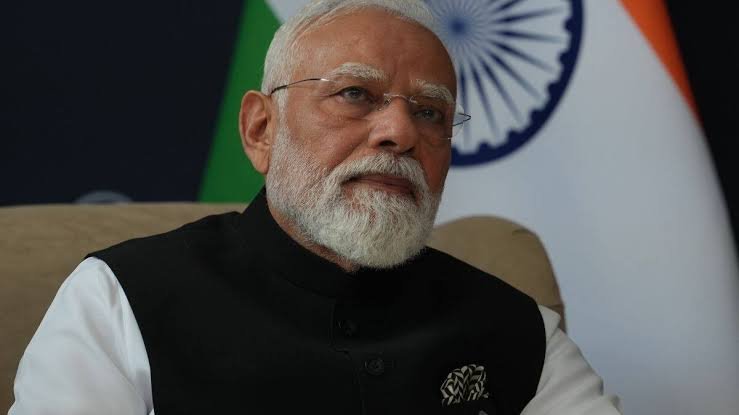

Prime Minister Narendra Modi has called for common global rules governing emerging technologies, clearer ways to identify AI-generated and deepfake content, and stronger technology-based systems to fight cyber fraud.
Modi made the remarks during a meeting with board members of the Global System for Mobile Communications Association, or GSMA, in New Delhi on October 6, ahead of India Mobile Congress 2026.
He said the next phase of digital growth must expand access while also strengthening trust and security.
The Prime Minister specifically highlighted artificial intelligence, 6G, cybersecurity and digital public infrastructure as areas where India wants deeper international cooperation.
FCRF Launches CP-FRM to Build India’s Next Generation of Fraud Risk Professionals
Modi Calls for Common Rules on Emerging Technology
One of the strongest policy signals from the meeting was Modi’s call for global standards and common rules covering new technologies.
Rapid advances in artificial intelligence, telecom networks and digital platforms increasingly cross national borders.
A deepfake created in one country can spread globally within minutes.
A cyber fraud network can operate from one jurisdiction while targeting victims in another.
Modi argued that such problems cannot be addressed effectively through isolated national approaches alone.
The Prime Minister did not set out a specific treaty, regulatory mechanism or timetable.
His comments instead amount to a broader push for countries and technology companies to coordinate on common standards.
Deepfakes Need Clear Identification, Modi Says
Modi also raised the growing problem of AI-generated and manipulated content.
He suggested developing mechanisms that allow people to immediately identify the origin of synthetic or deepfake material.
That could eventually involve technologies such as content credentials, watermarking, provenance systems or other forms of machine-readable labelling.
However, the government did not announce a specific technical standard during the meeting.
The key policy principle is that users should be able to distinguish genuine material from artificially generated or altered content.
That issue is becoming increasingly important as generative AI makes convincing fake images, audio and video easier and cheaper to produce.
Why Deepfake Identification Is Difficult
Simply placing a visible label on AI-generated material may not solve the problem.
Labels can be removed.
Images can be screenshotted.
Videos can be edited after creation.
Open-source tools may also operate outside systems where technology companies can enforce watermarking rules.
That is why researchers and regulators are increasingly examining provenance systems that record information about where digital content came from and how it was modified.
Even those systems depend on widespread adoption by platforms, device manufacturers and AI developers.
A global standard could make such systems more effective by reducing fragmentation between different countries and companies.
Cyber Fraud Also Becomes a Technology Policy Issue
Modi separately called for technology-driven solutions to combat the rapid growth of cyber fraud.
He said sustained awareness campaigns should also be used to warn people about suspicious calls and financial scams.
India has been expanding technology-based fraud prevention through systems that connect telecom intelligence with banks, payment providers and cybercrime agencies.
The Department of Telecommunications recently said its Financial Fraud Risk Indicator has helped prevent more than ₹5,000 crore in suspected fraudulent transactions.
That system uses telecom-related risk signals to help banks identify suspicious transactions before money leaves a victim’s account.
The broader direction is increasingly preventive: identifying fraudulent infrastructure early rather than relying only on recovery after money has been transferred.
‘Technology for the Last Mile’
Modi told GSMA representatives that technology must remain accessible and affordable, especially in the Global South.
He said digital services should reach the “last mile” so that technological progress does not widen existing inequalities.
That message connects India’s domestic digital policy with its international technology ambitions.
India has repeatedly presented systems such as Aadhaar, UPI and other Digital Public Infrastructure platforms as models that can be adapted by developing countries.
Modi said his conversations with international leaders had shown growing interest in that approach.
India Pushes Digital Public Infrastructure as Global Model
Digital Public Infrastructure, or DPI, refers to common digital systems that governments, businesses and citizens can build services on top of.
India’s most prominent examples include digital identity, payments and document-sharing infrastructure.
Modi told GSMA executives that such systems could act as a “force multiplier” for developing economies.
The argument is that countries do not necessarily need to build every digital service separately.
A common infrastructure layer can make it easier to launch banking, welfare, healthcare or identity services at scale.
The model has become an important part of India’s technology diplomacy.
GSMA Sees Opportunities in 6G and AI
GSMA board members praised India’s rapid expansion of mobile networks and digital infrastructure.
They also highlighted opportunities for deeper cooperation in 5G, 6G, artificial intelligence, cybersecurity, satellite connectivity and digital inclusion.
India has already positioned 6G as an area in which it wants to move from technology adoption toward standard-setting and intellectual-property development.
The government is also trying to expand domestic AI infrastructure, semiconductor production and data-centre capacity.
That makes international telecom partnerships increasingly important as networks become closely connected with AI and cloud computing.
India Mobile Congress Will Focus on Frontier Technology
The remarks came ahead of India Mobile Congress 2026 at Yashobhoomi in New Delhi.
This year’s event carries the theme “Scale Without Boundaries” and is expected to focus heavily on AI, telecom infrastructure, semiconductors, cybersecurity and satellite communications.
The government expects more than 1.5 lakh attendees, over 500 exhibitors and partners, around 600 startups and hundreds of technology leaders.
More than 2,000 technology use cases are expected to be showcased.
That makes Modi’s meeting with GSMA less of a standalone regulatory announcement and more of a signal about the priorities India intends to push during the conference.
India Already Has AI Governance Guidelines
The call for international standards also comes as India develops its own domestic AI-governance approach.
The government has already released AI Governance Guidelines setting out principles for responsible development and deployment.
India has generally favoured a risk-based approach rather than immediately introducing one comprehensive AI law.
Industry experts have also argued recently that India should develop safeguards suited to its own languages, population scale and AI ecosystem instead of simply copying foreign models.
The international standards Modi called for would therefore have to coexist with domestic approaches that may differ substantially between countries.
No New AI Law Was Announced
It is important not to overstate the meeting.
Modi did not announce a new AI Act, deepfake law or international regulatory agreement.
No binding standard was adopted.
The remarks instead identify the areas where the government wants greater international coordination: cyber fraud, AI-generated content, 6G, cybersecurity and digital access.
Any concrete global rules would still require negotiations between governments, regulators and technology companies.
The Real Challenge Is Interoperability
Different countries are already creating different AI and online-safety systems.
The European Union has adopted extensive AI regulation.
The United States has taken a different approach.
India is building its own governance framework.
That fragmentation can create problems when technology companies operate globally.
If each jurisdiction requires different labels, safety tests or technical standards, companies may have to build separate compliance systems for every market.
Common standards could reduce that complexity.
But achieving agreement will be difficult because governments have different views on privacy, national security, free expression and the appropriate role of technology companies.
What this means for you
India is signalling that future AI and cyber-safety rules should increasingly work across borders rather than remain country-specific. The immediate practical focus is likely to be clearer identification of deepfakes, stronger fraud-prevention technology and common standards for increasingly powerful digital systems.
Follow for daily updates on cybercrime, corporate fraud, DFIR, hacking, investigations, and digital forensics
