
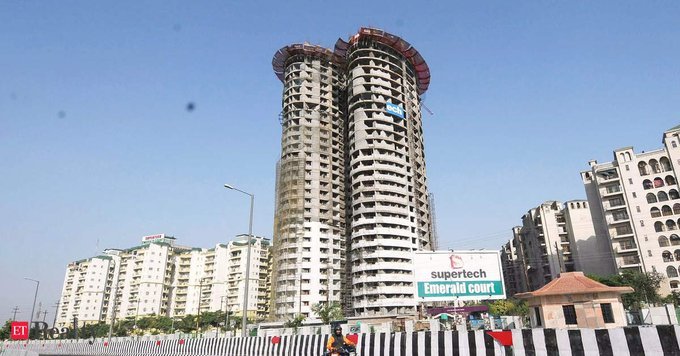
More than three years after the controversial Noida Twin Towers were demolished, a government-commissioned probe has finally fixed responsibility, holding 11 officials formerly posted in Noida guilty of serious lapses linked to the illegal construction. The investigation report has now been submitted to the Uttar Pradesh government, which is expected to take a call on disciplinary and legal action in the coming days. Of the officials named, seven have already retired, raising fresh questions about delays in accountability in one of India’s most high-profile urban governance cases.
The development comes even as the Supreme Court of India on Thursday directed NBCC (India) Limited to take over and complete 16 stalled residential projects of real estate developer Supertech Limited. The apex court also restrained all tribunals from passing any order that could obstruct NBCC’s work, signalling a clear attempt to safeguard the interests of thousands of homebuyers caught in the fallout of the scandal.
Certified Cyber Crime Investigator Course Launched by Centre for Police Technology
From landmark verdict to delayed accountability
The Twin Towers—once towering symbols of unchecked urban expansion—were ordered to be demolished by the Supreme Court on August 31, 2021, after the court found grave violations of building norms and collusion by officials of the Noida Authority. The demolition itself took nearly a year of preparation, with both towers finally brought down in a controlled implosion on August 28, 2022.
In a scathing judgment that reverberated across urban governance bodies nationwide, the apex court remarked that corruption appeared to seep from “every pore” of the planning authority. The observations triggered widespread public outrage and demands for action against officials who had allegedly enabled or ignored the violations.
Responding to the court’s strictures, the Uttar Pradesh government in September 2021 constituted a four-member committee headed by the Infrastructure and Industrial Development Commissioner to examine the role of officials, developers and other stakeholders. Based on the committee’s findings, an FIR was registered in Lucknow on October 4, 2021, against 26 officials and employees, directors of Supertech, and the project’s architect.
Of those 26 officials, 20 have since retired, two have died, and four were placed under suspension, underscoring how the passage of time blunted immediate punitive action.
Probe into 11 officials reaches government
The inquiry into 11 specific Noida officials, whose roles were examined in greater detail, followed a stop-start trajectory. Initially entrusted to the Additional Chief Executive Officer (ACEO) of Noida, the probe stalled after the officer’s transfer in September 2022. Multiple reminders were sent by the authority to the state government highlighting the delay.
Eventually, in March 2023, the investigation was reassigned to Soumya Srivastava, OSD/ACEO of Greater Noida. Officials said the report now submitted to the government concludes that these 11 officers were responsible for regulatory failures, including overlooking or facilitating deviations that made the illegal construction possible.
The Uttar Pradesh government is now examining the findings to decide the nature of action—ranging from departmental proceedings and recovery of losses to possible criminal prosecution where warranted.
Vigilance steps in
With the report formally reaching the government, vigilance teams have stepped up activity, visiting the Noida Authority’s offices earlier this week to collect files, approvals and correspondence linked to the Twin Towers project. Sources said the vigilance review could go beyond individual culpability to examine systemic failures, possible abuse of office and any personal enrichment by officials.
Parallel departmental inquiries are also underway at the state level against several senior IAS officers named in the wider case, including former CEOs and ACEOs of the Noida Authority, indicating that scrutiny is no longer limited to junior or mid-level officials.
NBCC to take charge of stalled projects
In a major relief for homebuyers, many of whom have been waiting for years, the Supreme Court’s latest order empowers NBCC to step in and complete 16 unfinished Supertech housing projects. The court made it clear that no tribunal or forum should pass directions that delay or derail construction, effectively ring-fencing NBCC’s mandate from legal roadblocks.
Legal experts see this as a calibrated, dual-track approach by the judiciary—ensuring consumer relief on one hand, while pushing the executive toward accountability on the other. “Demolition addressed the illegality. Accountability of officials will determine whether institutional reform actually follows,” said a senior urban governance expert.
A test of governance
Despite the demolition being hailed as a landmark moment in enforcing planning laws, the lack of swift action against officials had drawn sustained criticism over the past three years. The submission of the probe report now places the onus squarely on the state government to demonstrate that accountability will not be sacrificed to delay or retirement.
As vigilance inquiries intensify and the Supreme Court continues to monitor the aftermath, the Twin Towers case has re-emerged as a litmus test for governance, transparency and deterrence in urban development—one that will be judged not merely by the dramatic fall of two towers, but by whether responsibility is finally enforced.
About the author – Ayesha Aayat is a law student and contributor covering cybercrime, online frauds, and digital safety concerns. Her writing aims to raise awareness about evolving cyber threats and legal responses.
