

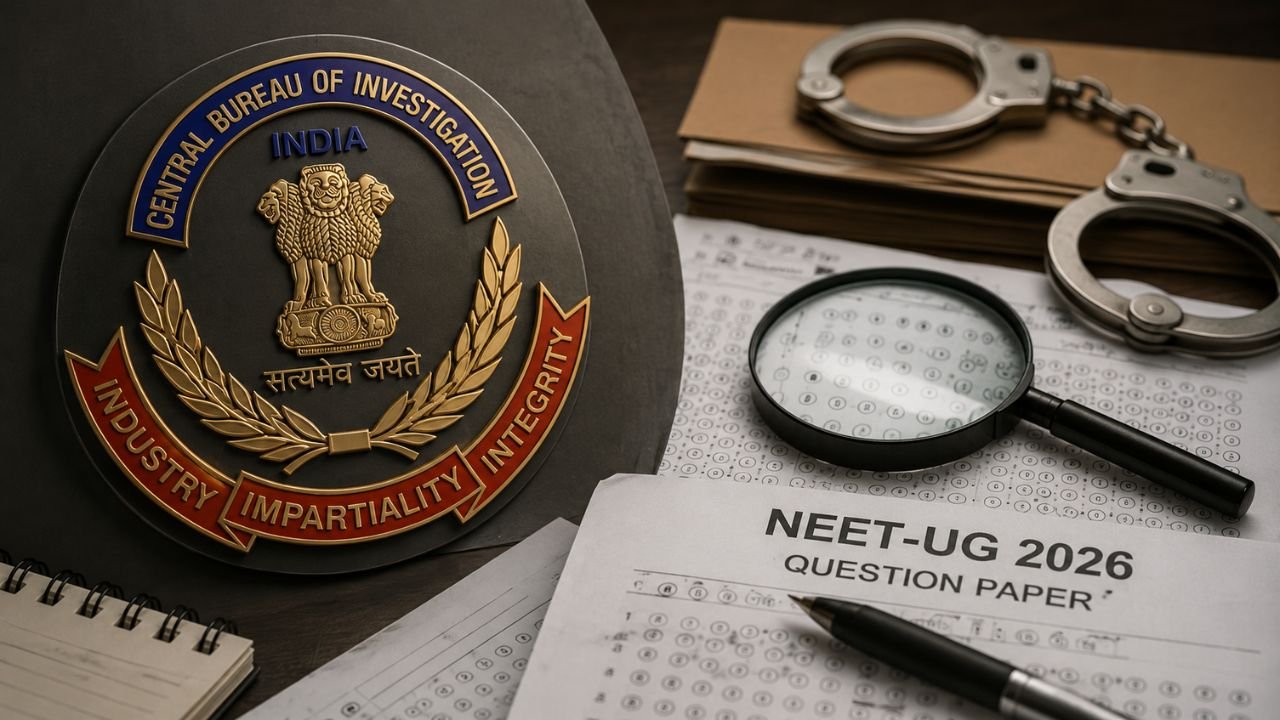

New Delhi | The country’s largest medical entrance examination NEET UG 2026 has been hit by a major paper leak scandal, raising serious questions over the integrity of the examination system. In this high-profile case, the Central Bureau of Investigation CBI has so far arrested nine accused. Investigations have revealed that the entire network operated with alleged involvement of insiders connected to the system, including NTA-linked experts, lecturers, agents, and intermediaries.
According to preliminary findings, the racket was run by individuals who had authorized access to question papers. The prime accused has been identified as Pune-based senior botany lecturer Manisha Gurunath Mandhare, who is believed to be the mastermind. She was reportedly appointed as an examination expert by the National Testing Agency NTA, and allegedly misused her official position to leak confidential question papers. Her alleged role includes accessing exam content in advance, sharing it with the syndicate, and enabling distribution through coaching-linked networks.
FCRF’s Flagship Cyber Law Certification Returns With a New Four-Week Cohort
Another key accused is retired chemistry professor from Latur, PV Kulkarni, who is alleged to have played a central role in extracting and circulating leaked questions. His role reportedly involved coordinating with intermediaries and arranging controlled dissemination of exam content through secret coaching setups. Along with him, Pune-based salon owner Manisha Waghmare has been named as part of the network. She is accused of recruiting candidates, arranging secret “memorization classes,” and facilitating the distribution chain of leaked material.
CBI officials stated that the operation began in the last week of April, when selected candidates were allegedly offered leaked questions in exchange for large sums of money. These questions were taught in underground coaching setups across multiple cities, where students were instructed to memorize answers rather than understand concepts, indicating a pre-planned cheating mechanism.
A coaching centre mock test in Latur became the turning point in the investigation after several questions were found to match the actual exam paper conducted shortly afterward. This discovery raised suspicion among parents, who filed complaints, leading to a formal investigation and eventual transfer of the case to the CBI.
In this case, several other accused have also been arrested. Jaipur-based Mangi Lal Biwal is accused of receiving leaked question papers and distributing them further within his local network. His son Vikas Biwal, a medical student, allegedly assisted in digitally sharing the leaked content. His brother Dinesh Biwal is accused of handling financial transactions linked to the racket, including receiving payments from candidates and routing them through informal channels.
Gurgaon resident Yash Yadav is identified as a key intermediary who allegedly acted as a bridge between the leak source and distribution network. Nashik-based Shubham Khairnar is accused of initially circulating the leaked question sets in coaching circles. Ahilyanagar resident Dhananjay Lokhande, an Ayurvedic practitioner, is alleged to have facilitated candidate identification and helped in organizing offline “special sessions” for memorization.
Investigations further suggest that the syndicate was not limited to a single state but spread across Maharashtra, Rajasthan, and Haryana. The accused allegedly targeted students from weaker economic backgrounds, offering them access to “special classes” held in discreet locations where exam questions and answers were memorized as a shortcut to secure high scores.
The most striking revelation was that several questions in the actual examination closely matched the notes provided during these secret sessions, confirming systematic leakage rather than coincidence. This prompted parents to escalate concerns, triggering a deeper probe.
CBI suspects that the racket may also be linked to previous years’ paper leak incidents. Officials are currently examining mobile data, banking transactions, and digital records of all accused to trace funding sources, communication patterns, and the broader operational structure of the network.
The agency is also investigating whether other examination officials or coaching institutes were involved in facilitating access, printing, or distribution of leaked materials. Early indications suggest that this is a long-running organized syndicate that has repeatedly exploited examination vulnerabilities.
The case has triggered a nationwide debate on exam integrity, transparency, and digital security mechanisms. Experts believe that without stronger internal monitoring, real-time encryption systems, and stricter accountability within examination bodies, preventing such leaks will remain extremely difficult.
All nine accused remain under interrogation as the CBI continues to map the full chain of masterminds, financiers, recruiters, and distributors involved in what is being described as one of the most organized examination fraud networks uncovered in recent years.
