


A food delivery worker, a bike-taxi rider and an auto driver allegedly turned ordinary printing equipment into a counterfeit currency operation after watching online videos on how fake notes could be made.
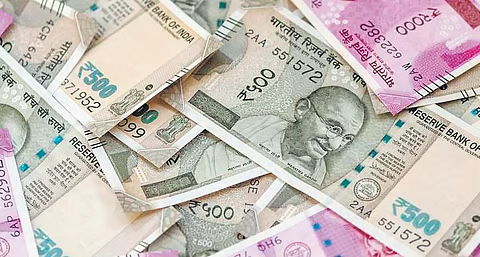
Hyderabad Police have arrested three men and seized alleged Fake Indian Currency Notes (FICN) with a face value of ₹2.91 lakh from Balapur. A fourth accused remains absconding, police said.
The case stands out not because investigators uncovered a sophisticated underground printing facility. Instead, police say the alleged operation began with freely available videos on YouTube and Instagram and guidance received from an unidentified person contacted through a phone number found online.
Algoritha Security Launches ‘Make in India’ Cyber Lab for Educational Institutions
From Online Videos to a Counterfeit Currency Plan
The arrested men were identified as Ramavath Ramu alias Mohammed, 36, Ramavath Mothilal, 35, and Ramavath Gandhi, 19. All three are residents of Chinthal Thanda in Nalgonda district.
According to police, Ramu worked as a food delivery executive and was facing financial difficulties. Investigators allege that he began exploring counterfeit currency after watching videos on social media.
He allegedly discussed the plan with Mothilal, a bike-taxi rider. Mothilal then contacted an unknown person using a number displayed in an online video about manufacturing counterfeit notes.
Police say the unidentified person advised them about the equipment and materials required, including a printer, scanner and suitable paper. The suspects allegedly began printing notes and trying to introduce them into everyday cash transactions.
Their alleged method was deliberately low-key.
Instead of attempting large transactions, the gang allegedly used small quantities of fake notes at liquor shops and vegetable markets, largely during the night. Such places can involve fast-moving cash transactions, giving recipients less time to closely inspect every note.
Task Force personnel from the Shamshabad Zone received information about the alleged circulation and apprehended the three suspects in Balapur on Wednesday. Their alleged associate, Sudheer John Chela alias Vamshi of Nagole, is yet to be arrested.
What FICN Means and How Fake Notes Are Detected
FICN simply stands for Fake Indian Currency Notes. It is the term commonly used by police and security agencies for counterfeit notes made to resemble genuine Indian currency.
A genuine banknote contains several security features that are difficult to reproduce accurately with ordinary printers. These include watermarks, security threads, raised printing and features that change appearance when a note is tilted.
The Reserve Bank of India says members of the public can check notes by seeing, touching and tilting them. For denominations of ₹100 and above, for example, the security thread changes from green to blue when viewed from different angles.
Counterfeiting is also a serious criminal offence. Section 178 of the Bharatiya Nyaya Sanhita provides for punishment extending to life imprisonment, or imprisonment of up to 10 years, for counterfeiting currency notes. Possessing equipment or material intended for counterfeiting can also attract severe punishment under Section 181.
Police Seize Printer, Scanner and More Than 1,100 Notes
The seizure gives investigators a clearer picture of how the alleged operation worked.
Police recovered 437 counterfeit ₹500 notes, 648 ₹100 notes and 39 ₹200 notes. They also seized a colour printer, scanner, laminator, liquid colours, watermark paper and other materials allegedly used for producing the notes.
The accused and seized items have now been handed over to Balapur Police for further investigation.
One key question remains unanswered: who was the unidentified person allegedly teaching the suspects how to manufacture counterfeit currency?
That digital trail could become important. Investigators may examine phone records, messaging applications and online interactions to determine whether the person was merely supplying instructions or was connected to a wider network.
Hyderabad Has Seen Similar Rackets Before
The case is not an isolated one.
In January 2025, Rachakonda Police arrested a man accused of manufacturing ₹5 lakh worth of counterfeit ₹500 notes. Police said he had searched online for specialised paper and was allegedly receiving advice from contacts about recreating features found on genuine currency.
Another Hyderabad racket was busted in November 2025. Eight people were arrested and counterfeit notes worth ₹4.75 lakh were seized. Investigators alleged that the principal accused scanned genuine ₹500 notes, edited the images digitally and used ordinary materials to imitate security features.
These cases show how counterfeit operations can increasingly combine inexpensive consumer technology with information found online.
The machinery may be basic. The distribution strategy is often simpler still: place forged notes into busy cash-heavy markets in small numbers and hope they disappear into normal circulation before anyone notices.
For police, tracing the people who produce such notes is only one part of the problem. Finding those who teach, supply materials or create networks for circulating them can expose a much wider chain.
What this means for you:
Check ₹100, ₹200 and ₹500 notes carefully when accepting cash, particularly in hurried transactions. If a note looks suspicious, do not knowingly spend it elsewhere; take it to a bank or report it to police for verification.
https://www.linkedin.com/company/policetechnology/home/
Follow for daily updates on cybercrime, corporate fraud, DFIR, hacking, investigations, and digital forensics
