

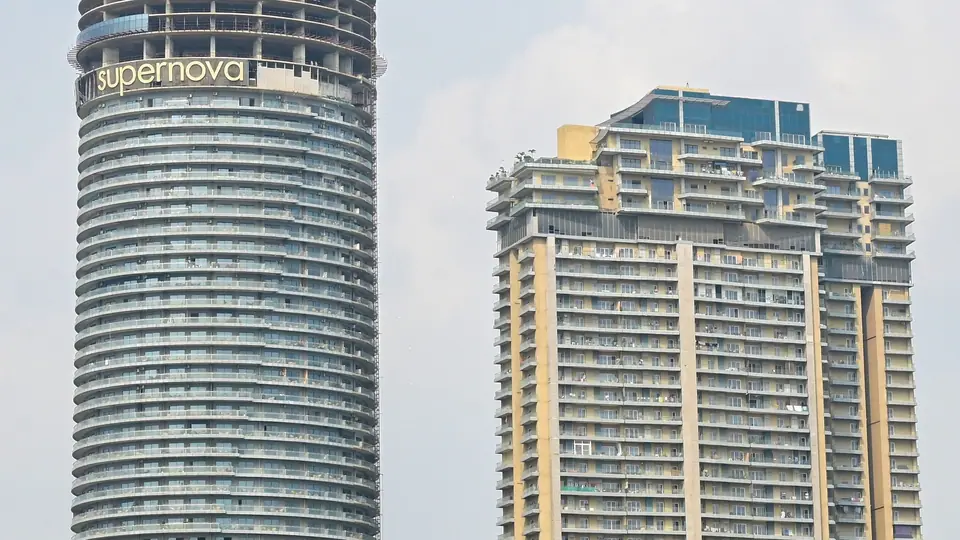

Noida’s Supernova complex has come under renewed scrutiny over short-term apartment rentals after a man staying in a one-day Airbnb accommodation died after falling from a high-floor balcony at the Sector 94 skyscraper.
The incident occurred just days after the Supernova Apartment Owners’ Association warned flat owners and tenants against offering apartments for brief stays through platforms such as Airbnb, OYO and Booking.com.
The association has said those continuing such short-term rentals could face legal action, citing security concerns, frequent movement of temporary guests and disturbances inside the complex.
Police are separately investigating the man’s death.
There is currently no evidence linking the apartment rental platform or the society’s short-stay arrangements to the circumstances that led to his death.
FCRF Launches CP-FRM to Build India’s Next Generation of Fraud Risk Professionals
Man Had Booked Apartment for One-Day Stay
Police said the man had checked into an apartment at Supernova Spira on Friday after booking it for a short-duration stay.
He was alone at the property.
On Saturday, he died after falling from a balcony on an upper floor of the tower.
The Indian Express, citing Additional Commissioner of Police Manisha Singh, reported that the man was from Gurugram and had checked into the building for a short rental stay a day earlier. Police are examining the circumstances surrounding the death.
Other reports identified him as Sambhav Jain, a resident of Manesar, and said the room had been booked through Airbnb.
There are discrepancies across initial reports about his exact age and whether the apartment was on the 41st or 43rd floor.
For that reason, those details should not be treated as settled until police issue a consistent final account.
Initial police findings cited financial stress and debt as possible factors behind the death.
Supernova Association Had Just Warned Against Short-Term Rentals
The death comes against the backdrop of a separate dispute over the growing use of apartments inside Supernova for short stays.
The Supernova Apartment Owners’ Association recently circulated a notice warning owners and tenants against listing apartments on Airbnb, OYO, Booking.com and similar platforms for brief rentals.
The association said legal action could be initiated against those violating the restriction, with responsibility resting on the concerned flat owner or tenant.
Residents have complained that short-duration rentals bring a continuous flow of unfamiliar visitors into what is partly a residential complex.
Concerns cited by the association include guests entering and leaving at odd hours, security monitoring difficulties and disturbances for permanent residents.
Around 200 Spira Units Used Commercially
Supernova comprises Nova East, Nova West and the much taller Spira tower.
Naresh K. Nandwani of the Supernova Apartment Owners’ Association told The Times of India that Nova East and Nova West together contain 582 residential units.
Spira, however, has a mixed-use section.
According to Nandwani, around 200 flats between the 19th and 43rd floors are used commercially, including for short-term rentals.
All three towers share the same campus and entry infrastructure.
That means people staying for only a few hours or days can still pass through common areas used by long-term residents.
This has become the central point of disagreement between residents and those operating short-stay accommodation from privately owned flats.
Gate-Ramming Incident Intensified Security Concerns
The apartment association’s warning followed another incident involving a bed-and-breakfast operator at the complex.
According to police and local reporting, security personnel stopped the operator from entering through the main gate.
The operator was later accused of driving his vehicle through a security barrier and was arrested.
The incident strengthened demands from residents for tighter controls over short-term accommodation businesses operating inside the complex.
The association subsequently circulated its warning against listings through Airbnb, OYO and Booking.com.
Noida Has Been Tightening Rules Around B&Bs
The Supernova dispute is part of a wider regulatory issue in Noida.
Short-term rentals have expanded in studio apartments and mixed-use high-rises along the Noida Expressway, often through online booking platforms.
Authorities have previously raised concerns that some such units were operating without the registrations normally required for formal bed-and-breakfast or homestay businesses.
Uttar Pradesh introduced its Bed and Breakfast and Homestay Policy in 2025 to bring such accommodation into a clearer regulatory framework.
Existing establishments covered by the policy were given a deadline to register.
The issue therefore goes beyond whether an apartment owner has the right to rent out a flat.
Authorities and resident bodies must also consider guest records, commercial use of residential property, fire and building safety, local registration requirements and the ability of security personnel to identify temporary occupants.
Airbnb Listing Does Not Establish Responsibility for Death
The fact that the man was staying in an Airbnb-booked apartment is relevant because it comes immediately after the association’s short-rental warning.
But the two issues should not be conflated.
Police have not accused Airbnb, the property owner or the apartment association of contributing to the death.
Initial reports suggest investigators are looking at the man’s personal circumstances, including possible financial distress.
The short-stay connection instead raises a different question: how effectively can a residential or mixed-use high-rise monitor hundreds of temporary visitors when individual units are repeatedly rented online?
That question was already being raised by Supernova residents before Saturday’s incident.
What this means for you
If you own or rent a flat and plan to list it for short stays, check the apartment association’s rules as well as state registration requirements before doing so. For permanent residents, the Supernova dispute also shows why societies increasingly want clear guest-verification and security rules for properties being operated like hotels inside residential complexes.
Follow for daily updates on cybercrime, corporate fraud, DFIR, hacking, investigations, and digital forensics
