

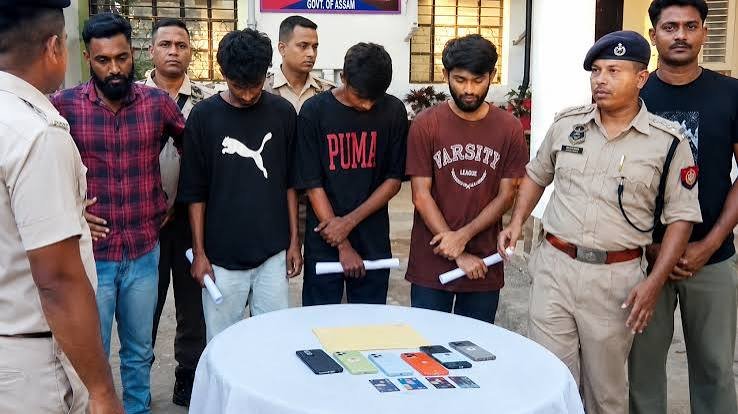

Assam’s Hailakandi Police have arrested four alleged cyber criminals for their involvement in online fraud, cyber scams, and operating an illegal online gambling network that allegedly duped people of lakhs of rupees. According to police, the accused were engaged in cyber fraud and online financial scams while also running online betting applications, with investigators suspecting the racket was part of a larger organised cybercrime network rather than an isolated local operation.
Two of the arrested individuals have been identified as Gaurav Ray Chaudhury and Jaharul Hasan Choudhury, while the identities of the remaining two accused have not yet been officially disclosed. Perhaps the most significant detail to emerge from the investigation so far is police’s assertion that the accused were allegedly in contact with a Chinese hacker syndicate to facilitate and operate the online gambling activities, a claim that, if substantiated, would connect this Hailakandi case to a considerably larger and well-documented international criminal architecture. Police have launched a detailed investigation to trace the financial transactions, identify other members of the network, and ascertain the full extent of the cyber fraud and gambling operation.
A Pattern That Extends Well Beyond Assam
Alleged Indian links to Chinese-run betting operations are not new, and recent cases elsewhere in the country illustrate how deeply layered these networks typically are. In Telangana, a Criminal Investigation Department probe into the offshore Dafabet gambling platform uncovered an intricate web of 46 mule bank accounts operating across eight layers of transactions, structured specifically to disguise the flow of gambling funds and frustrate law enforcement efforts. Investigators in that case found customers were recruited through aggressive marketing promoting cricket betting and casino games, with initial payouts used deliberately to build trust before users were encouraged to increase their wagers, a pattern common across India’s illegal betting ecosystem regardless of which specific platform or syndicate is involved.
Telangana CID Director General Charu Sinha, commenting on that investigation, offered a characterisation that applies with equal force to the Hailakandi case: illegal online betting platforms are not harmless gaming avenues but organised criminal enterprises that exploit vulnerable citizens, siphon money through layered financial networks, and fuel cyber-enabled crime more broadly.
The International Architecture Behind Such Syndicates
The reference to a “Chinese hacker syndicate” in the Hailakandi case fits within a documented pattern of sophisticated, technology-driven gambling operations run out of China despite gambling being illegal there. Security researchers have previously traced a Chinese cybercrime syndicate known as Vigorish Viper, closely linked to the Yabo Group, which built and maintained a full “technology suite” for offshore betting operations, encompassing website hosting, domain configuration, payment systems, and mobile apps, deployed across dozens if not hundreds of gambling brands targeting users well beyond China’s borders. Such syndicates have separately been linked by the Asian Racing Federation to human trafficking, with individuals coerced into forced labour at cyber fraud compounds to support betting operations and related scams.
This international infrastructure typically depends on local, on-the-ground operators in target countries, precisely the role Indian mule account networks and regional facilitators appear to play, to actually reach customers, collect payments, and launder proceeds through domestic banking channels before returning value to syndicate operators overseas. Whether the Hailakandi accused functioned as such ground-level operators for a larger Chinese-linked network, or were running a more localised scheme that merely drew on Chinese-developed betting software, is a distinction investigators will need to establish as the probe progresses.
India’s Tightening Legal Response to Online Betting
The Hailakandi arrests also arrive against the backdrop of India’s most significant recent regulatory shift on this front. The Online Gaming Act, 2025, alongside its accompanying 2026 Rules, has expanded the legal net around online money games considerably, targeting not just operators but also advertising, promotion, facilitation, and payment processing linked to real-money gambling and betting products, a recognition that enforcement focused solely on shutting down individual apps or websites had proven insufficient against operators who simply migrate to new domains, mirror sites, or messaging-app-based distribution.
That enforcement challenge remains substantial in practice. Illegal betting operations increasingly distribute through APK files, referral links, WhatsApp agents, and Telegram groups rather than conventional app stores, meaning a list of banned platforms can shift within days even after successful enforcement action, a dynamic security researchers have also observed in a separate and troubling trend of illegal betting syndicates compromising Indian government websites to redirect visitors toward betting platforms, exploiting the credibility of official domains to lend an illusion of legitimacy to unlawful operations.
What Comes Next for the Hailakandi Investigation
For now, Hailakandi Police have indicated that establishing the full extent of the network, both its domestic structure and any genuine link to Chinese-based operators, remains the central task ahead. Investigators are working to trace financial transactions and identify additional members of the operation, a process that, based on comparable cases elsewhere in India, will likely require untangling multiple layers of mule accounts and payment intermediaries before the true scale of the alleged fraud becomes clear.
As Assam and other northeastern states, given their proximity to international borders and historically lighter cyber enforcement infrastructure compared to metropolitan centres, continue to feature in cases involving alleged cross-border criminal links, the Hailakandi arrests serve as a reminder that the fight against organised online betting and cyber fraud in India increasingly requires investigators to look well beyond the district, and often well beyond the country, where an arrest is made.
Follow for daily updates on cybercrime, corporate fraud, DFIR, hacking, investigations, and digital forensics
