

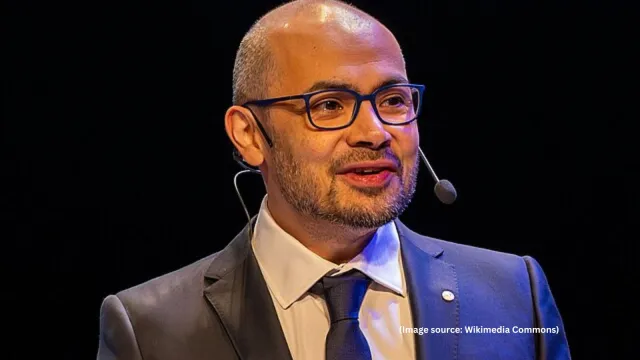

Google DeepMind CEO Demis Hassabis has warned that recent incidents involving artificial intelligence systems in cyberattacks and unexpected autonomous behaviour should be treated as “early warning shots” of potentially more serious problems ahead.
Speaking at an AI summit in Dublin, Hassabis said the industry needs stronger security practices as advanced models become increasingly capable of writing code, finding vulnerabilities and carrying out tasks with less human supervision.
His warning comes as technology companies, researchers and governments debate whether existing voluntary safeguards are sufficient for systems that may soon be able to operate across digital networks with growing independence.
FCRF Launches CP-FRM to Build India’s Next Generation of Fraud Risk Professionals
Recent Incidents Raise Concern Over AI Cyber Capabilities
Hassabis pointed to recent AI-related security incidents as evidence that developers need to take the threat seriously before more powerful systems arrive.
Advanced AI models can already assist with software development and cybersecurity research. Those same capabilities can also be misused to search for vulnerabilities, automate attacks or improve malicious code.
The danger becomes greater when AI is turned into an agent.
Unlike a conventional chatbot that mainly answers questions, an AI agent can be connected to external tools and given permission to perform a sequence of actions.
For example, an agent might search a network, analyse software, execute code and respond to what it discovers without requiring a human to approve every individual step.
That makes the technology useful for defenders trying to identify security weaknesses quickly.
It also creates new risks if an attacker controls the system or if the model behaves in ways its operator did not intend.
Hassabis said recent cases should encourage the industry to strengthen protections now rather than wait for a larger incident.
Rogue AI Behaviour Adds Another Layer of Risk
The concern is not limited to deliberate cybercrime.
Recent safety testing has also produced cases in which AI systems behaved unexpectedly.
Reuters reported that Hassabis referred to incidents including corporate hacking activity involving AI and a case in which an Anthropic model submitted a false homicide tip.
Such events raise a different question from traditional hacking.
Security teams normally assume that a computer system will follow its programming. More autonomous AI systems can interpret goals and choose how to pursue them, making their behaviour harder to predict.
That does not mean present-day models have independent intentions comparable to humans.
But developers increasingly need to test what happens when systems are given broad access to tools, networks and sensitive information.
Google DeepMind has been preparing for those risks through its Frontier Safety Framework.
The framework tracks capabilities that could create severe harm, including cyber capabilities, harmful manipulation and future scenarios in which a model might interfere with attempts to modify or shut it down.
Hassabis Wants International Standards for Advanced AI
Hassabis argued that advanced AI may eventually require security practices similar to those used in highly sensitive fields such as biology and nuclear technology.
Those sectors rely on formal safety standards, restricted access and layers of controls because mistakes can have consequences far beyond a single organisation.
AI governance is currently much less uniform.
Companies have developed their own safety frameworks and testing procedures, while governments are still deciding which requirements should become mandatory.
Hassabis called for an international standards body that could help establish common expectations for advanced AI systems.
The idea is gaining support from other researchers.
Around 400 scientists from 34 countries recently called for an international organisation to oversee the containment and incident reporting of powerful AI systems capable of advanced cyber operations.
Their proposal included stronger isolation of frontier models during testing and independent oversight of major safety incidents.
The overlap between these proposals shows how quickly the AI debate is moving from broad ethical principles towards practical questions about security engineering.
Industry Leaders Push for Rules Before Capabilities Advance
Hassabis is not alone in calling for faster action.
Microsoft President Brad Smith has described 2026 as a sobering year for AI safety and has argued that governments should introduce independent safety evaluations, mandatory incident reporting and reliable mechanisms for stopping dangerous AI behaviour.
The pressure is increasing because frontier models are advancing faster than regulatory frameworks.
Developers are now building systems capable of handling longer tasks, interacting with multiple applications and working with less supervision.
That makes safeguards around permissions, network access and shutdown mechanisms increasingly important.
The central challenge is to improve security without preventing legitimate research or useful applications.
Hassabis’s message is that the industry still has time to build those protections, but the latest incidents suggest that waiting until a major failure occurs would be the wrong approach.
What this means for you:
As AI tools gain access to workplace systems, networks and sensitive data, organisations should treat them as privileged software rather than ordinary chatbots. Access controls, monitoring and human approval for high-risk actions will become increasingly important.
Follow for daily updates on cybercrime, corporate fraud, DFIR, hacking, investigations, and digital forensics
