

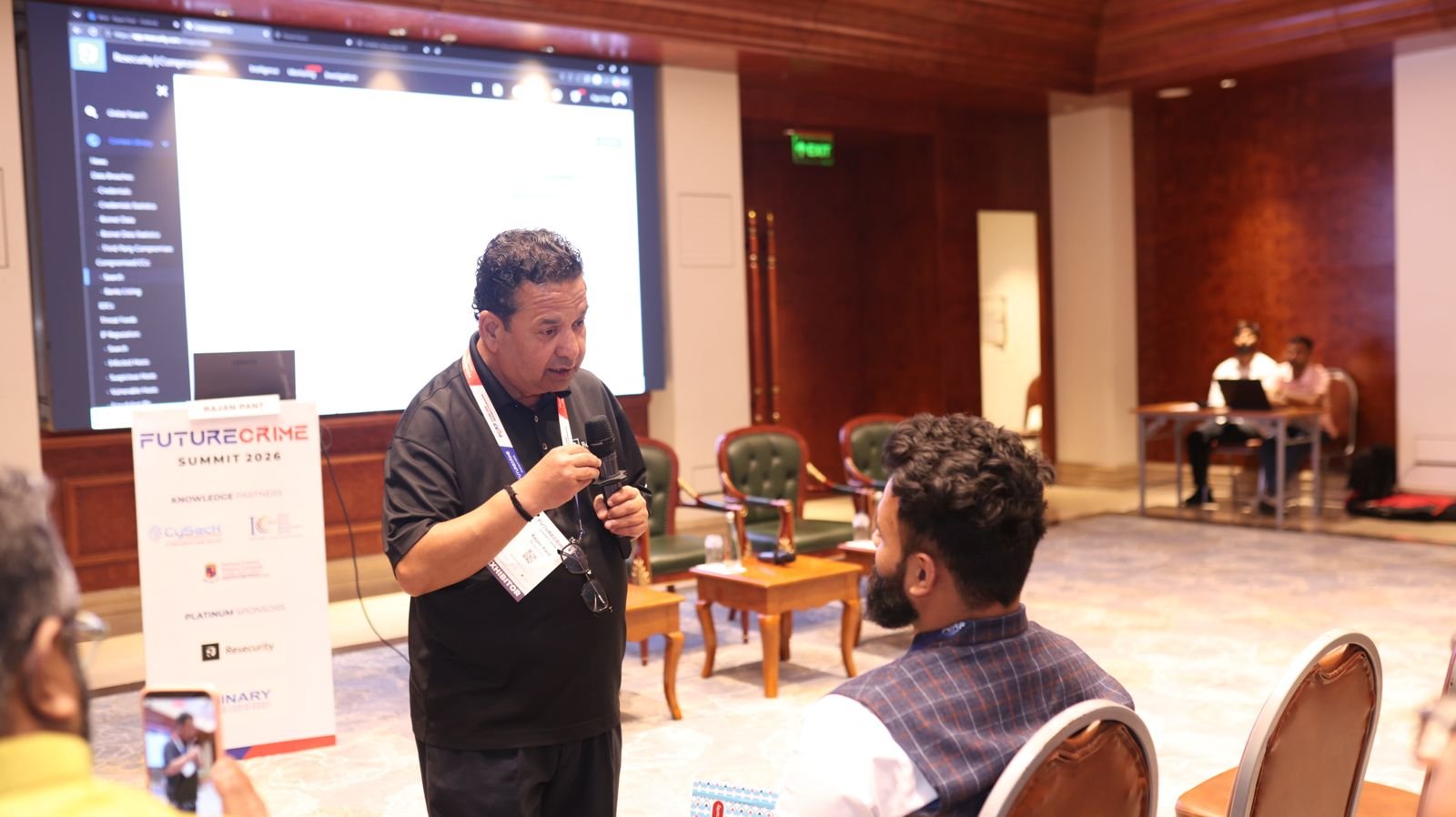
At the FutureCrime Summit 2026, a dedicated Resecurity Threat Intelligence Workshop examined how threat intelligence can help organisations identify emerging cyber risks, understand adversaries and strengthen their ability to respond before malicious activity develops into a major security incident.
The workshop was led by Rajan Pant and focused on the increasingly important role of threat intelligence in modern cybersecurity operations. As organisations face attacks ranging from credential theft and phishing to sophisticated intrusion campaigns, the ability to gather, analyse and interpret information about potential threats has become a critical component of cyber defence.
Threat Intelligence Moves Defence Beyond Reactive Security
Traditional cybersecurity models often concentrate on responding after suspicious activity has already reached an organisation’s systems. Threat intelligence seeks to move security teams further upstream by helping them understand what kinds of threats may be developing, who may be behind them and which technologies, vulnerabilities or organisations could be targeted.
This approach can involve analysing indicators of compromise, malicious infrastructure, attacker behaviour and other information capable of revealing patterns across the wider threat environment.
The workshop highlighted why this contextual understanding matters. A single suspicious IP address, domain or file may provide limited information by itself. When connected with broader intelligence about attacker methods, infrastructure and previous activity, however, it can help defenders understand the potential significance of an incident more quickly. For security teams, the value of threat intelligence therefore lies not simply in collecting more data, but in converting that information into knowledge that can support operational decisions.
Understanding Adversaries Strengthens Cyber Defence
Effective threat intelligence also requires organisations to look beyond individual attacks and examine the methods used by adversaries. Cybercriminal groups can change infrastructure, modify malware and adopt new techniques, but their broader patterns of behaviour may provide important clues for investigators and defenders. Understanding these tactics can help security teams anticipate how attackers may attempt to gain access, move through networks or exploit compromised information.
The Resecurity Threat Intelligence Workshop, led by Rajan Pant, placed this intelligence-led approach at the centre of security preparedness. For Security Operations Centres and incident-response teams, such intelligence can support faster prioritisation. Instead of treating every alert as an isolated event, analysts can assess whether activity corresponds with known malicious behaviour or emerging threat patterns. This can help organisations concentrate resources on incidents that present the greatest potential risk.
From Intelligence Collection To Actionable Decisions
One of the most important challenges in threat intelligence is ensuring that information remains actionable. Security teams operate in environments where enormous quantities of data may be generated every day. More intelligence does not automatically produce better security. Analysts must determine which information is credible, relevant and timely enough to influence defensive decisions.
Threat intelligence can support several areas of cybersecurity, including vulnerability prioritisation, incident investigation, proactive threat hunting and strategic risk assessment. It can also help organisations understand whether particular industries, technologies or digital assets are attracting increased attention from malicious actors. The effectiveness of such intelligence ultimately depends on how well it is integrated into existing security operations.
The broader message of the Resecurity Threat Intelligence Workshop at FutureCrime Summit 2026 was that organisations increasingly need to understand the threat environment beyond the boundaries of their own networks. As cyber threats become more organised, interconnected and adaptive, effective defence depends not only on detecting attacks when they occur, but also on recognising the signals that may precede them.
Threat intelligence provides one way of building that awareness. By connecting technical indicators with adversary behaviour and broader cyber-risk patterns, organisations can move toward a more informed and proactive model of cybersecurity, one in which intelligence becomes a foundation for faster decisions, stronger preparedness and more effective response.
