

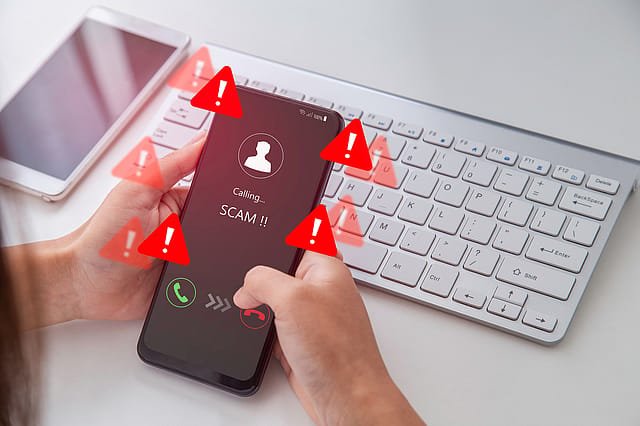
The government’s Financial Fraud Risk Indicator has helped prevent suspected cyber fraud transactions involving more than ₹5,000 crore since its launch in May last year, strengthening efforts to stop fraudulent payments before money leaves a victim’s account.
What Is the Financial Fraud Risk Indicator?
The Financial Fraud Risk Indicator, or FRI, is a risk-assessment framework developed by the Department of Telecommunications to help financial institutions determine in real time whether a mobile number is potentially associated with cybercrime or financial fraud.
The system classifies mobile numbers as having a Medium, High or Very High risk of being linked to financial scams.
It draws information from multiple sources, including the Indian Cybercrime Coordination Centre’s National Cybercrime Reporting Portal, DoT’s Chakshu platform and reports submitted by banks and other financial institutions.
The tool is part of DoT’s Digital Intelligence Platform and shares critical information with banks, UPI applications and financial companies so that potentially fraudulent transactions can be stopped before completion.
How Much Fraud Has the System Prevented?
The FRI has helped protect ₹5,043.73 crore of citizens’ money as of August 2026, according to the communications ministry.
Cumulative savings through the system stood at ₹139.16 crore in August 2025 before crossing ₹5,000 crore by August this year.
More than ₹2,000 crore in suspected fraud losses were prevented during the four months from April 2026 alone.
The figures underline the government’s increasing focus on preventing suspicious transactions at their point of origin rather than attempting to recover money after it has moved through the financial system.
How Does FRI Stop Suspicious Transactions?
Financial institutions can use information provided through the system during customer onboarding, transaction monitoring and fraud detection.
This allows banks and other institutions to flag or stop high-risk transactions before money leaves a customer’s account.
The communications ministry said the initiative marks a shift from responding to fraud after it takes place to preventing it at the point of transaction. Preventing a suspicious payment can also avoid the subsequent process of filing complaints, conducting investigations, freezing accounts, issuing record requisitions and attempting to recover funds.
This is particularly important because cyber fraud proceeds can move through multiple mule accounts within minutes, making recovery difficult once a transaction has been completed.
Proposal for Conducting Cyber Crisis Drill, Tabletop Exercise (TTEx) & CCMP Readiness Exercise
Which Financial Institutions Are Using the System?
The Department of Telecommunications has worked with the Reserve Bank of India, National Payments Corporation of India, Securities and Exchange Board of India and other financial-sector stakeholders to integrate FRI signals into fraud-prevention systems.
The framework is also being extended to securities-market intermediaries, insurance companies and pension-sector entities.
The expansion is intended to help prevent fraud involving trading and demat accounts, insurance transactions and pension accounts, extending the system beyond conventional banking and payment fraud.
More than 1,600 organisations are now on the Digital Intelligence Platform. The DoT has also conducted more than 25 training sessions covering 1,500 banks, financial institutions and regulators on FRI methodology, integration with the Digital Intelligence Platform and the use of risk signals.
What Role Do Citizens Play?
Citizen participation is also an important part of the system. Reports of suspicious calls and messages submitted through Sanchar Saathi and its Chakshu facility feed intelligence used by the Financial Fraud Risk Indicator.
The government has advised people to take warnings displayed by banking and UPI applications seriously and independently verify payment details before proceeding with a transaction.
Information collected from citizens, financial institutions and cybercrime reporting systems can help identify mobile numbers carrying a higher risk of involvement in financial scams.
What Should Cyber Fraud Victims Do?
If a financial cyber fraud has already occurred, victims have been advised to immediately call the national cybercrime helpline at 1930 or report the incident through the National Cybercrime Reporting Portal.
Quick reporting remains important because cyber fraud money can be transferred through multiple mule accounts within a short period, making it increasingly difficult to recover once it moves further through the financial system.
About the author — Ayesha Aayat writes on cybercrime, digital safety, and emerging online threats. Her work focuses on public awareness, legal clarity, and technology-driven risks.
Follow for daily updates on cybercrime, corporate fraud, DFIR, hacking, investigations, and digital forensics
