
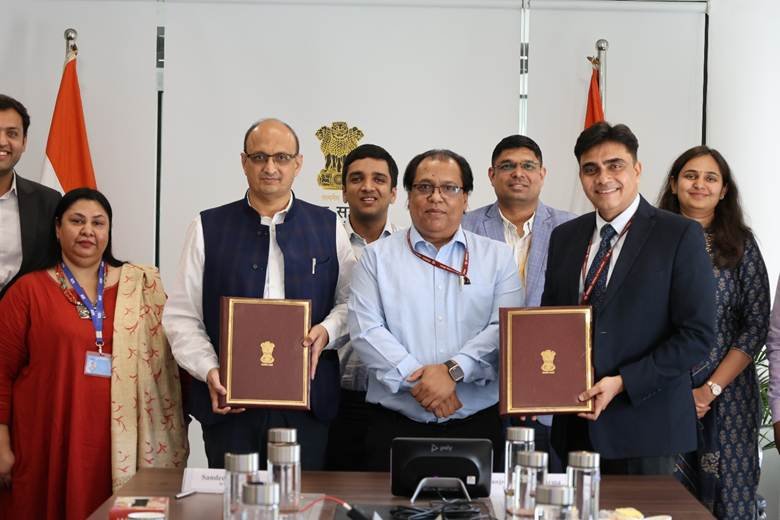
The Department of Telecommunications and the Securities and Exchange Board of India have signed a Memorandum of Understanding to strengthen cooperation against the misuse of telecom resources in securities market frauds and investment-related scams, in a move aimed at reinforcing the security of India’s financial ecosystem.
The agreement, posted by PIB Delhi on April 15, 2026, is intended to support early detection of fraudulent activity and improve investor protection through strategic data sharing.
Agreement Signed in Presence of Senior Officials
The MoU was signed by Sanjeev Kumar Sharma, Deputy Director General, AI and Digital Intelligence Unit, DoT, and Sandip Pradhan, Whole Time Member, SEBI. The signing took place in the presence of Deb Kumar Chakrabarti, Member (Services), Digital Communications Commission.
The agreement as a step towards deeper convergence between telecom intelligence and financial market regulation. It is positioned as part of a broader effort to tackle frauds in which telecom resources are used to facilitate deceptive financial activity.
Data Sharing Framework at the Core
At the centre of the partnership is a structured data-sharing mechanism designed to support the early detection and disruption of fraudulent activity. Under the arrangement, DoT will share the Financial Fraud Risk Indicator with SEBI to help identify mobile numbers linked to suspicious patterns through multi-dimensional analysis.
The Mobile Number Revocation List will also be shared automatically, allowing SEBI-regulated entities, including brokers and asset management companies, to ensure that investor accounts are linked only to active and valid mobile connections. In return, SEBI will provide inputs on telecom resources associated with accounts involved in cyber fraud, impersonation or money mule activities, enabling action within the telecom domain.
Shift Towards Preventive Investor Protection
The exchange of intelligence will be carried out through DoT’s Digital Intelligence Platform, which currently connects more than 1,400 stakeholders and facilitates real-time sharing of actionable information across institutions. The collaboration is described as especially significant in the context of India’s expanding digital investment landscape.
The Financial Fraud Risk Indicator, drawing on inputs from DoT’s Chakshu facility under Sanchar Saathi, financial institutions and law enforcement agencies, is intended to function as an early warning system to flag potentially fraudulent mobile connections before they are used in financial scams. Under Sanchar Saathi, more than 88 lakh fraudulent mobile connections have already been disconnected using ASTR, and that deployment of the indicator has helped prevent financial losses of about Rs 2,300 crore over the past ten months.
Going forward, the MoU is expected to support the development of standard operating procedures for coordinated action and institutional sharing of red flag indicators. The DoT-SEBI collaboration is intended to strengthen investor protection and enhance trust in India’s digital and financial ecosystem.
About the author – Rehan Khan is a law student and legal journalist with a keen interest in cybercrime, digital fraud, and emerging technology laws. He writes on the intersection of law, cybersecurity, and online safety, focusing on developments that impact individuals and institutions in India.
