

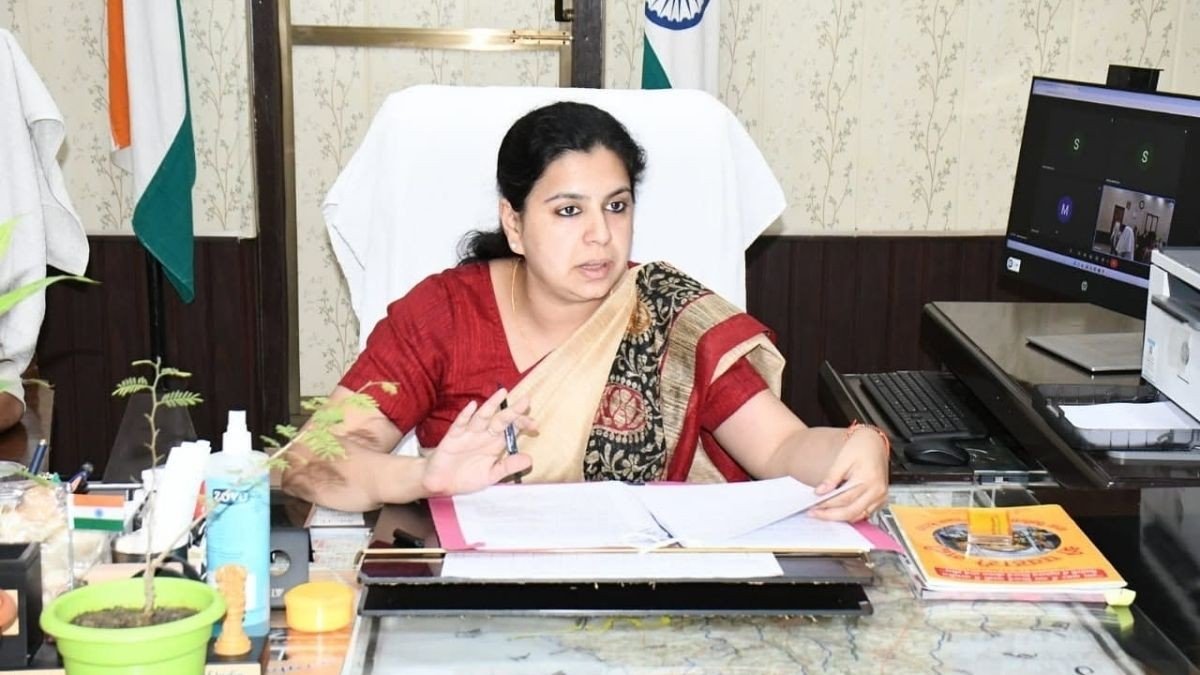
Former IAS officer Divya Mittal has announced her entry into politics, saying Uttar Pradesh will be the starting point of her political journey and that she intends to work independently rather than join an existing political party.
Mittal said Uttar Pradesh was her “karmabhoomi” and linked her decision to experiences during her administrative career, where she said she saw public problems remain unresolved even after official approvals, funds and provisions were available. She said she wants to raise questions over such failures and work directly with citizens.
Who Is Divya Mittal?
Divya Mittal is a former IAS officer originally from Rewari, Haryana. She studied at IIT and IIM and later worked in London, later left her job in London and returned to India.
Why Did Divya Mittal Resign From the IAS?
Mittal resigned from the IAS after 13 years of service, saying that her understanding of public service and purpose had evolved during her career. In her resignation note, she said her personal dreams had already been fulfilled and that she now wanted to live for the dreams she had seen for others. She made clear that leaving the IAS did not mean abandoning the larger purpose that had originally drawn her to public service.
Why Did Divya Mittal Enter Politics?
Mittal said her decision grew out of what she witnessed while serving in the administration. According to her, many public problems did not get resolved despite approvals, available funds and provisions being in place.
She said there were people whose voices failed to reach the government and, even when they did, their problems remained unheard.
Mittal cited the case of a remote village where residents had sought a school providing education beyond Class V. She said the proposal was approved, but construction had still not begun years later.
“It was not a question of funds or rules. There was a lack of intent,” she said.
She also referred to irregularities in official reports and questioned what she described as “higher-level interference” when work concerning poor people was delayed despite corrective action.
What Experience Shaped Her Decision?
Mittal recalled an incident from her tenure as Special Secretary, Revenue, involving a landless man who approached her with documents relating to a small piece of government land.
She said she checked the papers and found that a report in the matter was completely false. After she spoke to the officer concerned in the district, the error was acknowledged, the report was withdrawn and action was taken against the person who had prepared it.
The issue, however, did not end there. Mittal said she called twice and followed up three times to ensure the man received possession of the land, but was told that officials had been instructed “from above” not to proceed.
She questioned who this “above” referred to, arguing that in a constitutional system the people should ultimately be at the top. Mittal said she wanted answers for injustices of this kind.
FCRF Launches CP-FRM to Build India’s Next Generation of Fraud Risk Professionals
What Issues Does She Want to Raise?
Mittal said she intends to focus on problems including poor rural infrastructure, unsafe roads, examination paper leaks and employment concerns in the age of artificial intelligence.
She pointed to villages that still lack roads and places where rivers have no bridges, leaving communities isolated during the rainy season. She also spoke about dangerous potholes and questioned why known infrastructure problems sometimes remain unresolved.
According to Mittal, when authorities know where a pothole is, what the relevant file number is and how many deaths have occurred, failure to act becomes a matter requiring answers.
“I want politics of intent, justice, concern and long-term thinking,” she said. “My objective is not just to replace political leaders. It is to change the way politics functions.”
Will Divya Mittal Join a Political Party?
Mittal rejected speculation that she would join an existing political party and said she plans to work directly with citizens while building an independent platform.
She also alleged that false political rumours circulated after her resignation were intended to discourage newcomers from entering public life. She said she would not be deterred from raising public issues.
Mittal appealed to people from different sections of society, including teachers, farmers, students, doctors, labourers and lawyers, to participate in her initiative. She said meaningful political change could come only through collective public participation.
What Did Mittal Say After Leaving the IAS?
After her resignation was accepted, Mittal wrote, “Keep moving forward.”
She also announced that her resignation from the IAS had been accepted and quoted lines from poet Jaishankar Prasad’s play Chandragupta, invoking the idea of continuing forward on the path of service to the country.
Her move into politics marks a shift from administration to direct public engagement. Mittal has presented the decision as an attempt to question failures in governance and pursue issues that she believes remained unresolved during her years inside the administrative system.
The420 Insight
Mittal’s entry into politics is notable because she is framing her move around experiences from inside the bureaucracy rather than an immediate association with an established political party. Her stated test will now be whether an independent platform can translate those administrative concerns into sustained public and political action.
About the author — Ayesha Aayat writes on cybercrime, digital safety, and emerging online threats. Her work focuses on public awareness, legal clarity, and technology-driven risks.
Follow for daily updates on cybercrime, corporate fraud, DFIR, hacking, investigations, and digital forensics
