

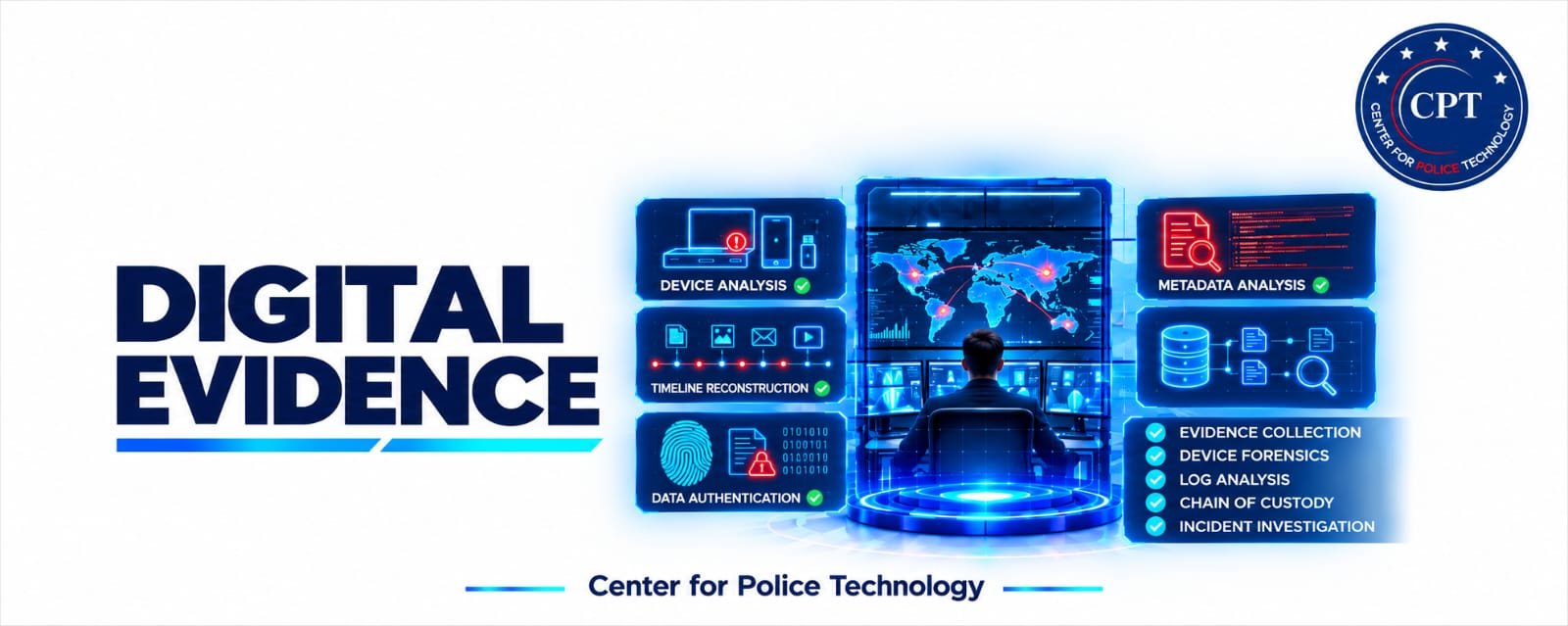
Centre for Police Technology Launches a 31-Day Cybersecurity Knowledge Series for Police, LEAs, Corporate Investigators, Digital Forensics, Fraud, Cyber Risk and Security Professionals
- A mobile phone recovered during an investigation may contain messages that establish a criminal conspiracy.
- A CCTV recording may reveal the movement of a suspect.
- An email may connect a fraudster to a phishing attack.
- A server log may help investigators reconstruct unauthorised access to a computer system.
These are examples of digital evidence, an increasingly important component of modern criminal investigations.
Digital evidence is no longer limited to cybercrime cases. Murder, kidnapping, financial fraud, organised crime, corruption, extortion and conventional offences may all involve information stored or transmitted through electronic devices.
However, digital evidence presents a challenge.
Unlike many forms of physical evidence, electronic information can be altered, deleted, copied, overwritten or remotely accessed. Some information exists only temporarily, while other records may be distributed across devices, cloud platforms and foreign jurisdictions.
For police officers and forensic investigators, the objective is not simply:
“Find the information stored on a device.”
It should be:
“Identify, preserve, authenticate and analyse digital information so that its relevance and reliability can be established during investigation and legal proceedings.”
What Is Digital Evidence?
Digital evidence refers to information in electronic or digital form that may be relevant to an investigation or legal proceeding.
It can exist on computers, mobile phones, storage devices, servers, cameras, cloud platforms, communication networks and connected equipment.
An investigator may need to determine:
- Who created or accessed the information?
- When was the information generated?
- Which device or account was involved?
- Has the information been altered?
- Can the information establish a sequence of events?
- Can its origin and integrity be demonstrated?
Digital evidence may directly support a finding, corroborate witness testimony or provide leads for further investigation.
However, finding a document on a computer does not automatically prove who created it. Similarly, recovering a message from an account does not necessarily establish who was operating that account at the relevant time.
Digital evidence therefore involves more than collecting electronic information. It requires preservation, authentication, technical examination and careful interpretation.
How Does Digital Evidence Investigation Work?
A digital evidence investigation normally begins by identifying relevant electronic sources. These may include devices recovered from a crime scene, accounts associated with suspects, communication records, CCTV systems or digital transaction records.
The first important step is preservation.
Investigators must protect potentially relevant information from accidental alteration, deletion or overwriting. Evidence is then collected or acquired using procedures appropriate to the device and circumstances.
Forensic specialists may create verified copies of storage media, extract authorised mobile-device data or obtain records from service providers through applicable legal procedures.
The information is subsequently examined. Investigators may recover relevant files, examine metadata, reconstruct activity or compare information from several sources.
Finally, findings are interpreted and documented.
The process can therefore become:
Identification → Preservation → Collection → Acquisition → Integrity Verification → Examination → Analysis → Documentation → Court Presentation
Every stage matters.
An investigator may discover highly relevant information, but inadequate documentation of how it was obtained can create serious questions about its reliability. Digital investigation begins with preservation, not interpretation.
What Are the Main Types of Digital Evidence?
Several categories of digital information may become relevant to police investigations.
Smartphones can contain messages, photographs, videos, contacts, application information, call records, location artefacts and account activity.
Computer Evidence
Computers may contain documents, browsing histories, downloads, email records, deleted files and traces of user activity.
Network Evidence
Firewalls, routers, servers and security systems may generate logs showing connections, authentication attempts and communication activity.
Cloud Evidence
Cloud platforms may hold documents, backups, account records, synchronised files and application information.
CCTV and Multimedia Evidence
Video recordings, photographs, audio files and metadata can help investigators reconstruct events.
Financial Evidence
Banking records, digital payment transactions, transaction identifiers and cryptocurrency information may support financial crime investigations.
Social Media Evidence
Publications, messages, uploaded files, account information and associated records may provide investigative leads.
Each category requires different technical skills and preservation methods.
What Technologies Are Used to Examine Digital Evidence?
Digital forensic investigations rely on several specialised technologies.
Forensic Imaging
Forensic imaging allows investigators to create controlled copies of digital storage for examination.
Depending on the acquisition method, it may preserve information beyond the files ordinarily visible to a user.
Mobile Forensics
Mobile forensic tools help examiners acquire and interpret accessible information from smartphones and tablets.
The level of access depends on the device, operating system, encryption, security controls and available lawful acquisition methods.
Computer Forensics
Computer forensic software can help investigators analyse file systems, user activity, browser artefacts, deleted information and operating-system records.
Network Forensics
Network forensic tools examine communication records, traffic captures and other information associated with network activity.
Cloud Forensics
Cloud investigations involve records stored or processed by remote services, often requiring provider cooperation and legally authorised access.
Multimedia Forensics
Specialised techniques can help examine image, audio and video authenticity, editing history and technical characteristics.
Cryptographic Hashing
Hash functions help verify whether digital data has changed between different stages of acquisition, storage or examination.
These technologies serve different purposes. No single forensic tool can reliably recover or interpret every form of digital evidence.
Which Digital Forensic Tools Are Important?
Several established tools support digital evidence examination.
EnCase Forensic, developed by OpenText, provides computer forensic examination and analysis capabilities. FTK, associated with Exterro, is used for processing, searching and examining electronic evidence.
Autopsy, an open-source digital forensics platform, supports file-system examination, keyword searching and analysis of digital artefacts. Cellebrite’s digital forensic technologies support authorised mobile-device acquisition and analysis.
Magnet AXIOM, developed by Magnet Forensics, supports examination and correlation of evidence from computers, mobile devices and cloud sources. Wireshark is widely used to examine network packet captures.
Volatility is an open-source memory forensics framework used to examine memory images and identify relevant operating-system artefacts. These tools can assist investigations, but their output must be interpreted by trained personnel.
A forensic report generated by software should not automatically be treated as a complete explanation of events.
The central principle is:
Forensic tools produce findings. Investigators must establish their meaning and reliability.
Why Is Preservation the First Priority?
Digital information can change quickly:
- A computer may automatically overwrite logs.
- A smartphone may receive new messages or synchronise information.
- Cloud records may be deleted after a retention period.
- A connected device may also be remotely accessed or wiped.
- Investigators therefore need to consider how their actions might affect the evidence.
- An unnecessary restart could destroy volatile information.
- Opening files may change certain metadata.
Connecting an unknown storage device to an ordinary computer could introduce security risks or alter its contents. Forensic personnel may use appropriate isolation methods, write-blocking technology, verified acquisition procedures and controlled examination environments.
However, the correct approach depends on the device.
- Switching off a running computer may cause the loss of valuable memory evidence.
- Powering down a locked smartphone may also complicate subsequent access.
The safest forensic decision depends on the evidence at risk, not a universal rule applied to every device.
What Is a Forensic Image?
A forensic image is a copy of digital storage obtained through a controlled acquisition process.
For supported storage devices, a forensic image may reproduce data at a level that includes deleted or otherwise hidden artefacts. The objective is to allow investigators to examine relevant information while limiting unnecessary interaction with the original evidence.
Forensic images are commonly verified using cryptographic hashes. An examiner can calculate a hash when the image is acquired and compare it with a later hash to assess whether the data has remained unchanged.
However, investigators must understand the limitations of different acquisition methods.
- A logical extraction from a smartphone may provide selected accessible files and databases rather than a complete physical copy of storage.
- A cloud export may contain records made available by the service rather than every item ever associated with an account.
An acquisition should be described according to what was actually collected, not what investigators assume it contains.
Why Are Hash Values Important?
A cryptographic hash is a mathematical value calculated from digital data. Algorithms such as SHA-256 are commonly used for integrity verification. If two copies of the same data produce matching SHA-256 hash values, this strongly supports the conclusion that their contents are identical.
If the values differ, the data is not identical. Hashing is therefore useful for verifying forensic images, transferred files and stored evidence. But hashing has an important limitation.
A hash cannot establish whether a document was originally truthful, whether an image was manipulated before collection or who created a particular file. It demonstrates something narrower. Hashing helps establish integrity. It does not independently establish authenticity, authorship or the truth of the contents.
What Is Chain of Custody?
Chain of custody is the documented history of evidence from collection through storage, examination, transfer and presentation. It should establish who handled the evidence, when it was handled and for what purpose.
For digital evidence, investigators may record:
- Device identification
- Date and place of collection
- Name of collecting officer
- Condition of the evidence
- Acquisition method
- Relevant hash values
- Storage and transfer details
- Examination history
The process can be understood as:
Collection → Evidence Registration → Secure Storage → Forensic Examination → Documentation → Court Presentation
Proper chain-of-custody records help demonstrate how the evidence was handled. They also enable investigators to explain whether any changes occurred during acquisition or analysis.
Evidence integrity depends on both technical safeguards and reliable documentation.
Can Deleted Digital Evidence Be Recovered?
Sometimes.
Deleting information does not necessarily mean that every underlying record disappears immediately. Depending on the device and storage system, investigators may recover deleted files, database fragments, cached records, thumbnails or backups.
However, recovery is not guaranteed. Encryption, secure deletion, storage optimisation, overwriting and cloud retention policies can make recovery difficult or impossible. Modern smartphones present additional technical challenges because of encryption and hardware-backed security.
Investigators must also distinguish between finding recovered data and establishing its meaning. A recovered message may need additional examination to establish its origin, timestamp, completeness and relationship to a particular individual.
Recovered data is an investigative finding. Its evidentiary significance must still be established.
How Can Digital Evidence Support Cybercrime Investigation?
Digital evidence is central to investigating phishing, ransomware, financial fraud, identity theft, online extortion and unauthorised access.
- A phishing investigation may involve suspicious emails, website records, domain information and account activity.
- A ransomware investigation may require malware samples, system logs, network records and attacker communications.
- In a financial fraud case, investigators may examine banking transactions, payment identifiers, device information and communication records.
For example, an investigation might follow:
Fraud Complaint → Account Identification → Transaction Records → Device Examination → Communication Analysis → Timeline Reconstruction → Verified Findings
Correlating information from several sources can help establish relationships between events.
However, investigators should not assume that identifying an IP address or online account automatically identifies the offender. Accounts can be shared or compromised, and network addresses may be used by multiple people.
Digital identifiers create investigative leads. They do not automatically establish criminal identity.
What Are the Challenges With CCTV and Multimedia Evidence?
CCTV recordings and multimedia files can provide valuable information. But investigators must examine their origin and technical characteristics carefully. A recording may contain an incorrect timestamp because the camera clock was not properly configured.
Video files may have been compressed, exported, edited or transferred through applications that change their metadata. Audio recordings can also be modified. The growth of deepfake technology creates additional challenges.
AI can generate convincing synthetic images, video and speech. Investigators may use multimedia forensic techniques to examine signs of manipulation, but automated detection results are not conclusive.
Relevant examination may require original files, recording-system details, metadata, compression analysis and other corroborating information. A convincing recording is not necessarily an authentic recording.
What Is the Legal Position in India?
India’s legal framework expressly recognises electronic and digital records.
The Bharatiya Sakshya Adhiniyam, 2023 is particularly important.
- Section 61 addresses the legal effect and admissibility of electronic or digital records, subject to the requirements of Section 63.
- Section 62 provides for proving the contents of electronic records in accordance with Section 63.
- Section 63 establishes conditions concerning the admissibility of electronic records and includes relevant certificate requirements.
- The Bharatiya Nagarik Suraksha Sanhita, 2023 also contains provisions relevant to investigation and electronic evidence.
- Section 193(3)(i) includes the sequence of custody in the case of electronic devices among the particulars required in the police report on completion of investigation.
- Other laws, including the Information Technology Act, 2000, may apply depending on the circumstances.
Investigators should therefore consider legal requirements from the beginning of the evidence-handling process. A screenshot, printout or electronic file should not automatically be assumed to satisfy every evidentiary condition. Technical recovery and legal admissibility are related, but they are not the same thing.
Are Police Agencies Already Using Advanced Digital Forensics?
Digital forensics is an established operational capability in law enforcement. In India, the Indian Cyber Crime Coordination Centre supports national cybercrime investigation capacity through coordination, research, training and forensic-related initiatives.
The Ministry of Home Affairs has also supported cyber forensic capabilities through the Cyber Crime Prevention against Women and Children scheme and other capacity-building measures.
Internationally, Europol’s European Cybercrime Centre supports complex cybercrime investigations through specialist technical and analytical capabilities. INTERPOL also supports member countries through digital forensic expertise, training and cooperation.
These are examples of established forensic and investigative capabilities.
They should not automatically be described as fully AI-powered forensic systems.
Existing digital forensic capability and emerging AI-assisted forensic capability must be clearly distinguished.
Can Artificial Intelligence Help Examine Digital Evidence?
Yes.
Artificial intelligence can assist investigators in examining large collections of digital information. AI systems may help identify potentially relevant documents, classify images, search technical records, organise timelines and identify patterns across datasets.
Natural-language interfaces may also help analysts search complex information more efficiently. However, AI introduces risks. A system may incorrectly interpret a message, misclassify an image or associate unrelated events.
Generative AI may produce explanations that appear convincing but are factually incorrect. Investigators should therefore preserve the underlying evidence and verify important findings independently.
Where AI materially contributes to an investigation, relevant analytical steps and tool details should be documented.
The fundamental distinction is:
AI can help locate and interpret evidence. It cannot independently establish that an investigative conclusion is correct.
What Mistakes Should First Responders Avoid?
One common mistake is unnecessarily operating a seized device before documenting its condition. Another is copying data without recording the source or using appropriate integrity verification.
Investigators should avoid relying exclusively on screenshots when more complete original records may be available. They should also avoid connecting suspicious devices to ordinary police computers without suitable forensic safeguards.
Other risks include failing to preserve short-lived cloud records, overlooking time-zone differences and transferring evidence through insecure channels. Uncontrolled examination of original evidence can also create unnecessary questions about integrity.
Forensic first responders should therefore understand when specialist assistance is required. Recovery and examination should never be allowed to unnecessarily compromise evidence preservation.
What Can Indian Police Adopt?
Immediate: 0–1 Year
Police units can strengthen digital evidence collection procedures, standardise documentation and improve secure evidence storage.
First responders should receive practical training in device handling, preservation and chain of custody.
Medium Term: 1–3 Years
Police organisations could strengthen coordination between investigating officers, cybercrime units, forensic laboratories and authorised service-provider disclosure processes.
Standardised evidence management could improve consistency and reduce unnecessary duplication.
Long Term: 3–5+ Years
More advanced systems may support secure evidence exchange, automated integrity verification, large-scale forensic search and AI-assisted examination.
Such systems should maintain strong access controls, audit records and clear accountability.
What Skills Will Police Investigators Need?
Investigators do not all need to become specialist digital forensic examiners.
But police personnel should understand digital evidence fundamentals.
Important skills include:
- Evidence Identification
- Recognising devices, accounts and records that may contain relevant information.
- Digital Preservation
- Understanding how electronic information can be lost or altered.
- Forensic Acquisition
- Knowing the difference between ordinary copying and controlled forensic acquisition.
- Hashing and Integrity
- Understanding what cryptographic verification can establish.
- Metadata and Timelines
- Interpreting technical records and reconstructing events.
- Legal Knowledge
- Understanding applicable requirements for electronic evidence.
- AI Literacy
- Recognising the capabilities and limitations of automated forensic analysis.
The future investigator may increasingly move from:
“Collect the device and send it for examination.”
towards:
“Identify relevant digital sources, preserve them correctly and coordinate a technically reliable forensic investigation.”
What Could Digital Evidence Investigation Look Like by 2030?
Digital evidence is likely to become increasingly distributed. Investigators may need to examine information from connected vehicles, wearable devices, smart homes, cloud platforms and AI-enabled systems.
The volume of information will continue to create challenges for forensic laboratories. AI-assisted search, automated classification and advanced evidence management may help examiners process larger datasets.
However, encryption, cross-border storage, disappearing messages and synthetic media will continue to complicate investigations.
The essential forensic question will remain:
“Can we demonstrate where this evidence came from, how it was handled and why the findings are reliable?”
Police Officer’s Quick Reference
5 Things Every Police Officer Should Know
-
Digital evidence can exist on devices, networks, cloud platforms and connected systems.
-
Electronic information can be modified or lost through improper handling.
-
Hashing helps verify integrity but does not independently prove authenticity.
-
Chain of custody must document evidence handling and transfers.
-
Electronic records must satisfy applicable legal requirements.
5 Major Opportunities
Faster investigations, better event reconstruction, improved financial tracing, stronger corroboration and more effective examination of large evidence collections.
5 Major Risks
Evidence alteration, accidental data loss, incomplete acquisition, broken chain of custody and incorrect interpretation.
5 Actions Police Leadership Should Consider
Standardise digital evidence procedures, train first responders, strengthen forensic laboratories, introduce secure evidence management and ensure investigators understand India’s electronic evidence requirements.
From Digital Information to Courtroom Evidence
Digital evidence has become an essential part of modern criminal investigation.
It can help reconstruct events, establish timelines, reveal relationships between suspects and connect activities occurring across different systems. But electronic information must be handled carefully. Improper collection, incomplete documentation or unreliable interpretation can undermine otherwise important findings.
For investigators, the central principle is simple:
Digital evidence must not only be recovered. Its origin, integrity and relevance must be established.
Identify the source. Preserve the evidence. Verify integrity. Document every important step. Present findings that can withstand scrutiny.
Day 8 — Digital Evidence
31 Days | 31 Key Topics | October 2026
A Cybersecurity Awareness Month Knowledge Initiative
Created by Centre for Police Technology (CPT)
Follow Centre for Police Technology (CPT) for the complete 31-Day Cybersecurity Knowledge Series.
Follow for daily updates on cybercrime, corporate fraud, DFIR, hacking, investigations, and digital forensics
